
Years
1876 in History
1876 is the year the human voice learned to travel. In February Alexander Graham Bell filed his telephone patent hours ahead of a rival; in March his assistant heard the first intelligible words down a wire. The same year, at the Little Bighorn, Lakota, Cheyenne and Arapaho warriors destroyed Custer's immediate command — the U.S. Army's worst defeat of the Plains wars.
At a Glance
- Defining event
- Bell makes the first telephone call on 10 March: 'Mr. Watson, come here, I want to see you'
- The patent race
- Bell files his telephone patent on 14 February, hours before Elisha Gray files a similar caveat; the patent is granted on 7 March
- Military shock
- Custer's immediate command of the 7th Cavalry is destroyed at the Little Bighorn on 25 June
- Sport founded
- The National League of Professional Baseball Clubs is founded in New York on 2 February
- Born this year
- Jack London, Konrad Adenauer and Pablo Casals are all born in 1876
- Disaster
- Fire at the Brooklyn Theatre kills nearly 300 people on 5 December
The defining story: the first telephone call
Alexander Graham Bell was 29, a teacher of the deaf in Boston, and officially working on something else. His backers were funding a 'harmonic telegraph' that would send several messages down one wire; Bell's obsession, pursued in a rented workshop with his assistant Thomas A. Watson, was a device that could carry the human voice itself. The race was close, and everyone in the small world of telegraphy knew it. On 14 February 1876 Bell's lawyer filed his patent application in Washington — and on the same day the Chicago inventor Elisha Gray filed a similar caveat, hours later. Bell's patent, later called the most valuable ever granted by common consent, was issued on 7 March.
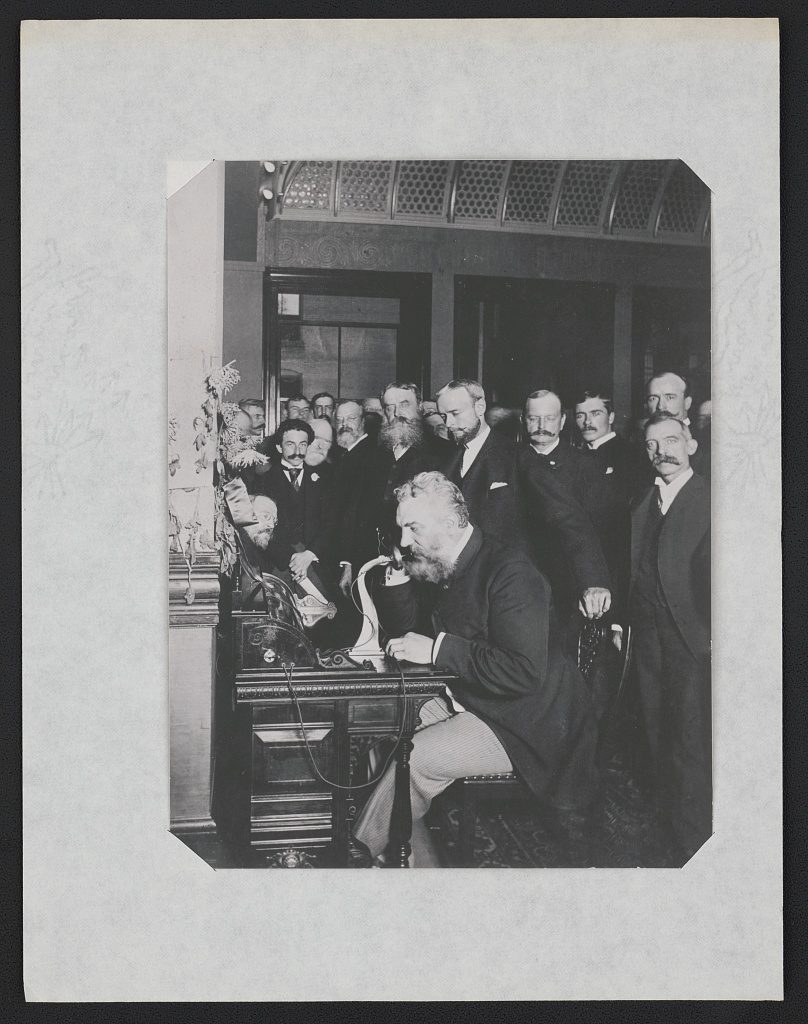
Three days later came the call. On the evening of 10 March, Bell was testing a liquid transmitter: a diaphragm whose vibrations moved a needle in a cup of acidulated water, varying the electrical current in step with the voice. Watson waited at the receiving instrument down the corridor. Bell spoke into the mouthpiece: 'Mr. Watson — come here — I want to see you.' In his notebook that night — now in the Library of Congress — Bell recorded what happened next: Watson came through the door and told him he had heard and understood every word. For the first time in history, intelligible speech had travelled by electricity.
The speed that followed was breathtaking. In June 1876 Bell demonstrated the telephone at the Philadelphia Centennial Exhibition, where the emperor of Brazil, Dom Pedro II, picked up the receiver and exclaimed, 'My God, it talks!' — publicity no money could buy. The Bell Telephone Company was founded in July 1877; within a decade telephones were spreading through American cities, and the patent was defended in hundreds of lawsuits as the priority fight with Gray and others ran on. The year's other American stories ran in the opposite direction, towards violence: in February the National League of Professional Baseball Clubs was founded in New York, and in April the Boston Red Caps beat Philadelphia 6–5 in its first game.
On 25 June, at the Little Bighorn in Montana, Lakota, Cheyenne and Arapaho warriors destroyed George Armstrong Custer's immediate command of the 7th Cavalry; Custer, aged 36, was killed with his men. In August, Wild Bill Hickok was shot dead while playing poker in Deadwood. In September the James-Younger gang's daylight raid on the bank at Northfield, Minnesota, collapsed under townspeople's gunfire, and in November U.S. troops destroyed the Northern Cheyenne village of Chief Dull Knife on the Powder River, in reprisal after the Little Bighorn. The year closed in horror of a different kind: on 5 December fire broke out during a performance at the Brooklyn Theatre in New York, and nearly 300 people died, many trampled in the panic.
Timeline of 1876
- 12 January
Jack London is born — the future novelist of The Call of the Wild and White Fang.
- 2 February
The National League of Professional Baseball Clubs is founded in New York.
- 14 February
Alexander Graham Bell files his patent application for the telephone, hours before Elisha Gray files a similar caveat.
- 7 March
Bell receives his U.S. patent for the telephone.
- 10 March
Bell makes the first successful telephone call, summoning his assistant Watson from the next room.
- 22 April
The Boston Red Caps beat the Philadelphia Athletics 6–5 in the first game played in baseball's National League.
- 25 June
At the Little Bighorn, Lakota, Cheyenne and Arapaho warriors destroy Custer's immediate command of the 7th Cavalry.
- 2 August
Wild Bill Hickok is shot dead while playing poker in a saloon in Deadwood.
- 7 September
The James-Younger gang's raid on the bank at Northfield, Minnesota, collapses under townspeople's gunfire; the gang is shattered.
- 25 November
U.S. troops under General Ranald Mackenzie destroy the Northern Cheyenne village of Chief Dull Knife on the Powder River.
- 5 December
Fire breaks out during a performance at the Brooklyn Theatre in New York; nearly 300 people die.
- 29 December
Pablo Casals is born — the Catalan cellist who would define his instrument in the twentieth century.
Why 1876 still matters
1876 still matters because the telephone remade the world more quietly and completely than almost any invention since print. Bell's notebook entry of 10 March is the birth certificate of an industry: within a decade the telephone was spreading through American cities, and within a generation the idea that a voice could be summoned instantly across any distance had stopped being miraculous and become infrastructure. Every phone call, voice message and video chat since descends from a liquid transmitter in a Boston workshop and a sentence spoken to a man in the next room.
The year's other legacy is a caution. The Little Bighorn was the U.S. Army's most famous defeat of the Plains wars, but its consequence was not a Native victory that endured: it brought reprisal, including the destruction of Dull Knife's village that November, and the military pressure on the Plains peoples only intensified. Between the telephone's first sentence and the Brooklyn Theatre's fire — nearly 300 dead in a place of public amusement — 1876 also showed both faces of the new industrial age: connection at miraculous speed, and catastrophe at the same scale.
The year also set patterns in American public life that have never since been broken. The National League founded in February still anchors professional baseball, and its first game was played that April. The telephone's inventor spent the year as a teacher of the deaf whose backers wanted a better telegraph; the patent they funded instead became, by common consent, the most valuable ever granted, and it was defended in hundreds of lawsuits. In November the corrupt 'Boss' Tweed, leader of New York's Tammany Hall machine, was handed over to authorities after being captured in Spain — the era's emblem of machine politics meeting its reckoning.
1876 on The History Trail
The History Trail tells the story of 1876 through the day the telephone first carried a human voice.
- March 10 in History — Bell makes the first telephone call in his Boston laboratory.
- The Telephone: How the Human Voice Learned to Travel — the full story of the invention patented in 1876.
- Rugby union — the history of the game taking shape in the same decade.
Sources
- HISTORY — What Happened on March 10
- Library of Congress — Alexander Graham Bell Family Papers (laboratory notebook)
- Encyclopaedia Britannica — On This Day: February 14
- Encyclopaedia Britannica — On This Day: June 25
- Encyclopaedia Britannica — On This Day: December 5
The facts on this page were checked against these sources on 19 November 2026. The History Trail's permanent pages are researched and written for this site; the live profiles elsewhere on The History Trail are assembled automatically from Wikipedia and Wikidata.
About the Author
Researched and written by the The History Trail Editorial Team — the accountable editorial function behind this site's permanent story pages. The team works from the published sources cited on each page; it does not invent historians, reviewers or credentials, and it corrects errors openly.
Fact Check
Every load-bearing fact on this page traces to one of the sources listed above, and significant claims link to their source in the text. Our checking method is described on the methodology page; errors can be reported via the corrections page.
Sources & Citations
Cite this page as: The History Trail Editorial Team, The History Trail — this article's title, publication and update dates are shown beneath its headline. The full source list appears under Sources above; the site's source standards are on the sources page.