
Years
1871 in History
1871 opened with an empire and closed with famous journeys and fires. On 18 January Wilhelm I of Prussia was proclaimed German emperor in the Hall of Mirrors at Versailles, while Paris starved under siege. In October the Great Chicago Fire destroyed the heart of that city — on the same night as the far deadlier Peshtigo Fire — and in November Henry Morton Stanley reached Ujiji and found David Livingstone, greeting him, by his own account, with 'Dr. Livingstone, I presume?'
At a Glance
- Defining event
- Proclamation of the German Empire at Versailles, 18 January 1871
- Peace on terms
- Treaty of Frankfurt, 10 May — France cedes Alsace-Lorraine to the new empire
- The fire
- Great Chicago Fire, 8-10 October — an estimated 17,450 buildings destroyed, some 100,000 homeless
- The deadlier fire
- Peshtigo Fire the same night kills an estimated 1,200 people
- The meeting
- Stanley finds Livingstone at Ujiji, 10 November, by Stanley's journal
- Culture opens
- Queen Victoria opens the Royal Albert Hall, 29 March; Verdi's Aida premieres in Cairo, 24 December
The defining story: an empire in a borrowed palace
For centuries 'Germany' was a geography, not a country — a patchwork of kingdoms, duchies and free cities, with Austria and Prussia competing for its leadership. Otto von Bismarck spent the 1860s changing that by war and diplomacy, and the Franco-Prussian War of 1870 brought the south German states into Prussia's alliance. After Napoleon III's capture at Sedan, German armies settled into the siege of Paris and made their headquarters in Louis XIV's palace at Versailles.
There, on 18 January 1871, Wilhelm I of Prussia was proclaimed German emperor in the Hall of Mirrors, Bismarck reading the proclamation to the assembled princes and officers. The date was chosen with intent: the anniversary of the coronation of the first king of Prussia in 1701. Wilhelm himself was reluctant about the new title. The humiliation of the setting was deliberate — France's conquerors proclaimed their empire in France's most glorious palace while its capital starved a few miles away — and it was remembered: in 1919 the Allies chose the same room to impose the Treaty of Versailles on a defeated Germany. The fighting ended with the Armistice of Versailles on 28 January, and the Treaty of Frankfurt on 10 May stripped France of Alsace-Lorraine.
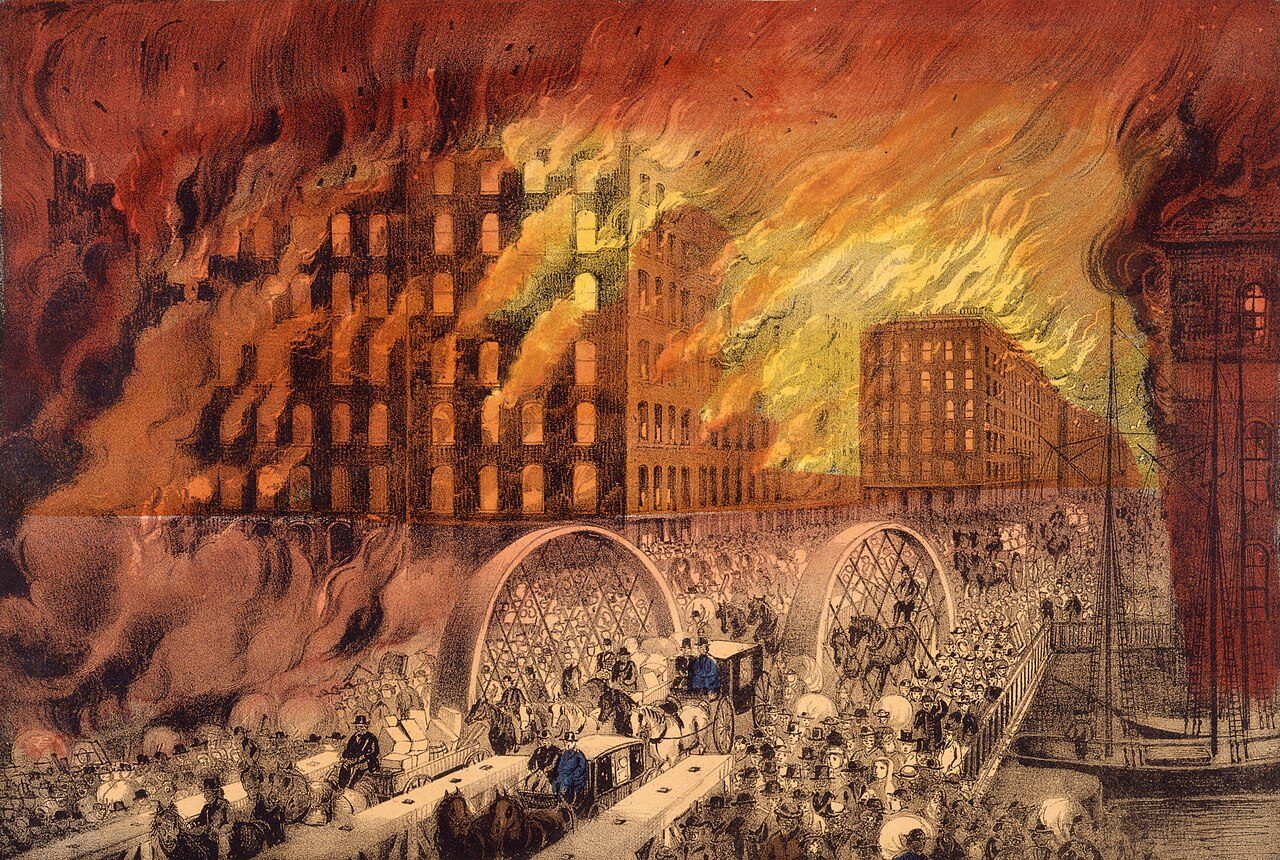
Autumn brought fire on an American scale. On the night of 8 October fire broke out in Chicago's DeKoven Street and, driven by wind through a city built of wood after a dry summer, burned for two days. The count, when rain helped end it on 10 October, read like the inventory of a city erased: an estimated 17,450 buildings destroyed, some 100,000 people homeless, and the dead estimated at 200 to 300. Chicago rebuilt fast, in brick and stone, drawing architects from across the world — but the same night, some 250 miles north, the Peshtigo Fire destroyed the Wisconsin lumber town and its forests, killing an estimated 1,200 people, several times Chicago's toll.
The year's other famous journey ended at a lake shore. David Livingstone, the explorer unheard from for years, had reached Ujiji on Lake Tanganyika in wretched condition. The New York Herald's reporter Henry Morton Stanley marched in on 10 November 1871, by his journal's account, and found him — greeting him, in Stanley's published telling, with 'Dr. Livingstone, I presume?' Stanley's supplies restored the explorer, and the two spent four months together before Stanley carried Livingstone's letters and journals back to the coast.
Timeline of 1871
- 18 January
Wilhelm I of Prussia is proclaimed German emperor at Versailles, founding the German Empire.
- 28 January
The Armistice of Versailles ends the Siege of Paris and the fighting of the Franco-Prussian War.
- 29 March
Queen Victoria opens the Royal Albert Hall in London, built as a memorial to Prince Albert.
- 10 May
The Treaty of Frankfurt ends the Franco-Prussian War; France cedes Alsace-Lorraine to Germany.
- 17 June
James Weldon Johnson, American writer and NAACP leader, is born.
- 27 June
The yen is adopted as Japan's official currency under the Meiji government.
- 10 July
Marcel Proust, French novelist of In Search of Lost Time, is born.
- 20 July
British Columbia joins the Canadian Confederation as a province.
- 19 August
Orville Wright, who with his brother Wilbur made the first powered flight, is born.
- 30 August
Ernest Rutherford, the New Zealand physicist who founded nuclear physics, is born.
- 8 October
The Great Chicago Fire begins; the same night, the Peshtigo Fire kills an estimated 1,200 people in Wisconsin.
- 10 October
Rain helps extinguish the Great Chicago Fire after two days.
- 10 November
Henry Morton Stanley finds David Livingstone at Ujiji on Lake Tanganyika.
- 24 December
Verdi's opera Aida receives its premiere at the Khedivial Opera House in Cairo.
Why 1871 still matters
The German Empire proclaimed at Versailles was, within a generation, Europe's leading industrial power, its population and steel output passing Britain's. The German question — how a unified Germany fits into Europe — was opened in the Hall of Mirrors in 1871, and much of the next century is the story of its answers. French determination to undo the settlement, above all the loss of Alsace-Lorraine, became a fixed star of European politics until 1914.
Chicago's fire became a founding myth of a different kind: a city erased in two days and rebuilt in brick and stone under stricter codes, inventing, in the process, the skyscraper. Peshtigo, the deadliest fire in American history, is remembered far less — the bigger city kept the story. Stanley's meeting with Livingstone made the reporter famous and opened his own path into Africa, with consequences in the Congo far darker than the meeting itself.
One caution belongs to the record, and this site keeps it: the date of the Ujiji meeting rests on Stanley's journal, pages of which are missing, and Britannica's modern telling notes the meeting was probably in October. The world keeps the anniversary where Stanley put it — 10 November — and the famous greeting appears in his published account rather than in any surviving private note.
1871 on The History Trail
An empire, two fires and a famous greeting lead this year on The History Trail.
- January 18 in History — The German Empire is proclaimed in the Hall of Mirrors at Versailles.
- October 8 in History — The Great Chicago Fire begins in DeKoven Street.
- November 10 in History — Stanley finds Livingstone at Ujiji.
- May 10 in History — The Treaty of Frankfurt ends the Franco-Prussian War.
- Rome — The city taken by Italian troops in 1870, completing the unification of Italy.
- Japanese yen — The currency Japan adopted on 27 June 1871 under the Meiji government.
Sources
- Encyclopaedia Britannica — On This Day: January 18
- Encyclopaedia Britannica — Franco-German War
- Encyclopaedia Britannica — On This Day: October 8
- Encyclopaedia Britannica — On This Day: November 10
- Encyclopaedia Britannica — Today in History: The Search for Dr. Livingstone
- Encyclopaedia Britannica — On This Day: May 10
The facts on this page were checked against these sources on 19 November 2026. The History Trail's permanent pages are researched and written for this site; the live profiles elsewhere on The History Trail are assembled automatically from Wikipedia and Wikidata.
About the Author
Researched and written by the The History Trail Editorial Team — the accountable editorial function behind this site's permanent story pages. The team works from the published sources cited on each page; it does not invent historians, reviewers or credentials, and it corrects errors openly.
Fact Check
Every load-bearing fact on this page traces to one of the sources listed above, and significant claims link to their source in the text. Our checking method is described on the methodology page; errors can be reported via the corrections page.
Sources & Citations
Cite this page as: The History Trail Editorial Team, The History Trail — this article's title, publication and update dates are shown beneath its headline. The full source list appears under Sources above; the site's source standards are on the sources page.