
On This Day
January 18 in History
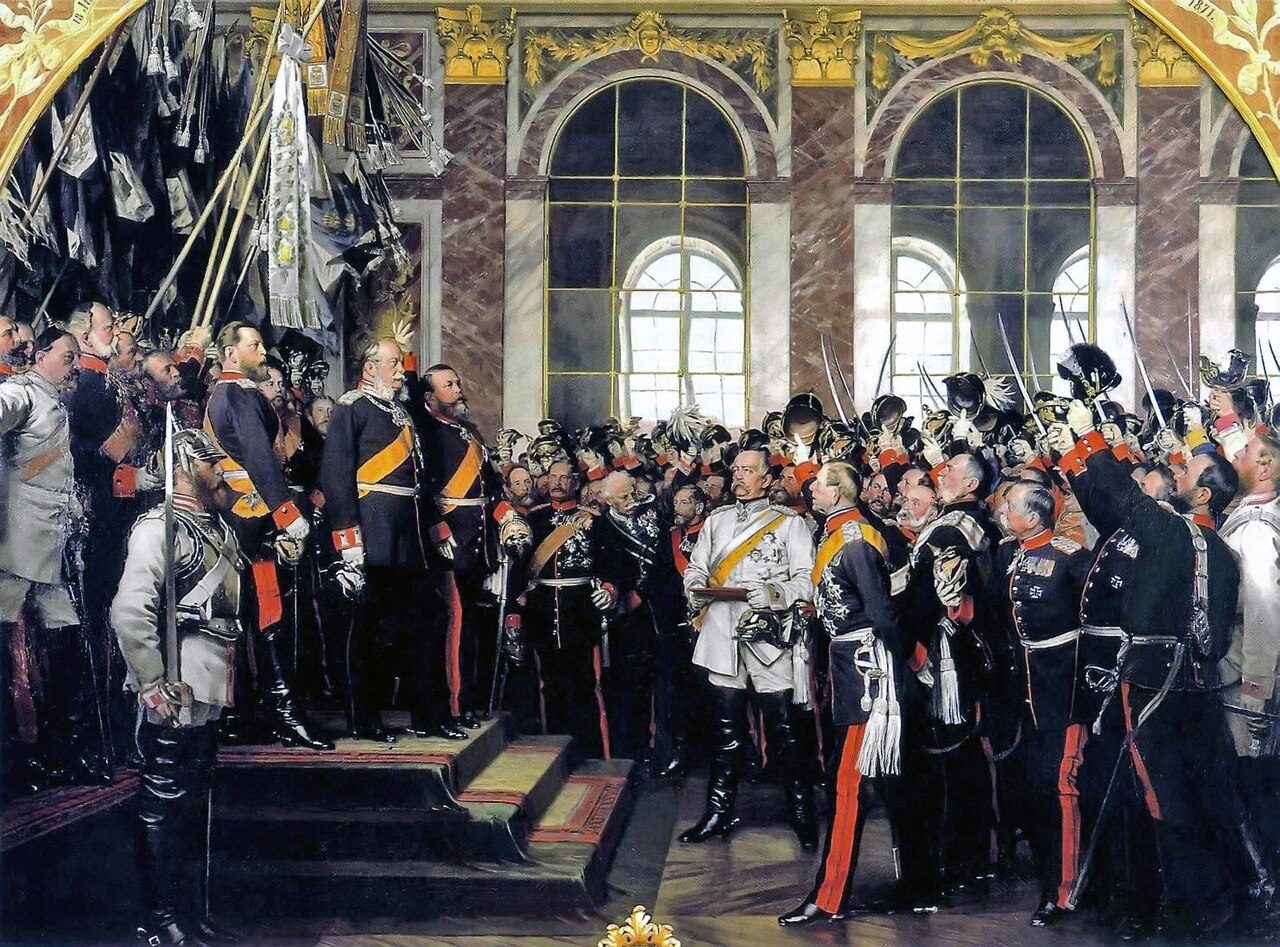
On 18 January 1871, in the Hall of Mirrors at Versailles — while Paris starved under siege — King Wilhelm I of Prussia was proclaimed German emperor, uniting Germany into an empire that would dominate Europe's next half-century. January 18 is also the day Captain Cook first reached Hawaii, sliced bread was briefly banned in America, and Sierra Leone's civil war was declared over.
Choose another date: open the On This Day calendar to browse events, births and deaths for any day of the year.
At a Glance
- When and where
- 18 January 1871, in the Hall of Mirrors of the Palace of Versailles
- The new emperor
- Wilhelm I, king of Prussia, proclaimed German emperor (Kaiser)
- The architect
- Otto von Bismarck, Prussia's chancellor, who read the proclamation
- The setting
- Versailles was the headquarters of the Prussian army besieging Paris in the Franco-Prussian War
- The date's meaning
- Chosen as the anniversary of the first Prussian king's coronation in 1701
- What it created
- A unified German Empire of 25 states — Europe's new industrial and military giant
Events on this day
- 474The seven-year-old Leo II succeeds his grandfather Leo I as Byzantine emperor; he dies within ten months.
- 1778Captain James Cook reaches the Hawaiian Islands, sighting Oahu and landing on Kauai two days later; he names them the Sandwich Islands.
- 1871Wilhelm I of Prussia is proclaimed German emperor at Versailles, founding the German Empire — the featured story above.
- 1919The Paris Peace Conference opens at Versailles, beginning the victors' work of remaking the world after the First World War.
- 1943The United States bans the sale of sliced bread — a wartime economy measure so unpopular it is reversed within weeks.
- 2002Sierra Leone's civil war is officially declared over, ending a conflict that killed an estimated 50,000 people and displaced some two million.
- 2005Airbus unveils the A380 in Toulouse, the largest passenger airliner ever built.
- 2023Jacinda Ardern announces she will resign as prime minister of New Zealand, saying she no longer has 'enough in the tank'.
Born on this day
- 1689Montesquieu — French philosopher whose Spirit of the Laws set out the separation of powers that shaped modern constitutions.
- 1779Peter Mark Roget — English physician who compiled the Thesaurus of English words that still bears his name.
- 1782Daniel Webster — American orator and statesman, the great defender of the Union in the Senate.
- 1882A. A. Milne — English author who created Winnie-the-Pooh from his son Christopher Robin's toys.
- 1892Oliver Hardy — American comedian, the larger half of Laurel and Hardy.
- 1904Cary Grant — Bristol-born Hollywood leading man of North by Northwest and Bringing Up Baby.
- 1955Kevin Costner — American actor and director of Dances with Wolves and Field of Dreams.
Died on this day
- 1862John Tyler — tenth president of the United States, who died a citizen of the Confederacy he had joined.
- 1873Edward Bulwer-Lytton — English novelist and politician who coined 'the pen is mightier than the sword'.
- 1936Rudyard Kipling — English author of The Jungle Book and Kim, first English-language Nobel laureate in literature.
- 1949Charles Ponzi — Italian-American swindler whose name became the word for a pyramid scheme.
The featured story: the German Empire is proclaimed at Versailles, 18 January 1871
For centuries 'Germany' was a geography, not a country — a patchwork of kingdoms, duchies and free cities loosely gathered in a confederation, with Austria and Prussia competing for its leadership. Otto von Bismarck, Prussia's chancellor, spent the 1860s changing that by war and diplomacy: Denmark in 1864, Austria in 1866, and finally, in 1870, France. The Franco-Prussian War brought the south German states into Prussia's alliance and, after the French emperor's capture at Sedan, the German armies settled into a siege of Paris — and made their headquarters in Louis XIV's palace at Versailles.
There, on 18 January 1871, the German Empire was proclaimed. As Britannica records, King Wilhelm I of Prussia was proclaimed German emperor in the Hall of Mirrors, with Bismarck — in a white cuirassier's uniform — reading the proclamation to the assembled princes and officers. The date was chosen with intent: 18 January was the anniversary of the coronation of the first king of Prussia in 1701. Wilhelm himself was reluctant, grumbling about the new title; the Grand Duke of Baden, leading the acclamation, carefully hailed 'Emperor Wilhelm' to dodge the question of whether he was emperor of Germany or merely in it.
The humiliation of the setting was deliberate and was remembered. France's new empire had been declared in France's most glorious palace while its capital starved a few miles away, and the peace that followed stripped France of Alsace and much of Lorraine and imposed a vast indemnity. French revanchism — the determination to undo 1871 — became a fixed star of European politics. In 1919, in the same Hall of Mirrors, the victorious Allies would choose the room precisely to answer the insult, and impose the Treaty of Versailles on a defeated Germany.
What was proclaimed that day was a state of 25 members — kingdoms, duchies and free cities under a Prussian emperor and a federal constitution that had legally taken effect on New Year's Day. Within a generation the empire was Europe's leading industrial power, its population and steel output passing Britain's, its army the continent's benchmark. The German question — how a unified Germany fits into Europe — was opened in the Hall of Mirrors in 1871, and in many ways the next century of European history is the story of its answers.
Why this date matters
January 18 keeps staging the transfer of power in public places. An empire was proclaimed in a captured palace in 1871; the peace that answered it began in the same palace in 1919. A child became emperor of Byzantium in 474; a prime minister announced her own departure, on her own terms, in 2023. Cook's arrival in Hawaii in 1778 opened an era for the Pacific, and the closing of Sierra Leone's war in 2002 ended one of Africa's cruellest. Even its smallest entry is about who controls the everyday: for a few weeks in 1943, the American government decided that bread must arrive unsliced. Few dates hold so many thresholds.
Sources
- Encyclopaedia Britannica — On This Day: January 18
- HISTORY — What Happened on January 18
- Encyclopaedia Britannica — When Was the German Empire Founded?
- Encyclopaedia Britannica — Franco-German War
- HistorIQly — January 18 (births and deaths lists)
The facts on this page were checked against these sources on 19 November 2026. The History Trail's permanent pages are researched and written for this site; the live profiles elsewhere on The History Trail are assembled automatically from Wikipedia and Wikidata.
About the Author
Researched and written by the The History Trail Editorial Team — the accountable editorial function behind this site's permanent story pages. The team works from the published sources cited on each page; it does not invent historians, reviewers or credentials, and it corrects errors openly.
Fact Check
Every load-bearing fact on this page traces to one of the sources listed above, and significant claims link to their source in the text. Our checking method is described on the methodology page; errors can be reported via the corrections page.
Sources & Citations
Cite this page as: The History Trail Editorial Team, The History Trail — this article's title, publication and update dates are shown beneath its headline. The full source list appears under Sources above; the site's source standards are on the sources page.