
On This Day
January 19 in History
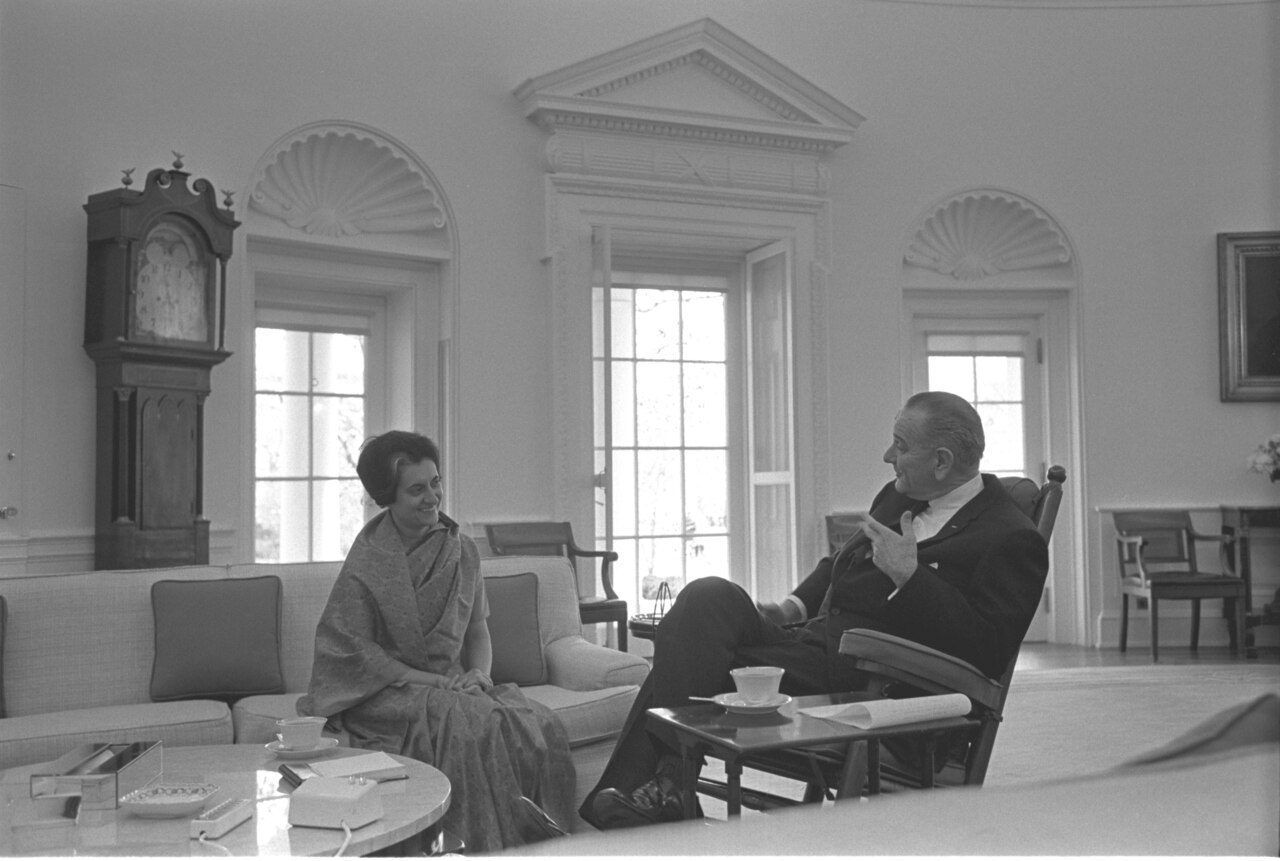
On 19 January 1966, eleven days after the sudden death of Prime Minister Lal Bahadur Shastri, India's Congress Party chose Indira Gandhi as its leader — making the 48-year-old daughter of Jawaharlal Nehru India's first woman prime minister. January 19 is also the day Lucille Ball gave birth on television before 44 million viewers, production began on Toy Story, and the first BlackBerry appeared.
Choose another date: open the On This Day calendar to browse events, births and deaths for any day of the year.
At a Glance
- The vacancy
- Prime Minister Lal Bahadur Shastri died suddenly at Tashkent on 11 January 1966
- The vote
- On 19 January 1966 Congress legislators chose Gandhi over Morarji Desai by 355 votes to 169
- The winner
- Indira Gandhi, 48, daughter of India's first prime minister, Jawaharlal Nehru
- Sworn in
- 24 January 1966 — the January 19 vote made her leader, and thus prime minister-designate
- The distinction
- India's first woman head of government, and one of the first women anywhere to lead a democracy
- The tenure ahead
- Prime minister 1966–1977 and again 1980–1984, until her assassination
Events on this day
- 1840American explorer Charles Wilkes claims a portion of Antarctica for the United States during his Pacific expedition.
- 1915German zeppelins raid Great Yarmouth and King's Lynn — the first air raid on Britain, bringing the war to civilian doorsteps.
- 1952The PGA votes to allow Black golfers to compete in its co-sponsored events, cracking golf's colour bar.
- 1953Lucille Ball gives birth in real life on the same night her character Lucy Ricardo does on I Love Lucy, before an audience of some 44 million.
- 1966Indira Gandhi is chosen leader of India's Congress Party, becoming the country's first woman prime minister — the featured story above.
- 1972Sandy Koufax becomes, at 36, the youngest player ever elected to baseball's Hall of Fame.
- 1977President Gerald Ford pardons Iva Toguri — 'Tokyo Rose' — convicted of treason for wartime broadcasts she was largely forced to make.
- 1993Production begins on Toy Story, Pixar's first feature and the first full-length computer-animated film.
- 1999The first BlackBerry device, the 850 pager, is released — putting email in pockets years before the smartphone era.
- 2013Fruitvale Station premieres at the Sundance Film Festival, launching the careers of Ryan Coogler and Michael B. Jordan.
Born on this day
- 1736James Watt — Scottish engineer whose improved steam engine powered the Industrial Revolution.
- 1798Auguste Comte — French philosopher who founded sociology and the positivist school.
- 1807Robert E. Lee — American general who commanded the Confederacy's Army of Northern Virginia.
- 1809Edgar Allan Poe — American master of the macabre, inventor of the detective story in 'The Murders in the Rue Morgue'.
- 1839Paul Cézanne — French painter whose structured landscapes opened the road to modern art.
- 1946Dolly Parton — American singer-songwriter and philanthropist, country music's most beloved figure.
Died on this day
- 1729William Congreve — English playwright of The Way of the World, the wittiest voice of Restoration comedy.
- 2000Hedy Lamarr — Austrian-American film star who co-invented the frequency-hopping technology behind modern wireless.
- 2006Wilson Pickett — American soul singer of 'In the Midnight Hour' and 'Mustang Sally'.
- 2013Stan Musial — American baseball great of the St. Louis Cardinals, 'Stan the Man'.
The featured story: Indira Gandhi is chosen to lead India, 19 January 1966
When Lal Bahadur Shastri died of a heart attack in Tashkent in the early hours of 11 January 1966 — hours after signing a peace declaration with Pakistan — India lost its second prime minister in less than two years. The Congress Party, which had governed since independence, had to choose a successor fast, and the contest narrowed to two: Morarji Desai, the austere veteran finance minister, and Indira Gandhi, the late Jawaharlal Nehru's daughter, who had served as minister of information and broadcasting and as Congress president. The party's elders, the group newspapers called the Syndicate, backed Gandhi, believing her the more electable — and the more manageable — choice.
On 19 January 1966 the Congress parliamentary party voted in New Delhi's Central Hall: Gandhi defeated Desai by 355 votes to 169, of 526 cast. With that vote she became leader of the Congress Party and therefore, as HISTORY puts it, prime minister of India — the first woman to head India's government. She was sworn in five days later, on 24 January. At 48 she led a country of nearly 500 million people facing food shortages, a wounded economy and the aftermath of war, and she was only the second woman in the modern world to lead a national government, after Ceylon's Sirimavo Bandaranaike.
Those who installed her expecting pliability misread her completely. Within three years Gandhi had split the Congress Party rather than submit to the Syndicate, nationalised India's major banks, and by 1971 won a landslide election on the slogan 'Garibi Hatao' — abolish poverty — before leading India to victory in the war that created Bangladesh. Her rule also darkened: the Emergency of 1975–77, when she suspended civil liberties and jailed opponents, cost her the 1977 election and remains the great stain on her record.
She returned to power in 1980 and was assassinated by her own bodyguards in October 1984, after ordering the army into the Golden Temple at Amritsar. By then she had been prime minister for fifteen of the eighteen years since that January vote — longer than anyone but her father. The choice made on 19 January 1966 did not merely fill a vacancy; it set the pattern of Indian politics, dynastic, centralised and fiercely personal, for the rest of the century. It also made a quieter point to the world: a poor, newly independent nation of half a billion people had handed its highest office to a woman by an internal vote, decades before many older democracies did.
Why this date matters
January 19 is a day when new technologies and new kinds of leaders step forward together. In 1953 television staged a birth watched by 44 million; in 1966 the world's largest democracy entrusted itself to a woman; in 1993 a computer-animated film went into production and in 1999 email shrank to pocket size. Its older entries rhyme: zeppelins made civilians targets of air war in 1915, and a golfer's colour bar cracked in 1952. The future keeps arriving on this date, usually ahead of schedule.
Sources
- Encyclopaedia Britannica — On This Day: January 19
- HISTORY — What Happened on January 19
- HISTORY — Indira Gandhi Becomes Indian Prime Minister
- This Day Trivia — January 19 (deaths list)
The facts on this page were checked against these sources on 19 November 2026. The History Trail's permanent pages are researched and written for this site; the live profiles elsewhere on The History Trail are assembled automatically from Wikipedia and Wikidata.
About the Author
Researched and written by the The History Trail Editorial Team — the accountable editorial function behind this site's permanent story pages. The team works from the published sources cited on each page; it does not invent historians, reviewers or credentials, and it corrects errors openly.
Fact Check
Every load-bearing fact on this page traces to one of the sources listed above, and significant claims link to their source in the text. Our checking method is described on the methodology page; errors can be reported via the corrections page.
Sources & Citations
Cite this page as: The History Trail Editorial Team, The History Trail — this article's title, publication and update dates are shown beneath its headline. The full source list appears under Sources above; the site's source standards are on the sources page.