
On This Day
March 10 in History
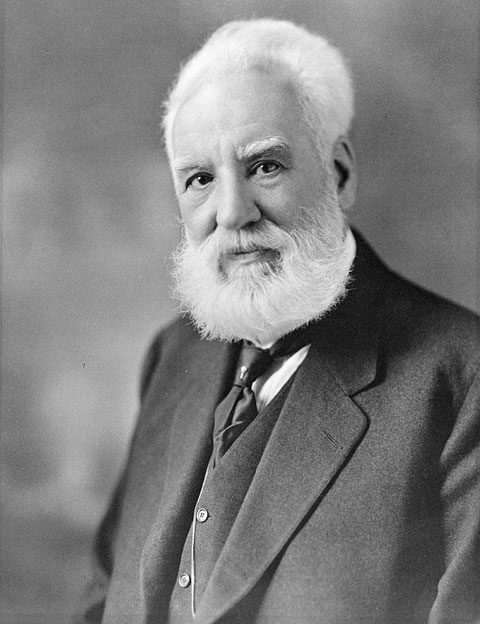
On 10 March 1876, in a Boston attic laboratory, Alexander Graham Bell spoke into his experimental telephone and his assistant, in the next room, heard him: 'Mr. Watson — come here — I want to see you.' It was the first intelligible speech ever carried by wire, three days after Bell's patent was granted. March 10 is also the day of the Tibetan uprising, the discovery of Uranus's rings, and the death of Harriet Tubman.
Choose another date: open the On This Day calendar to browse events, births and deaths for any day of the year.
At a Glance
- The date
- 10 March 1876, Boston — three days after Bell's telephone patent (No. 174,465) was granted
- The words
- 'Mr. Watson — come here — I want to see you', recorded by Bell in his laboratory notebook that night
- The listener
- Thomas A. Watson, Bell's assistant, listening at the receiver in another room
- The device
- A liquid transmitter: a needle dipping into acidulated water, varying the current as Bell's voice vibrated a diaphragm
- The race
- Bell's application had reached the Patent Office on 14 February, the same day as Elisha Gray's caveat for a similar invention
Events on this day
- 241 BCRome defeats Carthage at the Battle of the Aegates Islands, ending the First Punic War and making Rome master of Sicily.
- 1849Abraham Lincoln applies for a patent for a device to lift boats over shoals — the only U.S. president ever to hold a patent.
- 1862The United States issues its first paper money, as Legal Tender notes enter circulation to finance the Civil War.
- 1876Alexander Graham Bell makes the first successful telephone call, summoning his assistant Watson from the next room — the featured story above.
- 1949Mildred Gillars, the American broadcaster known as 'Axis Sally', is convicted of treason for her Nazi propaganda broadcasts.
- 1952Fulgencio Batista seizes power in Cuba in a coup, cancelling elections three months before they were due.
- 1959Thousands of Tibetans surround the Dalai Lama's palace in Lhasa, fearing a Chinese plot to seize him, beginning the Tibetan uprising; he escapes to India a week later.
- 1969James Earl Ray pleads guilty to the assassination of Martin Luther King Jr., a plea he will spend the rest of his life trying to retract.
- 1977Astronomers observing a star's occultation by Uranus discover the planet's rings, the first ring system found around a giant planet since Saturn's.
- 2006NASA's Mars Reconnaissance Orbiter arrives at Mars, beginning a mission that has since returned more data than all other Mars missions combined.
Born on this day
- 1940Chuck Norris — American martial artist and action star of Walker, Texas Ranger.
- 1958Sharon Stone — American actress of Basic Instinct and Casino.
- 1964Prince Edward — youngest child of Queen Elizabeth II, created Duke of Edinburgh in 2023.
- 1971Jon Hamm — American actor who played Don Draper in Mad Men.
- 1983Carrie Underwood — American singer who won American Idol and became one of country music's biggest stars.
- 1984Olivia Wilde — American actress and director of Booksmart and Don't Worry Darling.
Died on this day
- 1913Harriet Tubman — American abolitionist who escaped slavery and led some 70 enslaved people to freedom on the Underground Railroad.
- 1948Zelda Fitzgerald — American writer and artist, wife of F. Scott Fitzgerald, dead in a fire at the Highland Hospital in Asheville.
- 1985Konstantin Chernenko — Soviet leader whose death in office opened the way for Mikhail Gorbachev.
- 1988Andy Gibb — English-Australian singer, the youngest of the Gibb brothers, dead at 30.
The featured story: Bell makes the first telephone call, 10 March 1876
Alexander Graham Bell was 29, a teacher of the deaf in Boston, and officially working on something else. His backers were funding a 'harmonic telegraph' that would send several messages down one wire; Bell's obsession, pursued in a rented attic workshop at 5 Exeter Place with his assistant Thomas A. Watson, was a device that could carry the human voice itself. The race was close and everyone in the small world of telegraphy knew it: on 14 February 1876 Bell's lawyer filed his patent application in Washington, and on the same day the Chicago inventor Elisha Gray filed a caveat — a notice of an invention in progress — describing a strikingly similar speaking telegraph. Bell's patent, No. 174,465, was granted on 7 March, three days before the machine demonstrably worked.
On the evening of 10 March, Bell was testing a liquid transmitter: a diaphragm whose vibrations moved a needle in a cup of acidulated water, varying the electrical current in step with the voice. Watson waited at the receiving instrument in another room, down the corridor. Bell spoke into the mouthpiece: 'Mr. Watson — come here — I want to see you.' In his notebook that night Bell recorded what happened next: Watson came through the door and told him he had heard and understood every word. For the first time in history, intelligible speech had travelled by electricity. By Watson's later account, the summons was half-accident — Bell had spilled battery acid on himself and genuinely wanted help — which would make the first telephone call also the first emergency call.
Bell's notebook, now in the Library of Congress, is the call's birth certificate, and the speed that followed was breathtaking. In June 1876 Bell demonstrated the telephone at the Philadelphia Centennial Exhibition, where the emperor of Brazil, Dom Pedro II, picked up the receiver and exclaimed, 'My God, it talks!' — publicity no money could buy. The Bell Telephone Company was founded in July 1877; within a decade telephones were spreading through American cities, the patent was defended in hundreds of lawsuits, and the priority fight with Gray — and with Antonio Meucci, whose earlier work the U.S. House of Representatives formally acknowledged in 2002 — became one of the longest arguments in the history of invention.
What began in the attic on 10 March 1876 rewired the world more completely than almost any single evening's work. Bell himself, who grew wealthy and famous beyond measure, always thought his work with the deaf the more important calling — he had a deaf mother and a deaf wife, and he refused to keep a telephone in his own study because its ringing interrupted his thinking. The call to Watson lasted seconds. The conversation it started has not yet ended.
Why this date matters
March 10 is the calendar's day for messages crossing distances. Bell's voice crossed a corridor on it in 1876 and began the shrinking of the world; NASA's orbiter crossed to Mars on it in 2006; Tibetans crossed mountains to exile after it in 1959, following the uprising the date began; and on it in 241 BC a sea battle ended a war and told the Mediterranean its future would be Roman. Its deaths close the circuit: Harriet Tubman, who carried people out of slavery in person, message by journey, died on the day the telephone was born — 37 years after the call, in a world already wiring itself together.
Sources
- Encyclopaedia Britannica — On This Day: March 10
- HISTORY — What Happened on March 10
- Library of Congress — Alexander Graham Bell Family Papers (laboratory notebook)
- Smithsonian Institution — Bell Telephone (3D record)
The facts on this page were checked against these sources on 19 November 2026. The History Trail's permanent pages are researched and written for this site; the live profiles elsewhere on The History Trail are assembled automatically from Wikipedia and Wikidata.
About the Author
Researched and written by the The History Trail Editorial Team — the accountable editorial function behind this site's permanent story pages. The team works from the published sources cited on each page; it does not invent historians, reviewers or credentials, and it corrects errors openly.
Fact Check
Every load-bearing fact on this page traces to one of the sources listed above, and significant claims link to their source in the text. Our checking method is described on the methodology page; errors can be reported via the corrections page.
Sources & Citations
Cite this page as: The History Trail Editorial Team, The History Trail — this article's title, publication and update dates are shown beneath its headline. The full source list appears under Sources above; the site's source standards are on the sources page.