
On This Day
March 1 in History
On 1 March 1872 President Ulysses S. Grant signed the act that set aside more than two million acres of geysers, canyons and waterfalls at the headwaters of the Yellowstone River as a public park — Yellowstone, widely considered the world's first national park, and the model for protected places everywhere since. March 1 is also the day the Salem witch hunt began, the Zimmermann Telegram was published and the Peace Corps was founded.
Choose another date: open the On This Day calendar to browse events, births and deaths for any day of the year.
At a Glance
- The act
- Signed by President Ulysses S. Grant on 1 March 1872, setting aside the Yellowstone region 'as a public park or pleasuring-ground for the benefit and enjoyment of the people'
- The size
- About 2.2 million acres across the territories of Wyoming, Montana and Idaho — none of them yet states
- The evidence
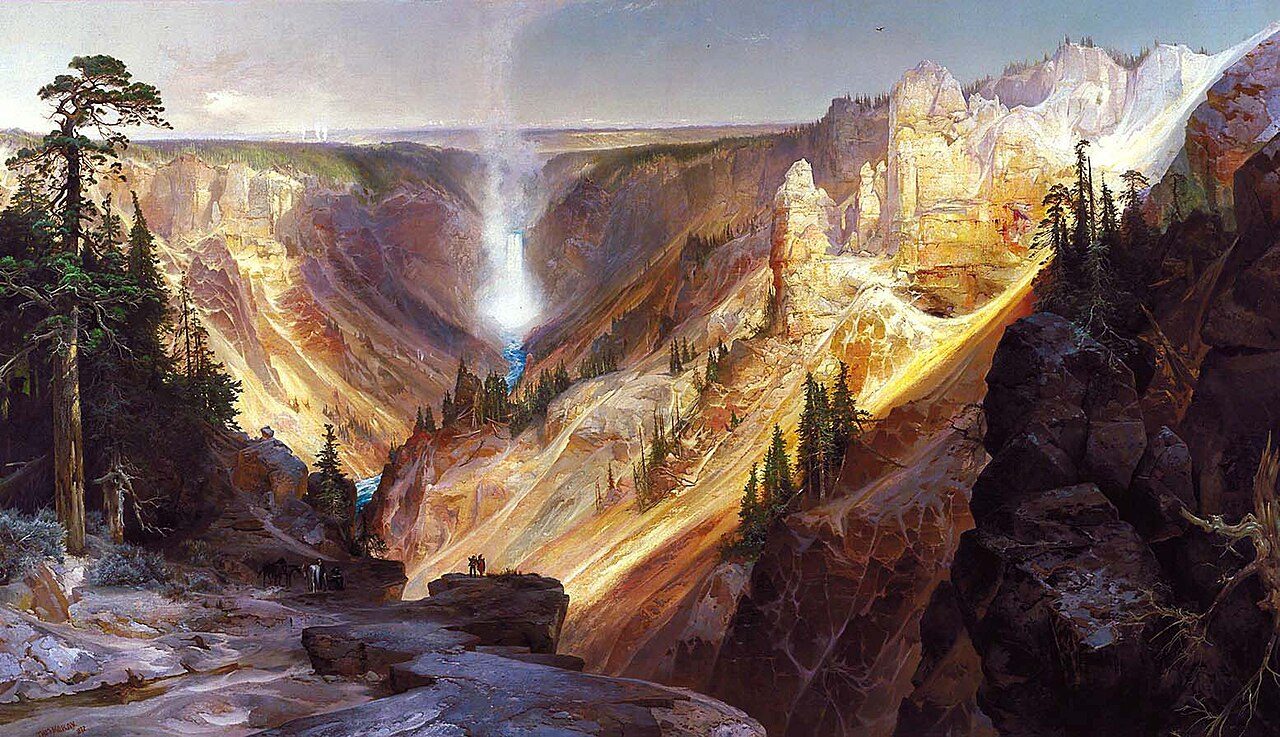
- William Henry Jackson's photographs and Thomas Moran's sketches from the 1871 Hayden survey, which convinced a sceptical Congress the wonders were real
- The cost
- Native peoples who had lived and hunted in the region for thousands of years were progressively excluded from the park created on their land
- The legacy
- Yellowstone became the template for the national park idea; the U.S. National Park Service followed in 1916
Events on this day
- 1692Three women — Sarah Good, Sarah Osborne and the enslaved Tituba — are charged with witchcraft in Salem Village, Massachusetts, opening the Salem witch hunt.
- 1781The Articles of Confederation are finally ratified, nearly four years after Congress sent them to the states, giving the United States its first frame of government.
- 1864Rebecca Lee Crumpler becomes the first African American woman to earn a medical degree, graduating in Boston.
- 1872President Grant signs the act creating Yellowstone National Park, the world's first national park — the featured story above.
- 1875Congress passes the Civil Rights Act of 1875, the last of the Reconstruction Force Acts, aiming to bar racial discrimination in public places and juries.
- 1910An avalanche sweeps two trains into a canyon at Wellington, Washington, killing 96 people in the deadliest avalanche in American history.
- 1917The Zimmermann Telegram, Germany's intercepted proposal of a Mexican alliance against the United States, is published in American newspapers.
- 1932Charles Lindbergh's 20-month-old son is kidnapped from the family home in Hopewell, New Jersey; the baby is later found murdered.
- 1961President John F. Kennedy signs the executive order establishing the Peace Corps.
- 1966The Soviet probe Venera 3 strikes Venus, becoming the first human-made object to reach the surface of another planet.
- 1971A bomb explodes in the U.S. Capitol in Washington, damaging the building but injuring no one; the Weather Underground claims responsibility.
Born on this day
- 1810Frédéric Chopin — Polish composer and pianist whose works redefined what the piano could express.
- 1904Glenn Miller — American bandleader whose orchestra defined the sound of the swing era.
- 1917Dinah Shore — American singer and television host, the top female vocalist of the 1940s.
- 1927Harry Belafonte — American singer and actor who popularised calypso and marched at the front of the civil rights movement.
- 1954Ron Howard — American child actor turned Oscar-winning director of Apollo 13 and A Beautiful Mind.
- 1983Lupita Nyong'o — Kenyan actress who won an Academy Award for her debut film role in 12 Years a Slave.
- 1994Justin Bieber — Canadian singer who rose from YouTube videos to become one of the best-selling pop stars of his generation.
Died on this day
- 589Saint David — bishop and patron saint of Wales, whose feast day is still celebrated on 1 March.
- 1911Jacobus Henricus van 't Hoff — Dutch chemist who won the first Nobel Prize in Chemistry, in 1901.
- 1938Gabriele D'Annunzio — Italian poet, novelist and flamboyant soldier who seized and ruled Fiume in 1919–20.
- 1983Arthur Koestler — Hungarian-born British author of Darkness at Noon, the defining novel of disillusion with communism.
- 1991Edwin H. Land — American inventor of the Polaroid instant camera and co-founder of the Polaroid Corporation.
- 2014Alain Resnais — French director of Hiroshima mon amour and Last Year at Marienbad, a pillar of the New Wave era.
- 2020Jack Welch — American executive who built General Electric into one of the world's most valuable companies as its chairman and CEO.
The featured story: Yellowstone becomes the first national park, 1 March 1872
The Yellowstone country had been rumoured about for decades — trappers' tales of boiling springs, spouting water and a canyon painted in impossible colours were widely dismissed as tall stories. In 1871 the geologist Ferdinand V. Hayden led a federally funded survey into the region, taking with him the photographer William Henry Jackson and the artist Thomas Moran. What they brought back changed the story from folklore into evidence: Jackson's glass-plate photographs and Moran's sketches showed Congress a landscape no one could dismiss, and a campaign gathered pace to protect it before settlers, miners and souvenir hunters could stake claims and fence it off.
On 1 March 1872 President Ulysses S. Grant signed the act. It withdrew the tract — some 2.2 million acres where the Wyoming, Montana and Idaho territories met — from settlement, occupancy or sale, and dedicated it 'as a public park or pleasuring-ground for the benefit and enjoyment of the people.' All three territories were still years from statehood, so the park was a purely federal creation, run at first on a shoestring: its first superintendent served unpaid, poaching and vandalism went largely unchecked, and from 1886 the U.S. Cavalry had to be sent in to police it. Only in 1916, with the creation of the National Park Service, did Yellowstone gain a professional civilian guardian.
The act's fine words also carried a cost that the celebrations long skipped over. Native peoples — Shoshone, Bannock, Crow, Blackfeet, Nez Perce and others — had lived, hunted and travelled in the Yellowstone region for thousands of years. The park's creation began their exclusion from it: treaties were reinterpreted, hunting was criminalised, and tribes were progressively shut out of land the law now described as an empty wilderness, though it had never been empty at all. Modern accounts of the park's founding, including the National Park Service's own, now put that displacement at the centre of the story rather than its edge.
What began on 1 March 1872 outgrew its authors' imaginations. Yellowstone's example — a landscape held in public trust, protected for its own sake and for everyone — was copied across the United States and then the world; today more than a hundred countries have national parks modelled in some measure on it. The idea that nature could be owned by nobody and everybody at once, radical in 1872, started here, with a signature in the middle of an American winter.
Why this date matters
March 1 keeps founding things. The Articles of Confederation took legal effect on it in 1781; Yellowstone invented the national park on it in 1872; the Peace Corps began on it in 1961. Against those beginnings sit darker openings — the Salem witch hunt's first charges in 1692 and the Lindbergh kidnapping in 1932 — and a pattern of ideas travelling: a German telegram that helped pull America toward war in 1917, and a Soviet probe carrying the first human-made object to another planet's surface in 1966. It is a date for starting, for better and worse.
Sources
- Encyclopaedia Britannica — On This Day: March 1
- HISTORY — What Happened on March 1
- National Park Service — Yellowstone's Photo Collection (William H. Jackson photographs)
- National Park Service — A History of the First National Park (David A. Clary)
The facts on this page were checked against these sources on 19 November 2026. The History Trail's permanent pages are researched and written for this site; the live profiles elsewhere on The History Trail are assembled automatically from Wikipedia and Wikidata.
About the Author
Researched and written by the The History Trail Editorial Team — the accountable editorial function behind this site's permanent story pages. The team works from the published sources cited on each page; it does not invent historians, reviewers or credentials, and it corrects errors openly.
Fact Check
Every load-bearing fact on this page traces to one of the sources listed above, and significant claims link to their source in the text. Our checking method is described on the methodology page; errors can be reported via the corrections page.
Sources & Citations
Cite this page as: The History Trail Editorial Team, The History Trail — this article's title, publication and update dates are shown beneath its headline. The full source list appears under Sources above; the site's source standards are on the sources page.