
Years
1869 in History
1869 is the year the world suddenly got smaller and science got a map. In March, Dmitri Mendeleev presented the periodic table in St. Petersburg; in May, a golden spike joined America's Atlantic and Pacific coasts by rail; and in November the Suez Canal opened, cutting the sea route between Europe and Asia by thousands of miles.
At a Glance
- Defining event
- The Suez Canal is inaugurated on 17 November, linking the Mediterranean with the Red Sea
- Science landmark
- Mendeleev presents the first periodic table to the Russian Chemical Society on 6 March
- Rail landmark
- The golden spike completes the first transcontinental railroad at Promontory Summit, Utah, on 10 May
- Born this year
- Mohandas Gandhi, born 2 October — the future leader of India's independence movement
- Rights milestone
- Wyoming enacts the first U.S. law granting women the vote on equal terms with men, 10 December
- Financial shock
- The 'Black Friday' panic on Wall Street, 24 September, as Gould and Fisk try to corner the gold market
The defining story: a canal, a railroad and a table of elements
The year's most durable creation appeared first as a filing system. Dmitri Mendeleev was writing a textbook, The Principles of Chemistry, and needed a way to present the sixty-odd known elements as a family rather than a heap. Working, by the famous account, with the elements written on cards that he shuffled like a game of patience, he arranged them by atomic weight and noticed that their chemical behaviour repeated at intervals. On 6 March 1869 his paper was presented to the Russian Chemical Society in St. Petersburg. What separated his table from similar schemes was nerve: where his arrangement required an element that did not exist, he left a hole and predicted the missing element's weight, density and chemistry in detail; where a measured atomic weight broke his pattern, he said the measurement was wrong.
In May the United States finished stitching its continent together. On 10 May the golden spike was driven at Promontory Summit, Utah, completing the first transcontinental railroad and joining America's coasts by rail. Days later Susan B. Anthony and Elizabeth Cady Stanton founded the National Woman Suffrage Association in New York, campaigning for a constitutional amendment; the cause won a territorial victory in December, when Wyoming enacted the first law in the United States granting women the vote on equal terms with men — fifty years before the Nineteenth Amendment.
Autumn brought a financial convulsion and a birth that would reshape the next century. On 24 September, financiers Jay Gould and James Fisk tried to corner the gold market, triggering the 'Black Friday' panic on Wall Street. On 2 October, in India, Mohandas Gandhi was born — the future leader of India's independence movement and pioneer of nonviolent resistance. In November, Rutgers defeated Princeton 6–4 in New Brunswick, New Jersey, in the first intercollegiate American football game, and the clipper ship Cutty Sark, among the fastest sailing ships ever built, was launched in Scotland — a masterpiece of the sailing age in the very month that age was made obsolete.
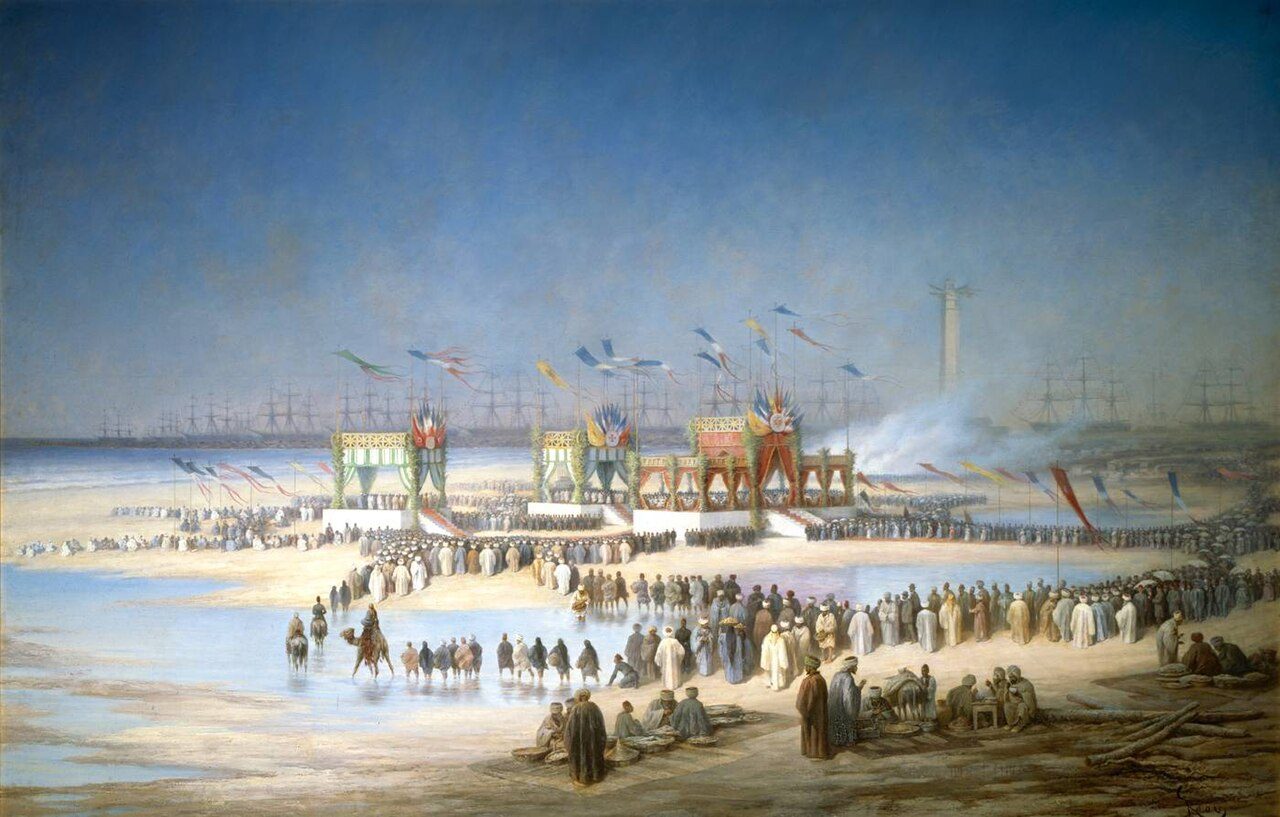
For on 17 November 1869 the Suez Canal was inaugurated in Egypt. The waterway was the work of Ferdinand de Lesseps, a former French diplomat who had obtained his concession in 1854 to build a sea-level canal across the desert between the Mediterranean and the Red Sea, against years of British opposition. Empress Eugénie of France, in the imperial yacht L'Aigle, led the first convoy of dozens of ships into the canal at the brand-new Port Said, amid cannon salutes and fireworks. The Khedive Ismail had spent so lavishly on the festivities that he helped bankrupt his country. Steamships, which could use the canal as sailing ships mostly could not, displaced sail on the Asia routes at once; Britain, having denounced the canal, bought the bankrupt Khedive's shares in 1875 and occupied Egypt itself in 1882, largely to hold the waterway.
Timeline of 1869
- 6 March
Mendeleev's first periodic table is presented to the Russian Chemical Society, predicting several still-undiscovered elements.
- 8 March
Hector Berlioz, French composer of the Symphonie fantastique, dies in Paris.
- 18 March
Neville Chamberlain is born — the future British prime minister remembered for appeasement.
- 10 May
The golden spike completes the first transcontinental railroad at Promontory Summit, Utah, joining America's coasts by rail.
- 15 May
Susan B. Anthony and Elizabeth Cady Stanton found the National Woman Suffrage Association in New York.
- 22 July
John A. Roebling, designer of the Brooklyn Bridge, dies of tetanus after an accident at its site.
- 31 August
Irish scientist Mary Ward is killed falling from an experimental steam car — the first recorded fatal motor accident.
- 24 September
Financiers Jay Gould and James Fisk try to corner the gold market, triggering the 'Black Friday' panic on Wall Street.
- 2 October
Mohandas Gandhi is born — the future leader of India's independence movement.
- 6 November
Rutgers defeats Princeton 6–4 in the first intercollegiate American football game.
- 17 November
The Suez Canal is inaugurated in Egypt, linking the Mediterranean with the Red Sea.
- 22 November
The clipper ship Cutty Sark, among the fastest sailing ships ever built, is launched at Dumbarton in Scotland.
- 10 December
The Wyoming Territory enacts the first U.S. law granting women the vote on equal terms with men.
Why 1869 still matters
1869 still matters because so much of the modern world's wiring was laid in it. The Suez Canal became the jugular of empire and then of oil: nationalised by Nasser in 1956, triggering the Suez Crisis, and closed by war from 1967, it remains one of the chokepoints of world trade. The transcontinental railroad bound the United States into a single economy, and the pattern of 1869 — a transport shortcut redrawing maps of trade and power — has repeated with every canal, railway and shipping lane since.
Mendeleev's table had the strangest afterlife of all: it was proved by things that did not yet exist. Gallium, his predicted eka-aluminium, was found in 1875 — and when its discoverer's first density measurement disagreed with the prediction, Mendeleev wrote from St. Petersburg to say the sample must be impure; remeasured, it matched. Scandium followed in 1879 and germanium in 1886, matching his predictions almost property for property. The periodic table stopped being one chemist's filing system and became chemistry's map, the chart on every laboratory wall today.
The year's people mattered as much as its machines. Gandhi, born in October, would grow up to lead India's independence movement against the empire the Suez Canal served, pioneering the nonviolent resistance the record credits to him. Neville Chamberlain, born in March, would face the century's consequences as Britain's prime minister at the outbreak of the Second World War. And the year's financial panic left a name: 'Black Friday', coined for Gould and Fisk's gold corner, still labels days when markets break. Wyoming's experiment, finally, was no gesture — the record notes it came fifty years before the Nineteenth Amendment made women's suffrage national.
1869 on The History Trail
The History Trail marks 1869 with the two days that shrank the world and ordered its elements.
- March 6 in History — Mendeleev presents the periodic table to the Russian Chemical Society.
- November 17 in History — the Suez Canal opens, linking the Mediterranean with the Red Sea.
- Black Friday — the story behind the name the 1869 gold panic gave to financial crashes.
Sources
- Royal Society of Chemistry — Finding the periodic table
- Encyclopaedia Britannica — On This Day: March 6
- HISTORY — Suez Canal opens
- Encyclopaedia Britannica — On This Day: November 17
- Encyclopaedia Britannica — On This Day: May 10
- Encyclopaedia Britannica — On This Day: December 10
The facts on this page were checked against these sources on 19 November 2026. The History Trail's permanent pages are researched and written for this site; the live profiles elsewhere on The History Trail are assembled automatically from Wikipedia and Wikidata.
About the Author
Researched and written by the The History Trail Editorial Team — the accountable editorial function behind this site's permanent story pages. The team works from the published sources cited on each page; it does not invent historians, reviewers or credentials, and it corrects errors openly.
Fact Check
Every load-bearing fact on this page traces to one of the sources listed above, and significant claims link to their source in the text. Our checking method is described on the methodology page; errors can be reported via the corrections page.
Sources & Citations
Cite this page as: The History Trail Editorial Team, The History Trail — this article's title, publication and update dates are shown beneath its headline. The full source list appears under Sources above; the site's source standards are on the sources page.