
Years
1889 in History
1889 is remembered for iron and water. In Paris, Gustave Eiffel climbed his completed tower and raised the French flag over the tallest structure humans had ever built, the centrepiece of the fair marking the Revolution's centenary. Two months later in Pennsylvania, the neglected South Fork Dam failed above Johnstown and sent a lake down the valley, killing 2,208 people in America's deadliest flood.
At a Glance
- Defining event
- The Eiffel Tower is inaugurated on 31 March and opens to the public on 6 May as the entrance arch of the World's Fair
- The structure
- 300 metres tall — the tallest thing humans had ever built — assembled from some 18,000 iron components and 2.5 million rivets
- Disaster
- The Johnstown Flood, 31 May: the South Fork Dam fails and 2,208 people die
- Born this year
- Charlie Chaplin (16 April) and Adolf Hitler (20 April) are born four days apart
- New states
- North Dakota and South Dakota join the United States on 2 November; Brazil is proclaimed a republic on 15 November
- Founded this year
- Nintendo is founded in Kyoto on 23 September, to make hand-painted playing cards
The defining story: the Eiffel Tower and the Johnstown Flood
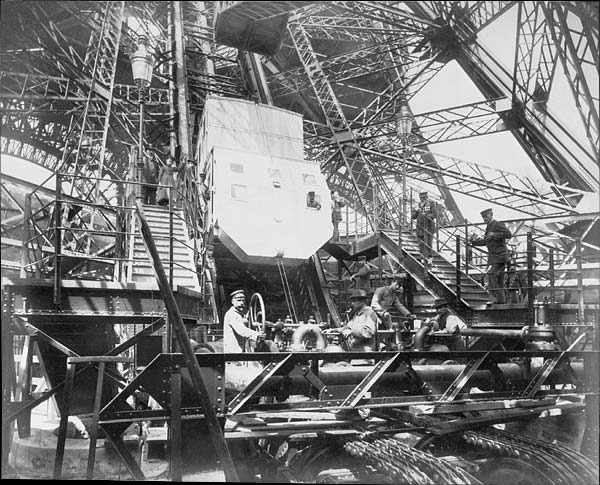
The tower began as an argument about what the modern age should look like. For the 1889 Exposition Universelle — the world's fair marking one hundred years since the Revolution — Paris wanted a monument a thousand feet tall, and held a competition. The winning design, by Maurice Koechlin and Émile Nouguier, engineers in Gustave Eiffel's firm, was a tapering pylon of latticed iron spread across the Champ-de-Mars. Eiffel, the great bridge-builder of the age, bought the rights, promoted the design tirelessly and put his name on it. Construction began in January 1887 and ran with industrial precision: every one of some 18,000 iron components was drawn, calculated and fabricated in Eiffel's works, then assembled on site by about 300 workers with 2.5 million rivets — and, by the standards of such projects, a single fatal accident.
In two years, two months and five days the structure was complete, rising 300 metres — taller than the Great Pyramid, taller than any cathedral. The inauguration, on 31 March 1889, was a workman's ceremony rather than a state pageant. The lifts were not ready, so Eiffel led officials and his own engineers up the 1,710 steps on foot. At the summit he raised a large tricolour — 'the French flag,' he liked to say, 'is the only one with a 300-metre pole' — while a 21-gun salute sounded. On 6 May the tower opened to the public as the entrance arch of the fair, and its lifts became the marvel of the exhibition. The year around it was crowded: in April, Charlie Chaplin and Adolf Hitler were born four days apart, and thousands of settlers raced in the Oklahoma land rush; in July, the first issue of The Wall Street Journal was published in New York.
On the same spring day the tower's fair was delighting Paris — 31 May — the year's other defining event struck Pennsylvania. Fourteen miles up the Little Conemaugh River from the steel town of Johnstown stood the South Fork Dam, an earthen wall holding back a reservoir two miles long. The lake belonged to a private fishing and hunting club whose members were among Pittsburgh's richest industrialists; the club had altered the dam, lowering its crest and partly blocking its spillway, and maintenance had been neglected for years. After days of torrential rain the reservoir topped the wall, a warning rider's message arrived as rumour rather than command, and in the middle of the afternoon the dam simply dissolved.
Some 14.55 million cubic metres of water emptied down the valley in under an hour and struck Johnstown at about forty miles an hour. Whole streets were scoured to the bedrock; wreckage piled against the stone arches of the railroad bridge, formed a jam thirty feet high, and caught fire, killing survivors trapped within it. The official count put the dead at 2,208, with damage estimated at $17 million — the deadliest flood in American history.
Timeline of 1889
- 31 March
The Eiffel Tower is inaugurated in Paris; Gustave Eiffel climbs its 1,710 steps and raises the French flag at the summit.
- 16 April
Charlie Chaplin is born in London — the future creator of the Little Tramp and defining star of silent cinema.
- 20 April
Adolf Hitler is born in Austria — the future dictator of Nazi Germany.
- 22 April
The Oklahoma land rush begins: thousands of settlers race to claim plots in nearly two million acres of newly opened territory.
- 6 May
The Eiffel Tower opens to the public in Paris as the entrance arch of the World's Fair.
- 31 May
The South Fork Dam fails above Johnstown, Pennsylvania; the flood kills 2,208 people.
- 8 July
The first issue of The Wall Street Journal is published in New York.
- 23 September
Fusajiro Yamauchi founds Nintendo in Kyoto, Japan, to make hand-painted playing cards.
- 6 October
The Moulin Rouge cabaret opens in Paris, with its red windmill and the can-can.
- 14 November
Journalist Nellie Bly sets out from New York to travel around the world in under 80 days; she does it in 72.
- 15 November
Emperor Pedro II is deposed in a coup and Brazil is proclaimed a republic.
- 23 November
The first jukebox goes into service at the Palais Royale Saloon in San Francisco.
- 6 December
Jefferson Davis, the only president of the Confederate States of America, dies in New Orleans at 81.
Why 1889 still matters
1889 still matters because its iron tower became the shorthand for a city and a century. The Eiffel Tower was built as a temporary fairground arch, painted a reddish brown in its first year, and meant to come down when its permit ran out; instead it became the most recognisable structure on Earth and the permanent symbol of Paris. The fair it crowned announced that the modern age would be built of iron, electricity and spectacle — the same fair season that gave the world the Moulin Rouge and, across the Atlantic, a financial newspaper that still sets the business agenda.
Johnstown left a different kind of legacy: a template. A neglected dam owned by the rich, warnings discounted as rumour, a town destroyed in an hour — the flood became America's defining parable of industrial negligence, and it made the American Red Cross, whose relief operation under Clara Barton established it as the nation's relief agency of first resort. Between the tower and the flood, 1889 holds the industrial age's promise and its price in a single year, which is why both stories are still told.
The year's quieter foundings compounded for a century. The Wall Street Journal, first issued in July, became the newspaper of record for the business world the tower's age created. Nintendo, founded in Kyoto in September to make hand-painted playing cards, would reinvent itself across the following century. Brazil's republic, proclaimed in November after the emperor's deposition, ended monarchy in South America's largest country. And Vincent van Gogh painted The Starry Night in 1889 — an artwork that became, like the tower itself, one of the most recognised images on Earth.
1889 on The History Trail
The History Trail tells 1889 through its tower, its flood and the Paris of the great fair.
- March 31 in History — the Eiffel Tower is inaugurated in Paris.
- May 31 in History — the Johnstown Flood, the deadliest flood in American history.
- Paris — the city the tower came to symbolise.
- The Starry Night — Van Gogh's masterpiece, painted in 1889.
- Pizza — the food whose most famous variety dates from this era.
Sources
- La Tour Eiffel (official site) — 1889: 130 Years of Amazement, the Inauguration of 31 March 1889
- HISTORY — This Day in History: March 31
- Encyclopaedia Britannica — On This Day: March 31
- Encyclopaedia Britannica — On This Day: May 31
- HISTORY — This Day in History: May 31
- Encyclopaedia Britannica — On This Day: November 14
The facts on this page were checked against these sources on 19 November 2026. The History Trail's permanent pages are researched and written for this site; the live profiles elsewhere on The History Trail are assembled automatically from Wikipedia and Wikidata.
About the Author
Researched and written by the The History Trail Editorial Team — the accountable editorial function behind this site's permanent story pages. The team works from the published sources cited on each page; it does not invent historians, reviewers or credentials, and it corrects errors openly.
Fact Check
Every load-bearing fact on this page traces to one of the sources listed above, and significant claims link to their source in the text. Our checking method is described on the methodology page; errors can be reported via the corrections page.
Sources & Citations
Cite this page as: The History Trail Editorial Team, The History Trail — this article's title, publication and update dates are shown beneath its headline. The full source list appears under Sources above; the site's source standards are on the sources page.