
On This Day
March 31 in History
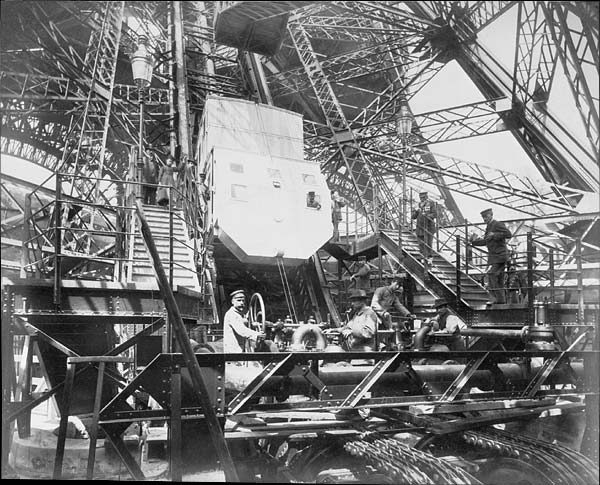
On 31 March 1889, with the lifts not yet working, Gustave Eiffel led a party of officials up the 1,710 steps of his just-completed tower in Paris and raised an enormous French tricolour at the top, to a 21-gun salute. At 300 metres the Eiffel Tower was the tallest human-made structure on Earth, built in just over two years as the entrance arch of the World's Fair celebrating the centenary of the French Revolution — and intended, under its permit, to be dismantled in twenty years. March 31 is also the day the United States took possession of the Virgin Islands and the Dalai Lama reached India.
Choose another date: open the On This Day calendar to browse events, births and deaths for any day of the year.
At a Glance
- The occasion
- The Exposition Universelle of 1889, Paris's world's fair for the centenary of the French Revolution
- The designers
- Conceived by engineers Maurice Koechlin and Émile Nouguier of Gustave Eiffel's company; Eiffel championed, financed and built it
- The build
- January 1887 to March 1889 — two years, two months and five days; some 300 workers assembled 18,000 prefabricated iron parts with 2.5 million rivets
- The inauguration
- 31 March 1889, 1:30 p.m. — Eiffel climbs the 1,710 steps with officials and raises the flag; the lifts enter service only when the fair opens in May
- The record
- At 300 metres (about 312 with its flagpole) the world's tallest structure, a title it held until New York's Chrysler Building in 1930
- The reprieve
- Licensed for only 20 years, the tower was saved from demolition by its usefulness as a radio-telegraphy mast — and by becoming Paris itself
Events on this day
- 1492Spain's Catholic Monarchs issue the Alhambra Decree, ordering the expulsion of practicing Jews from Spain — one of the great forced migrations of the age.
- 1774Britain's Parliament passes the Boston Port Act, closing the port of Boston until the town pays for the tea destroyed in the Tea Party — a punishment that helps unite the colonies.
- 1854Commodore Matthew Perry signs the Convention of Kanagawa with Japan, opening two Japanese ports to American ships and ending two centuries of seclusion.
- 1889The Eiffel Tower is inaugurated in Paris — the featured story above.
- 1909Shipbuilders in Belfast lay the keel of RMS Titanic, first of the White Star Line's three great Olympic-class liners.
- 1917The United States takes possession of the Danish West Indies, bought from Denmark for $25 million and renamed the US Virgin Islands.
- 1939Britain and France announce their guarantee of Poland's independence — the pledge that turns Hitler's next aggression into a European war.
- 1959The 14th Dalai Lama, fleeing the suppression of the Tibetan uprising, crosses into India and is granted asylum, beginning an exile that continues today.
- 1966The Soviet Union launches Luna 10, which becomes the first spacecraft to orbit the Moon.
- 1991The Warsaw Pact's military organisation is dissolved at Prague, closing the alliance system that faced NATO through the Cold War.
Born on this day
- 1732Joseph Haydn — Austrian composer, father of the symphony and the string quartet.
- 1811Robert Bunsen — German chemist whose burner stands in every school laboratory, and who helped found spectroscopy.
- 1872Sergei Diaghilev — Russian impresario whose Ballets Russes revolutionised dance and design.
- 1927César Chávez — American labour leader who organised farm workers into a national movement.
- 1943Christopher Walken — American actor of The Deer Hunter, known for one of cinema's most imitated voices.
- 1971Ewan McGregor — Scottish actor of Trainspotting and the Star Wars prequels.
Died on this day
- 1727Isaac Newton — English physicist and mathematician, author of the Principia, dead in London at 84 (31 March by the modern calendar).
- 1855Charlotte Brontë — English novelist of Jane Eyre, dead at 38, a year after her marriage and in early pregnancy.
- 1913J. P. Morgan — American banker whose firm financed railroads, steel and the US government itself, dead in Rome at 75.
- 1995Selena — Mexican-American singer, the 'Queen of Tejano music', murdered at 23 by the president of her fan club.
- 2016Zaha Hadid — Iraqi-born British architect, the first woman to win the Pritzker Prize outright, dead at 65.
The featured story: the inauguration of the Eiffel Tower, 31 March 1889
The tower began as an argument about what the modern age should look like. For the 1889 Exposition Universelle — the world's fair marking one hundred years since the Revolution — Paris wanted a monument a thousand feet tall, and held a competition. The winning design, by Maurice Koechlin and Émile Nouguier, engineers in Gustave Eiffel's firm, was a tapering pylon of latticed iron, its four feet spread across the Champ-de-Mars. Eiffel, the great bridge-builder of the age, bought the rights, promoted it tirelessly and put his name on it. Paris's artists were appalled: a famous protest letter of 1887, signed by writers and composers, called the rising tower a gigantic black factory chimney dishonouring the city.
Building it was the rebuttal. Construction began in January 1887 and ran with industrial precision: every one of some 18,000 iron components was drawn, calculated and fabricated in Eiffel's works at Levallois-Perret, then assembled on site by about 300 workers with 2.5 million rivets — and, by the standards of such projects, a single fatal accident. In two years, two months and five days the structure was complete, rising 300 metres — taller than the Great Pyramid, taller than any cathedral, the tallest thing humans had ever built. It was painted, as the tower's own history notes, a Venetian red.
The inauguration, on Sunday 31 March 1889, was a workman's ceremony rather than a state pageant. The lifts were not ready, so at half past one Eiffel led Prime Minister Pierre Tirard's representatives, city officials and his own engineers up the 1,710 steps on foot. At the summit he raised a large tricolour — 'the French flag,' he liked to say, 'is the only one with a 300-metre pole' — while a 21-gun salute sounded and fireworks were set off from the second platform. Below, he paid tribute to the 300 workers who had built it. The public had to wait: the tower opened to visitors when the fair itself opened in May, lifts running, and nearly two million people climbed it before the exhibition closed.
Under its concession the tower was licensed to stand for twenty years, after which Paris could pull it down — and by 1909 many expected exactly that. What saved the Iron Lady was utility wearing the disguise of romance: its height made it priceless for the new science of radio, first for military telegraphy, then for broadcasting, and the permit was extended. The artists who petitioned against it lost so completely that their target became the universal symbol of their city and of France: the most visited paid monument on Earth, repainted every seven years, and so completely Paris that the 31 March climb of 1889 now reads less like an inauguration than a coronation.
Why this date matters
March 31 is a day of arrivals and thresholds: a flag at the top of the world's tallest tower in 1889, a refugee leader reaching safety in India in 1959, a spacecraft settling into orbit around the Moon in 1966, an empire of alliances quietly dissolved in 1991. Even its darker entries are thresholds — a port closed in 1774 that pushed colonies toward union, a guarantee in 1939 that defined where a continent would draw its line. The last day of March behaves like a door: things pass through it and do not come back the same.
Sources
- Encyclopaedia Britannica — On This Day: March 31
- HISTORY — This Day in History: March 31
- La Tour Eiffel (official site) — 1889: 130 Years of Amazement, the Inauguration of 31 March 1889
- Sky HISTORY — Eiffel Tower Opens
The facts on this page were checked against these sources on 19 November 2026. The History Trail's permanent pages are researched and written for this site; the live profiles elsewhere on The History Trail are assembled automatically from Wikipedia and Wikidata.
About the Author
Researched and written by the The History Trail Editorial Team — the accountable editorial function behind this site's permanent story pages. The team works from the published sources cited on each page; it does not invent historians, reviewers or credentials, and it corrects errors openly.
Fact Check
Every load-bearing fact on this page traces to one of the sources listed above, and significant claims link to their source in the text. Our checking method is described on the methodology page; errors can be reported via the corrections page.
Sources & Citations
Cite this page as: The History Trail Editorial Team, The History Trail — this article's title, publication and update dates are shown beneath its headline. The full source list appears under Sources above; the site's source standards are on the sources page.