
On This Day
March 30 in History
In the small hours of 30 March 1867, in Washington, US Secretary of State William H. Seward and the Russian minister Eduard de Stoeckl agreed the sale of Russian America — Alaska — to the United States for $7.2 million, about two cents an acre. Newspapers mocked the deal as 'Seward's Folly' and 'Seward's Icebox'. It added 586,000 square miles to the United States, and time has reversed every word of the mockery. March 30 is also the day President Reagan was shot and survived, and the day the Treaty of Paris ended the Crimean War.
Choose another date: open the On This Day calendar to browse events, births and deaths for any day of the year.
At a Glance
- The seller
- Russia, its American colony unprofitable, its treasury strained by the Crimean War, and fearful Britain would seize Alaska in any future war
- The buyer
- Secretary of State William H. Seward, an expansionist who had long coveted Pacific commerce and territory
- The deal
- Treaty signed in Washington in the early hours of 30 March 1867; $7.2 million for about 586,000 square miles — under two cents an acre
- The reception
- 'Seward's Folly', 'Seward's Icebox', 'Johnson's polar bear garden' — the purchase was widely ridiculed in the American press
- The process
- The Senate ratified in April; the formal transfer took place at Sitka in October 1867; Congress nearly balked at paying, appropriating the money only in 1868
- The vindication
- Gold rushes in the 1890s, then oil at Prudhoe Bay in 1968 and vast fisheries and minerals; Alaska became the 49th state in 1959
Events on this day
- 1814Allied armies enter Paris after defeating Napoleon; within days the emperor abdicates for the first time.
- 1822The United States organises Florida, acquired from Spain three years earlier, as a federal territory.
- 1842Dr Crawford Long of Georgia uses ether as an anaesthetic in surgery for the first time, removing a tumour from a patient's neck.
- 1856The Treaty of Paris ends the Crimean War, curbing Russian power in the Black Sea and reshaping the European balance.
- 1867The United States and Russia sign the treaty ceding Alaska for $7.2 million — the featured story above.
- 1870The Fifteenth Amendment, barring denial of the vote on account of race, is formally certified as part of the US Constitution.
- 1912France establishes a protectorate over Morocco by the Treaty of Fès, deepening its North African empire.
- 1981President Ronald Reagan is shot in the chest outside a Washington hotel by John Hinckley Jr.; Reagan survives surgery, and press secretary James Brady is permanently disabled.
- 1987Van Gogh's Sunflowers sells at Christie's in London for £24.75 million, nearly triple the previous record for any painting — on the artist's birthday.
Born on this day
- 1746Francisco Goya — Spanish painter and printmaker, court artist turned merciless witness of war and folly.
- 1853Vincent van Gogh — Dutch painter whose Sunflowers and Starry Night, sold for almost nothing in his life, now anchor the world's museums.
- 1937Warren Beatty — American actor and director of Bonnie and Clyde and Reds.
- 1945Eric Clapton — British guitarist of Cream and Derek and the Dominos, and a solo institution.
- 1968Céline Dion — Canadian singer, among the bestselling recording artists in history.
Died on this day
- 1912Karl May — German novelist whose Winnetou adventure stories of the American West sold in the hundreds of millions.
- 1925Rudolf Steiner — Austrian philosopher and founder of anthroposophy and the Waldorf schools.
- 1986James Cagney — American actor of Yankee Doodle Dandy and a string of definitive gangster roles, dead at 86.
- 2002Elizabeth, the Queen Mother — widow of George VI and mother of Elizabeth II, dead at 101, the monarchy's beloved matriarch.
The featured story: the Alaska Purchase, 30 March 1867
Alaska in 1867 was Russian America: a thin chain of fur-trading posts along a vast, cold coast, run at a loss by the Russian-American Company and garrisoned by a few hundred men. The Crimean War had taught St Petersburg two lessons — that the colony could not be defended against Britain, whose navy and Canadian frontier surrounded it, and that it was better sold to the friendly United States than lost to the enemy for nothing. Feelers went out before the American Civil War and were renewed after it. On the American side, Secretary of State William H. Seward, who had survived an assassination attempt the night Lincoln was shot, was building a commercial empire on the Pacific and needed no persuading.
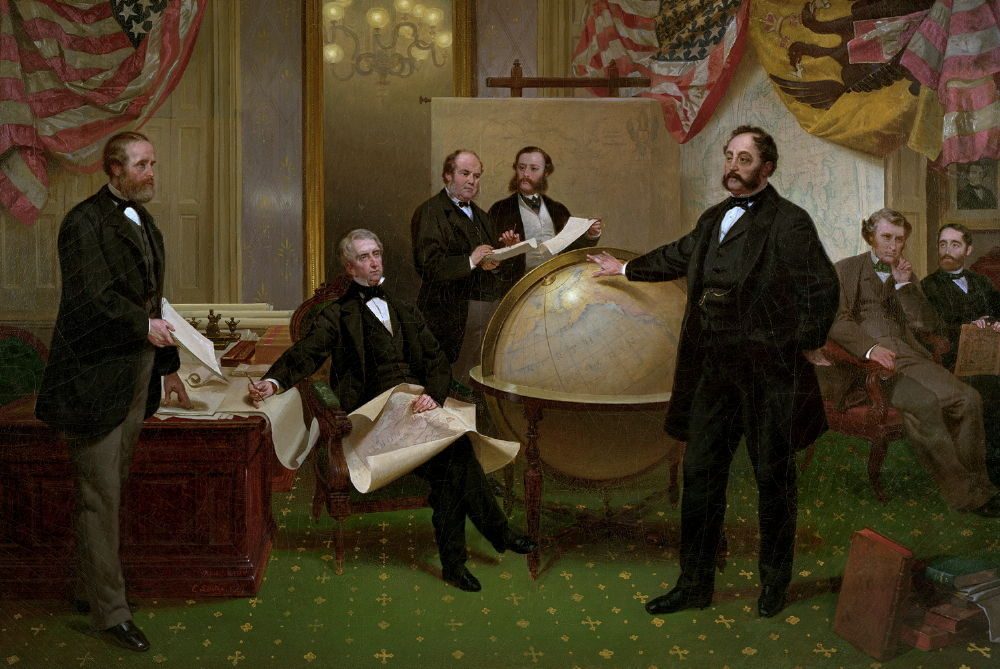
The negotiation, once de Stoeckl received his instructions and his price in March 1867, took days rather than months. Seward pressed to close before Congress adjourned; the Russian minister was summoned late on 29 March, the State Department's clerks were called back, and the treaty was drafted and signed in the small hours of 30 March — the scene Leutze painted, with its globe and maps and air of destiny. The terms: Russia ceded all its North American territory and islands, some 586,000 square miles, for $7.2 million. The Senate, lobbied hard by Charles Sumner, ratified within a fortnight.
Then came the ridicule and the second fight. Editorialists christened the purchase 'Seward's Folly' and 'Seward's Icebox', a worthless waste of money on a frozen desert; the House of Representatives, deep in the impeachment struggle against President Johnson, held up the appropriation for more than a year, and dark rumours of bribery attended its eventual passage in July 1868 — the famous $7.2 million cheque, payable to de Stoeckl, survives in the National Archives. The flag had already changed: at Sitka in October 1867, Russian troops lowered their colours and the Stars and Stripes rose over what most Americans regarded as a spectacular irrelevance.
The irrelevance compounded quietly and then spectacularly. Gold at Juneau in 1880 and the Klondike stampede of the 1890s; salmon fisheries that fed a continent; wartime strategic value when the Aleutians became a front line; statehood in 1959; and in 1968 the largest oil field in North America at Prudhoe Bay, followed by the pipeline that still anchors Alaska's economy. At two cents an acre, the purchase Seward closed before dawn on 30 March 1867 stands as perhaps the most profitable land deal any government ever signed — the folly belonged to the mockers.
Why this date matters
March 30 is the calendar's argument for patience in judgement. A treaty signed before dawn in 1867 was laughed at for a generation and is now the textbook case of a bargain; a painting dismissed in its maker's lifetime set the world auction record on his birthday in 1987; a president was shot in 1981 and joked with his surgeons. The date keeps punishing first impressions. What looks like folly at breakfast, March 30 insists, may simply be value that has not finished arriving.
Sources
- Encyclopaedia Britannica — On This Day: March 30
- HISTORY — This Day in History: March 30
- University of Alaska Fairbanks — Historic painting comes to Alaska (on the signing of the Alaska Treaty)
- National Archives — Check for the Purchase of Alaska (1868)
The facts on this page were checked against these sources on 19 November 2026. The History Trail's permanent pages are researched and written for this site; the live profiles elsewhere on The History Trail are assembled automatically from Wikipedia and Wikidata.
About the Author
Researched and written by the The History Trail Editorial Team — the accountable editorial function behind this site's permanent story pages. The team works from the published sources cited on each page; it does not invent historians, reviewers or credentials, and it corrects errors openly.
Fact Check
Every load-bearing fact on this page traces to one of the sources listed above, and significant claims link to their source in the text. Our checking method is described on the methodology page; errors can be reported via the corrections page.
Sources & Citations
Cite this page as: The History Trail Editorial Team, The History Trail — this article's title, publication and update dates are shown beneath its headline. The full source list appears under Sources above; the site's source standards are on the sources page.