
Years
1890 in History
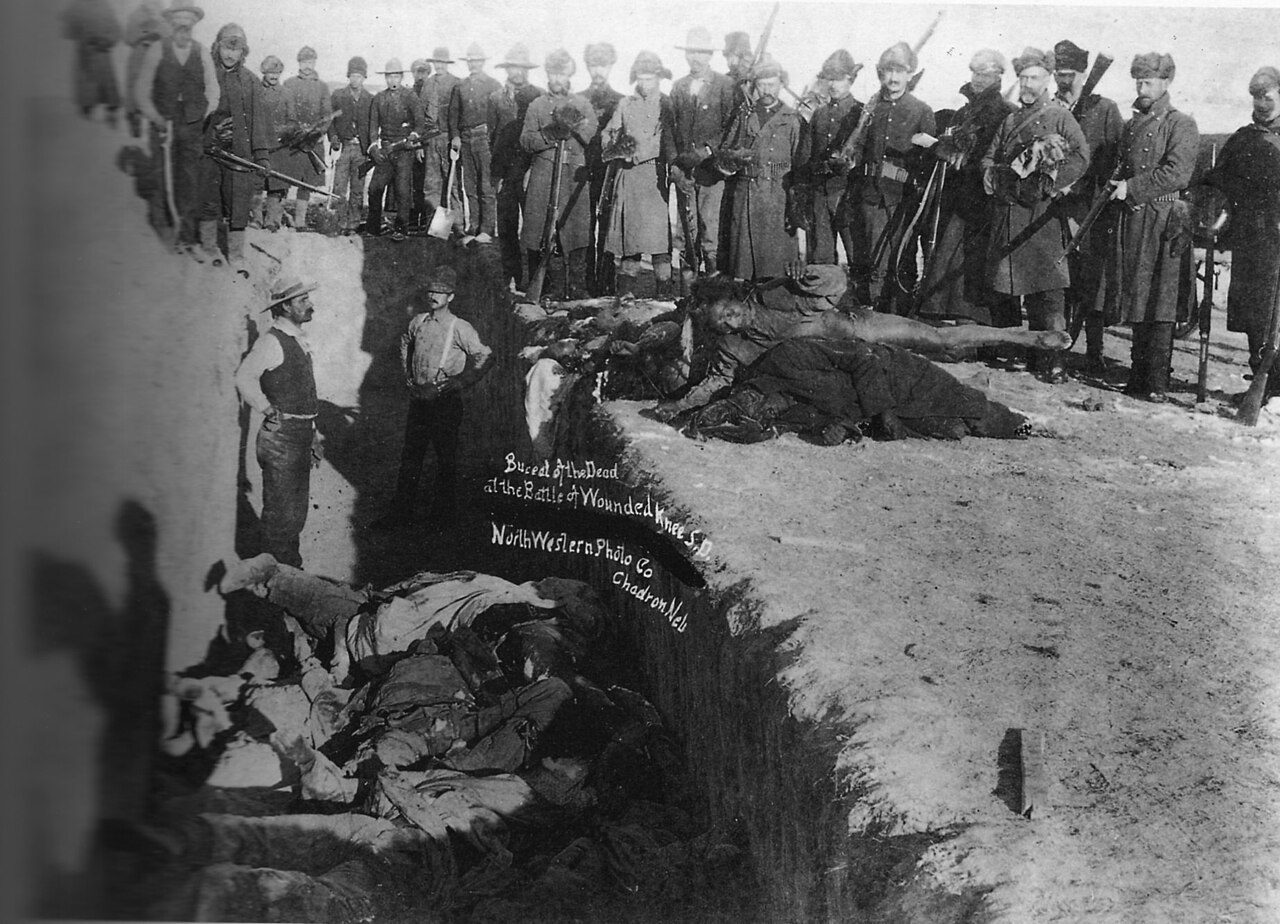
1890 ended in massacre. On 29 December soldiers of the U.S. 7th Cavalry, disarming a Miniconjou Lakota camp at Wounded Knee Creek, opened fire and killed an estimated 250-300 Lakota, almost half of them women and children — two weeks after Sitting Bull was killed at Standing Rock. The year also dismissed Bismarck from Germany's chancellorship, passed America's first antitrust law, admitted Wyoming with women's votes intact, and lost Vincent van Gogh at 37.
At a Glance
- Defining event
- Wounded Knee Massacre, 29 December 1890 — an estimated 250-300 Lakota killed
- The prelude
- Sitting Bull killed at Standing Rock during an attempted arrest, 15 December
- Bismarck falls
- Kaiser Wilhelm II dismisses Otto von Bismarck, 20 March
- Trusts targeted
- Sherman Antitrust Act becomes law, 2 July, the first federal statute against monopolies
- Equality state
- Wyoming admitted as the 44th state, 10 July, the first where women voted on equal terms
- Van Gogh dies
- Vincent van Gogh dies at Auvers-sur-Oise, 29 July, at 37, having sold almost nothing
The defining story: the massacre at Wounded Knee Creek
The killing grew out of fear. Through 1890 the Ghost Dance — a religious movement promising the return of the buffalo and the disappearance of the settlers — had spread through the Lakota reservations, and officials in Washington read it as preparation for war. Troops poured into South Dakota. The year's politics elsewhere were also turning: on 20 March Kaiser Wilhelm II dismissed Otto von Bismarck, the chancellor who had unified Germany, ending the Bismarck era a generation after Sedan. In Washington, on 2 July, the Sherman Antitrust Act became law, the first federal statute against monopolies and restraint of trade, and on 10 July Wyoming was admitted as the forty-fourth state — the first in which women could vote on equal terms with men.
In the summer the century lost its most unrecognised genius: on 29 July Vincent van Gogh died at Auvers-sur-Oise at 37, two days after shooting himself, having sold almost nothing in his lifetime. On 6 August William Kemmler became the first person executed in the electric chair, at Auburn Prison, New York. On 1 October Yosemite National Park was established in California, protecting the valley and its giant sequoia groves.
December brought the crisis to its end. On 15 December Sitting Bull, the Lakota leader who had helped defeat Custer at the Little Bighorn, was killed by Indian agency police during an attempt to arrest him at Standing Rock. His followers fled, and many joined the band of Chief Big Foot, himself ill with pneumonia, who set out with some 350 people, most of them women and children, towards the Pine Ridge agency hoping for safety. The 7th Cavalry intercepted the band on 28 December and escorted it to a camp beside Wounded Knee Creek, where four Hotchkiss guns were trained on the tipis from the hill above.
On the morning of 29 December Colonel James W. Forsyth ordered the Lakota disarmed. Soldiers searched the camp and gathered the men to surrender their rifles. Then a shot rang out — accounts have never agreed on whose; a young man named Black Coyote, said to be deaf, was struggling with soldiers over his rifle when it discharged. The soldiers answered with a volley at point-blank range, and the Hotchkiss guns tore into the camp. Soldiers pursued fleeing women and children across the frozen prairie, killing some as far as two miles away. Modern scholars estimate between 250 and 300 Lakota dead, almost half women and children, among them Big Foot; about 25 soldiers also died, several shot by their own comrades. A blizzard then buried the field.
Timeline of 1890
- 9 January
Karel Čapek, the Czech writer who gave the world the word 'robot', is born.
- 10 February
Boris Pasternak, Russian poet and author of Doctor Zhivago, is born.
- 20 March
Kaiser Wilhelm II dismisses Otto von Bismarck, the chancellor who had unified Germany.
- 19 May
Ho Chi Minh, Vietnamese revolutionary leader, is born.
- 16 June
Stan Laurel, the English comic actor of Laurel and Hardy, is born.
- 2 July
The Sherman Antitrust Act becomes law in the United States.
- 10 July
Wyoming is admitted to the Union as the forty-fourth state, the first where women could vote on equal terms with men.
- 29 July
Vincent van Gogh dies at Auvers-sur-Oise at 37.
- 6 August
William Kemmler becomes the first person executed in the electric chair, at Auburn Prison, New York.
- 15 September
Agatha Christie, creator of Hercule Poirot and Miss Marple, is born.
- 1 October
Yosemite National Park is established in California.
- 14 October
Dwight D. Eisenhower, the future 34th U.S. president, is born.
- 15 December
Sitting Bull is killed at Standing Rock during an attempt to arrest him.
- 29 December
U.S. 7th Cavalry troops kill an estimated 250-300 Lakota at Wounded Knee Creek.
Why 1890 still matters
The Army called Wounded Knee a battle and decorated its soldiers; history has settled on the other word. The massacre became the enduring symbol of the destruction of Plains Indian life — so potent that in 1973 members of the American Indian Movement occupied the site for 71 days to protest the treatment of Native peoples, and in 1990, a century on, Congress formally expressed its deep regret. The mass grave on the hill above the creek is still there, at the centre of the Pine Ridge Reservation.
The year's other settlements structured the century to come. Bismarck's dismissal removed the careful manager of Europe's alliances and left foreign policy to Wilhelm II. The Sherman Act, little used at first, became the legal foundation on which American antitrust enforcement was later built. Wyoming's admission with women's suffrage intact set the precedent the Nineteenth Amendment nationalised thirty years later.
And 1890's births read like a cast list for the twentieth century: Eisenhower and de Gaulle, born 22 November, would lead the liberation of Europe; Agatha Christie became the best-selling fiction writer of all time; H. P. Lovecraft, Groucho Marx and Fritz Lang remade popular imagination. A year that began with a word — Čapek, born 9 January, would coin 'robot' — ended with the last great atrocity of the Indian Wars.
1890 on The History Trail
A massacre, a dismissal and an antitrust law lead this year on The History Trail.
- December 29 in History — The Wounded Knee Massacre, told in full.
- December 15 in History — Sitting Bull is killed at Standing Rock.
- March 20 in History — Wilhelm II dismisses Bismarck.
- July 2 in History — The Sherman Antitrust Act becomes law.
- Agatha Christie — The novelist born on 15 September 1890, creator of Poirot and Miss Marple.
- July 29 in History — Vincent van Gogh dies at Auvers-sur-Oise at 37.
- October 1 in History — Yosemite National Park is established in California.
Sources
- Encyclopaedia Britannica — Wounded Knee Massacre
- Smithsonian Magazine — On This Day in 1890, the U.S. Army Killed Nearly 300 Lakota People in the Wounded Knee Massacre
- Encyclopaedia Britannica — On This Day: December 29
- Encyclopaedia Britannica — On This Day: December 15
- Encyclopaedia Britannica — On This Day: March 20
- Encyclopaedia Britannica — On This Day: July 2
The facts on this page were checked against these sources on 19 November 2026. The History Trail's permanent pages are researched and written for this site; the live profiles elsewhere on The History Trail are assembled automatically from Wikipedia and Wikidata.
About the Author
Researched and written by the The History Trail Editorial Team — the accountable editorial function behind this site's permanent story pages. The team works from the published sources cited on each page; it does not invent historians, reviewers or credentials, and it corrects errors openly.
Fact Check
Every load-bearing fact on this page traces to one of the sources listed above, and significant claims link to their source in the text. Our checking method is described on the methodology page; errors can be reported via the corrections page.
Sources & Citations
Cite this page as: The History Trail Editorial Team, The History Trail — this article's title, publication and update dates are shown beneath its headline. The full source list appears under Sources above; the site's source standards are on the sources page.