
On This Day
October 1 in History
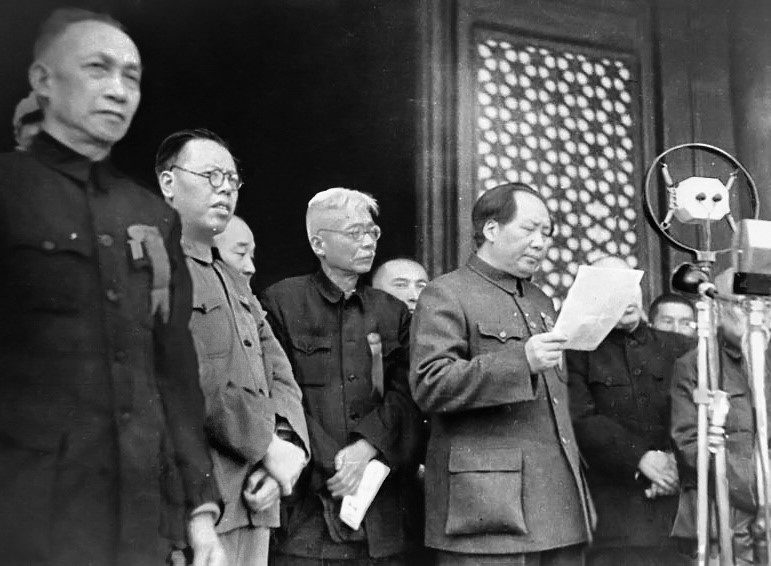
On 1 October 1949, before an estimated 300,000 people in Tiananmen Square, Mao Zedong proclaimed the founding of the People's Republic of China, sealing the Communist victory in the Chinese Civil War and ending the Republic of China's rule on the mainland. October 1 is also the day the Ford Model T went on sale, Nigeria won its independence and Walt Disney World opened.
Choose another date: open the On This Day calendar to browse events, births and deaths for any day of the year.
At a Glance
- Proclaimed
- 1 October 1949, from the Gate of Heavenly Peace (Tiananmen), Beijing
- Proclaimed by
- Mao Zedong, chairman of the Chinese Communist Party
- The crowd
- An estimated 300,000 people gathered in Tiananmen Square
- What it ended
- The Communists' victory over the Nationalists in the Chinese Civil War
- The old government
- The Republic of China withdrew across the mainland and relocated to Taiwan by December 1949
- First recognition
- The Soviet Union recognised the People's Republic on 2 October 1949
- Today
- 1 October is the National Day of the People's Republic of China
Events on this day
- 331 BCAlexander the Great defeats Darius III of Persia at the Battle of Gaugamela, sealing the fate of the Persian Empire.
- 1791The Legislative Assembly, France's first elected legislature under the revolutionary constitution, holds its first session.
- 1890Yosemite National Park is established in California, protecting the Yosemite Valley and its giant sequoia groves.
- 1891Stanford University opens its doors in California, founded by Leland and Jane Stanford in memory of their son.
- 1908The Ford Model T goes on sale in the United States at $825, beginning the era of the affordable family car.
- 1936Francisco Franco is named head of state of Nationalist Spain as the Spanish Civil War gathers force.
- 1946The Nuremberg trials end with sentences on the leading Nazi defendants, including twelve death sentences.
- 1949Mao Zedong proclaims the People's Republic of China from the Gate of Heavenly Peace in Beijing — the featured story above.
- 1960Nigeria becomes independent of Britain, the most populous country in Africa joining the wave of decolonisation.
- 1971Walt Disney World opens in Florida, the second and far larger of Disney's American theme-park resorts.
- 1975Muhammad Ali defeats Joe Frazier in the 'Thrilla in Manila', their third and most brutal fight, stopped after fourteen rounds.
- 1994The Pacific island nation of Palau becomes independent, the last of the United Nations trust territories in the Pacific to do so.
- 2017A gunman fires on a music festival in Las Vegas, killing 58 people in the deadliest mass shooting in modern United States history.
Born on this day
- 1920Walter Matthau — American actor of The Odd Couple and a string of rueful comic roles.
- 1924Jimmy Carter — 39th president of the United States and later Nobel Peace Prize laureate for his humanitarian work.
- 1930Richard Harris — Irish actor and singer, from This Sporting Life to Dumbledore in the first Harry Potter films.
- 1935Julie Andrews — English singer and actress, star of Mary Poppins and The Sound of Music.
- 1989Brie Larson — American actress who won an Academy Award for Room and went on to play Captain Marvel.
Died on this day
- 1684Pierre Corneille — French playwright, founder of classical French tragedy with Le Cid.
- 1864Christian Friedrich Ludwig Buschmann — German instrument maker credited with inventing the accordion.
- 1885Anthony Ashley-Cooper, 7th Earl of Shaftesbury — British social reformer who campaigned for factory and child-labour laws.
- 2018Charles Aznavour — French-Armenian singer-songwriter whose career spanned more than seventy years.
The featured story: the People's Republic of China is proclaimed, 1 October 1949
The ceremony in Beijing on 1 October 1949 was the formal end of a civil war that had consumed China, with interruptions, for more than two decades. Mao Zedong's Communists and Chiang Kai-shek's Nationalists had fought since 1927, paused uneasily to resist Japan, and then resumed their struggle in earnest after 1945. By the start of 1949 the outcome was no longer in doubt. The People's Liberation Army took Beiping, as Beijing was then called, in January, crossed the Yangtze in April and captured the Nationalist capital, Nanjing, then took Shanghai in May. One by one the great cities of China changed hands, and the Nationalist government retreated southward, still claiming to rule a country it no longer controlled.
On the afternoon of 1 October, before an estimated 300,000 people gathered in Tiananmen Square, Mao climbed the rostrum of the Gate of Heavenly Peace, the great gate at the northern edge of the square that had watched over the old imperial city. At about three o'clock he read the proclamation announcing the founding of the People's Republic of China and declaring that the Chinese people had stood up. The new state's five-starred red flag was raised over the square for the first time, artillery fired a salute, and the band played the March of the Volunteers, which became the national anthem. A new government was named the same day, with Mao as chairman and Zhou Enlai as premier and foreign minister.
The proclamation did not, by itself, end the old China. The Republic of China did not surrender or dissolve; its government withdrew step by step across the mainland and, by December 1949, had relocated to the island of Taiwan, which it continued to govern. From that point there were two governments, in Beijing and in Taipei, each insisting that it was the legitimate government of all China, a division across the Taiwan Strait that has never formally been resolved. On the mainland, meanwhile, the new state set about unifying a vast, war-exhausted country under a single party's rule for the first time in decades.
The outside world reacted along the lines of the new Cold War. The Soviet Union recognised the People's Republic the very next day, on 2 October 1949, and other communist states followed, while most Western governments withheld recognition for years. Inside China, the founding is remembered as the moment the country stood up after a century of invasion, civil conflict and foreign pressure, and 1 October remains the National Day of the People's Republic, the centrepiece of a week-long holiday. Few twentieth-century dates have reshaped the lives of more people at once: the state proclaimed that afternoon governed, then as now, more human beings than any other on earth.
Why this date matters
October 1 is a date on which new orders have repeatedly been switched on. A park and a university were founded on it, the first mass-produced car went on sale on it, and two nations, Nigeria and Palau, began their independence on it. Above all it is the birthday of the modern Chinese state: the day in 1949 when a civil war's verdict was announced to a crowd of hundreds of thousands and the government of a fifth of humanity changed in an afternoon. The date is still a national holiday in China, and the photograph of the ceremony — a man in a plain suit on an imperial gate — remains one of the defining images of the twentieth century.
Sources
- Encyclopaedia Britannica — On This Day: October 1
- HISTORY — This Day in History: October 1
- Ohio State University, Origins — The Establishment of the People's Republic of China
- On That Day — October 1
The facts on this page were checked against these sources on 19 November 2026. The History Trail's permanent pages are researched and written for this site; the live profiles elsewhere on The History Trail are assembled automatically from Wikipedia and Wikidata.
About the Author
Researched and written by the The History Trail Editorial Team — the accountable editorial function behind this site's permanent story pages. The team works from the published sources cited on each page; it does not invent historians, reviewers or credentials, and it corrects errors openly.
Fact Check
Every load-bearing fact on this page traces to one of the sources listed above, and significant claims link to their source in the text. Our checking method is described on the methodology page; errors can be reported via the corrections page.
Sources & Citations
Cite this page as: The History Trail Editorial Team, The History Trail — this article's title, publication and update dates are shown beneath its headline. The full source list appears under Sources above; the site's source standards are on the sources page.