
On This Day
September 30 in History
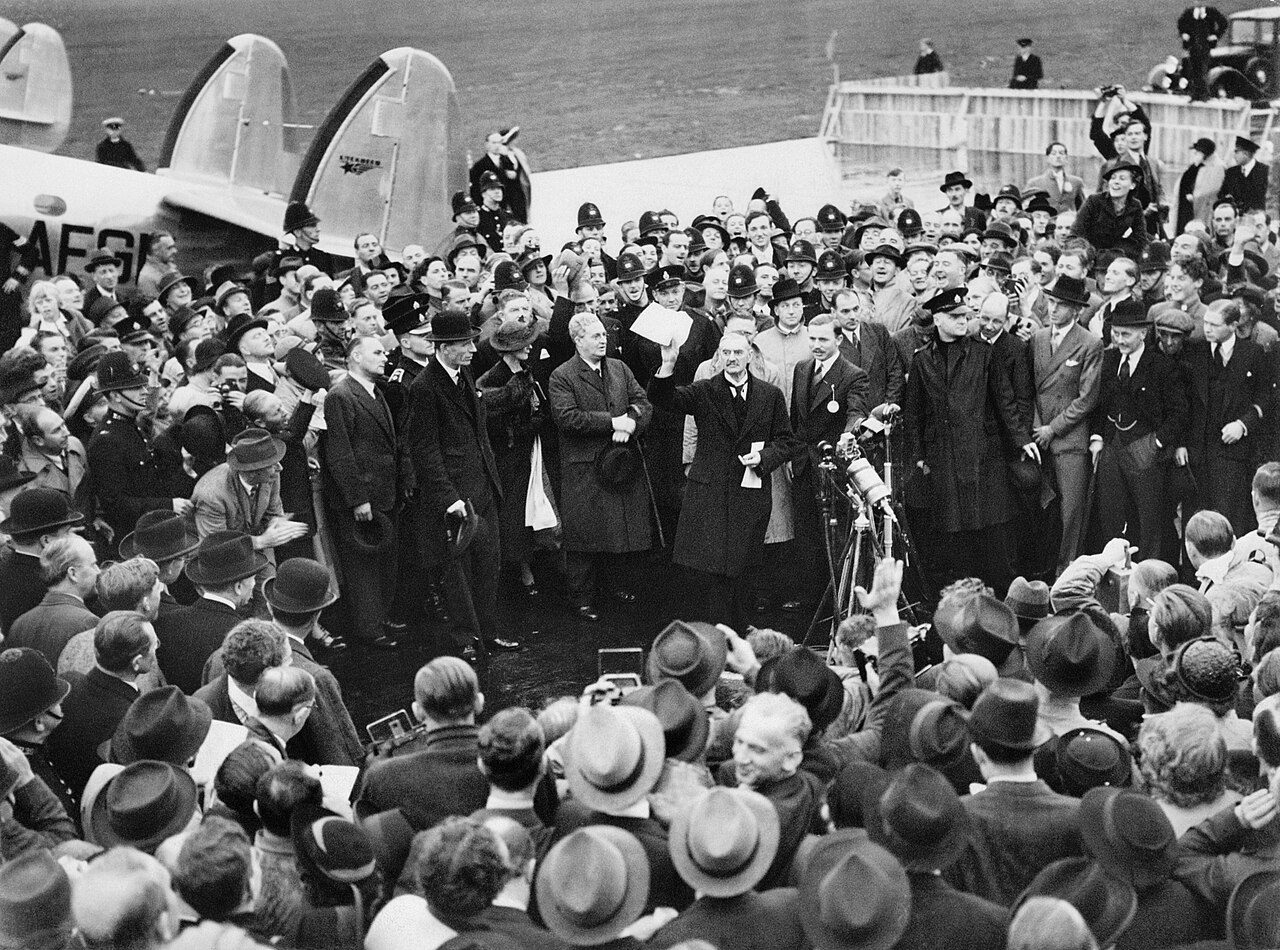
In the early hours of 30 September 1938, Britain, France, Germany and Italy signed the Munich Agreement, handing Czechoslovakia's Sudetenland to Nazi Germany without a Czechoslovak at the table; that afternoon Prime Minister Neville Chamberlain flew home, waved the paper at Heston Aerodrome, and promised 'peace for our time'. September 30 is also the day Babe Ruth hit his 60th home run, the Berlin Airlift ended, and James Dean died.
Choose another date: open the On This Day calendar to browse events, births and deaths for any day of the year.
At a Glance
- The crisis
- Hitler demanded the Sudetenland, the German-speaking borderlands of Czechoslovakia, and threatened war by 1 October 1938
- The conference
- Chamberlain, Daladier, Mussolini and Hitler met at Munich on 29 September; no Czechoslovak or Soviet representative took part
- The agreement
- Signed in the early hours of 30 September, it ceded the Sudetenland to Germany in stages during October
- The paper
- Chamberlain also obtained Hitler's signature on a short Anglo-German declaration of peaceful intent — the paper he waved on landing
- The words
- At Heston and then at Downing Street on 30 September he declared: 'I believe it is peace for our time'
- The sequel
- Germany took the rest of Czechoslovakia in March 1939; Britain and Germany were at war within eleven months
Events on this day
- 1791Mozart's last opera, The Magic Flute, is performed for the first time, in Vienna, weeks before his death.
- 1882Thomas Edison's first commercial hydroelectric power station begins operating at Appleton, Wisconsin.
- 1927Babe Ruth hits his 60th home run of the season for the New York Yankees, a record that stands for 34 years.
- 1935President Franklin D. Roosevelt dedicates the Hoover Dam on the Colorado River.
- 1938The Munich Agreement is signed, ceding the Sudetenland to Germany — the featured story above.
- 1949The Berlin Airlift ends after fifteen months, having supplied West Berlin through the Soviet blockade.
- 1954USS Nautilus, the world's first nuclear-powered submarine, is commissioned by the United States Navy.
- 1962Labour leader César Chávez founds the National Farm Workers Association in California, the seed of the United Farm Workers.
- 1968The Boeing 747, the first wide-body airliner, is rolled out to the public in Everett, Washington.
- 1982The Boston bar sitcom Cheers is broadcast for the first time.
- 2005A Danish newspaper publishes cartoons of the Prophet Muhammad, provoking protests and a worldwide debate over free expression.
Born on this day
- 1861William Wrigley Jr. — American businessman who built the Wrigley chewing-gum company.
- 1921Deborah Kerr — Scottish actress of From Here to Eternity and The King and I.
- 1924Truman Capote — American writer of Breakfast at Tiffany's and In Cold Blood.
- 1928Elie Wiesel — Romanian-born Holocaust survivor and writer of Night, Nobel Peace laureate.
- 1975Marion Cotillard — French actress, Academy Award winner for La Vie en Rose.
Died on this day
- 1770George Whitefield — English evangelist whose preaching tours helped ignite the Great Awakening in America.
- 1955James Dean — American actor killed at 24 in a car crash in California, with only East of Eden yet released.
- 1985Simone Signoret — French actress, Academy Award winner for Room at the Top.
- 2010Stephen J. Cannell — American television producer who created The Rockford Files and The A-Team.
The featured story: the Munich Agreement is signed, 30 September 1938
Munich is the twentieth century's great parable of a bargain, and it was struck by men who believed they were preventing a war, not postponing one. Through the summer of 1938 Adolf Hitler demanded the Sudetenland — Czechoslovakia's German-speaking frontier districts, which happened to contain its border fortifications and much of its industry — and set 1 October as his deadline. Britain's prime minister, Neville Chamberlain, who had never flown before that September, flew three times to Germany to negotiate, convinced that Hitler's aims were limited and that Czechoslovakia, a state created in 1919, was, as he told the British public, 'a far-away country' of people 'of whom we know nothing.'
The endgame came at Munich on 29 September 1938, where Chamberlain, France's Édouard Daladier, Italy's Benito Mussolini and Hitler settled Czechoslovakia's fate in a single day. The Czechoslovak government, whose army was mobilised and whose forts were being signed away, was not in the room; its representatives waited in a corridor to be told the result. The Soviet Union, bound by treaty to Czechoslovakia, was not invited. In the early hours of 30 September the four powers signed: Germany would occupy the Sudetenland in stages between 1 and 10 October, and Britain and France in effect guaranteed the rump state that remained — a guarantee never made good.
Before leaving Munich, Chamberlain called on Hitler privately and persuaded him to sign a short Anglo-German declaration affirming 'the desire of our two peoples never to go to war with one another again.' It was this paper — not the Munich Agreement itself — that Chamberlain waved to the crowds at Heston Aerodrome that afternoon, and read again from a Downing Street window to cheering thousands: 'My good friends, for the second time in our history, a British Prime Minister has returned from Germany bringing peace with honour. I believe it is peace for our time.' Much of Britain, terrified of bombing, received him as a saviour; Winston Churchill, in the Commons days later, called the settlement 'a total and unmitigated defeat.'
The sequel is the reason 'Munich' became a synonym for surrender. In March 1939 Hitler tore up the agreement's spirit and occupied the rest of Czechoslovakia; in September 1939 he invaded Poland and Britain and France declared the war they had bought eleven months to prepare for. Historians still argue over the purchase — whether the year gained let Britain build the fighters and radar that won in 1940, or whether 1938 offered the better chance to fight with Czechoslovakia's army and forts intact. What no one argues is the date's lesson, learned by every statesman since: an agreement is worth the intentions of the man who signs it.
Why this date matters
September 30 is the calendar's day of reckoning with bargains and machines. A dam is dedicated, a submarine commissioned, a jumbo jet unveiled — engineering's promises kept. Against them stands the century's most famous broken promise, a sheet of paper waved at an airport in 1938. Even the day's endings fit the theme of accounts coming due: an airlift honourably completed in 1949, a young actor's career closed in a California intersection in 1955. It is a date that asks what any signature, invention or reputation is finally worth.
Sources
- Encyclopaedia Britannica — On This Day: September 30
- HISTORY — This Day in History: September 30
- Wikimedia — On This Day feed: September 30
- Wikimedia Commons — File: MunichAgreement.jpg

The facts on this page were checked against these sources on 19 November 2026. The History Trail's permanent pages are researched and written for this site; the live profiles elsewhere on The History Trail are assembled automatically from Wikipedia and Wikidata.
About the Author
Researched and written by the The History Trail Editorial Team — the accountable editorial function behind this site's permanent story pages. The team works from the published sources cited on each page; it does not invent historians, reviewers or credentials, and it corrects errors openly.
Fact Check
Every load-bearing fact on this page traces to one of the sources listed above, and significant claims link to their source in the text. Our checking method is described on the methodology page; errors can be reported via the corrections page.
Sources & Citations
Cite this page as: The History Trail Editorial Team, The History Trail — this article's title, publication and update dates are shown beneath its headline. The full source list appears under Sources above; the site's source standards are on the sources page.