
Years
1861 in History
1861 is the year the American Union broke. Southern states seceded through the winter, formed the Confederate States of America at Montgomery, and on 12 April Confederate guns opened fire on Fort Sumter, beginning the American Civil War. Abraham Lincoln, inaugurated in March with seven states already gone, called for 75,000 volunteers, and in July the war's first major battle, at Bull Run, ended the North's hope of a short, gallant conflict. Abroad, Russia freed its serfs and Italy was proclaimed a kingdom.
At a Glance
- Defining event
- Confederate guns open fire on Fort Sumter, 12 April, beginning the American Civil War
- The break
- Seven states secede before Lincoln's inauguration; the Confederacy is established at Montgomery on 4 February
- The presidents
- Jefferson Davis inaugurated at Montgomery, 18 February; Abraham Lincoln inaugurated at Washington, 4 March
- The first battle
- First Bull Run, 21 July — the Union advance dissolves into a rout watched by picnicking congressmen
- Elsewhere
- Tsar Alexander II frees Russia's serfs, some 23 million people, on 3 March; the Kingdom of Italy is proclaimed on 17 March
- The wires
- The first transcontinental telegraph is completed at Salt Lake City, 24 October, effectively ending the Pony Express
The defining story: Fort Sumter and the coming of the Civil War
The break came by instalments. When Abraham Lincoln, candidate of the explicitly antislavery Republican Party, won the presidential election of 1860, Southern states began to leave: South Carolina's cadets fired on the Union steamer Star of the West in Charleston Harbor on 9 January, Alabama seceded on 11 January as the fourth state to go, and a last attempt at compromise — the Crittenden Compromise, protecting slavery in law — was defeated in the Senate on 16 January. Kansas entered the Union as a free state on 29 January, after the violent struggle of 'Bleeding Kansas'. On 4 February delegates from six seceded states met in Montgomery, Alabama, to establish the Confederate States of America; Jefferson Davis was elected provisional president on 9 February and inaugurated on 18 February, and in March the Montgomery convention adopted the Confederacy's Permanent Constitution. Lincoln, meanwhile, reached Washington secretly on 23 February after slipping through Baltimore, where an assassination plot had been uncovered — though he had paused on the way at Westfield, New York, to meet 12-year-old Grace Bedell, whose letter had advised him to grow a beard.
Two emancipations framed the American crisis from abroad. On 3 March Tsar Alexander II issued the emancipation manifesto freeing Russia's serfs — some 23 million people. The next day, 4 March, Lincoln was inaugurated as 16th president with seven states already seceded, Texas having become the seventh on 2 March; he refused to recognise secession as lawful. On 17 March the Kingdom of Italy was formally proclaimed, uniting most of the peninsula under Victor Emmanuel II — nation-making by proclamation in Europe, nation-breaking by secession in America, in the same fortnight. The question the republic had avoided since its founding — whether the Union could be dissolved at will, and whether a nation proclaimed on the equality of men could continue to hold four million people in slavery — was now to be settled by force.
In the early morning of 12 April Confederate guns opened fire on the federal garrison at Fort Sumter in Charleston Harbor. After a 34-hour bombardment Major Robert Anderson surrendered his roughly 85 soldiers to some 5,500 besieging troops — and, curiously, the first battle of the bloodiest American war killed no one. Four more Southern states joined the Confederacy; Lincoln called for 75,000 volunteers on 15 April to suppress the rebellion; Britain proclaimed neutrality on 13 May, a blow to Confederate hopes of British recognition; and Tennessee voted to secede on 8 June, the last state to join the Confederacy. The sections that now faced each other had grown into different societies: a North rapidly industrialising, with agriculture based mostly on free labour, and a South whose economy rested on plantations worked by enslaved people.
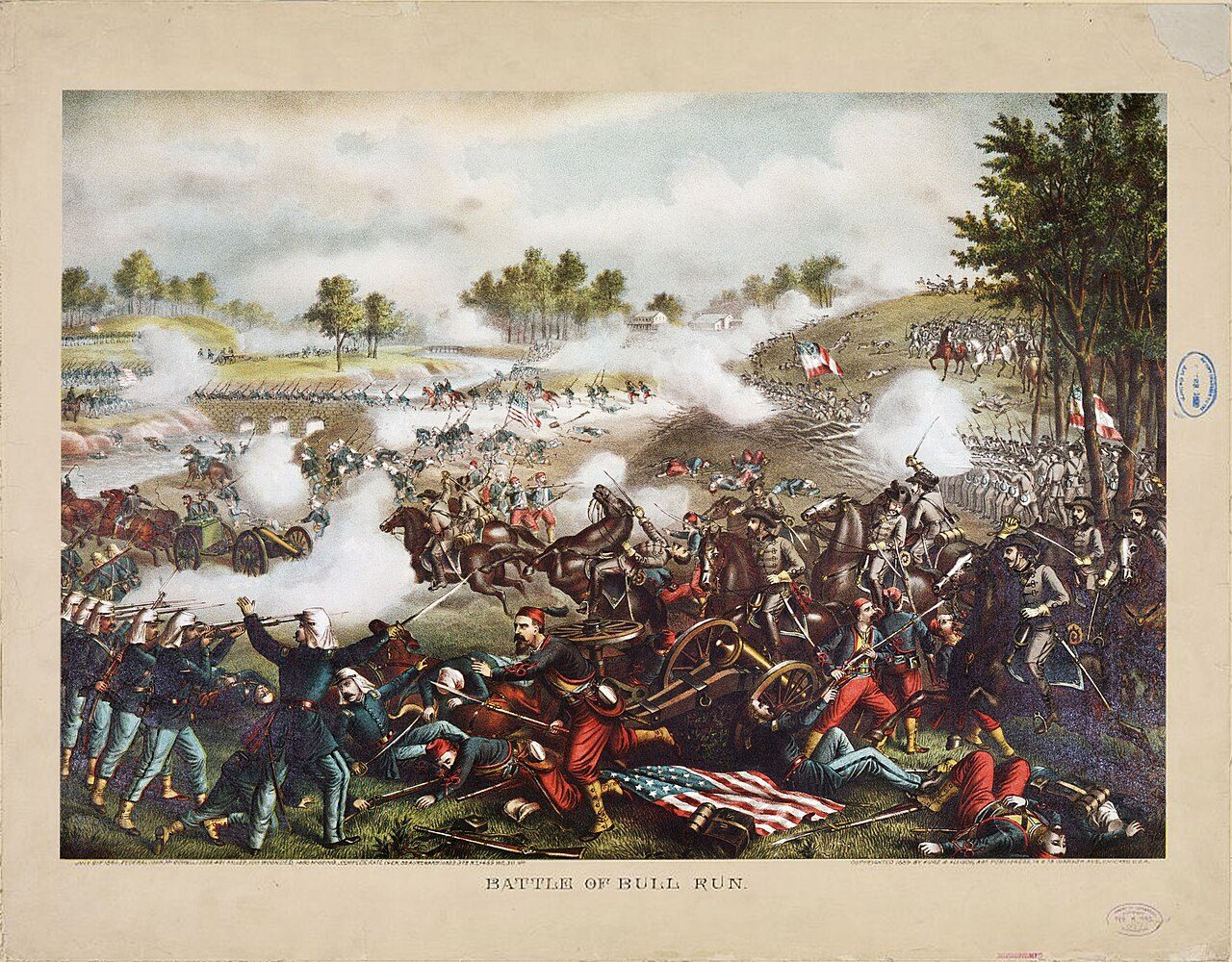
The war's first major battle destroyed the illusion that it would be short. Three months in, Union enlistments were running out — many regiments had signed for ninety days — and the newspapers demanded action: 'On to Richmond.' Lincoln, knowing his army was unready, also knew the Confederates were no readier: 'You are green, it is true, but they are green also; you are all green alike.' General Irvin McDowell marched some 35,000 men toward the railway junction at Manassas, Virginia, where General Beauregard waited behind a creek called Bull Run. The flanking attack that should have fallen at dawn on 21 July began mid-morning and still nearly worked — until Joseph E. Johnston's army arrived by train from the Shenandoah Valley, the first time in warfare that railways delivered troops directly to a battlefield, and on Henry House Hill Thomas J. Jackson set his men in line and stood, in the words that named him for life, 'like a stone wall'. The Union advance dissolved into a rout, watched by picnicking congressmen who had come out from Washington to see the victory. The year ran on into industrial war: Lincoln signed the first federal income tax in American history on 5 August, 3 percent on incomes over $800; the transcontinental telegraph was completed on 24 October; and on 7 November Ulysses S. Grant fought his first battle of the war, at Belmont, Missouri.
Timeline of 1861
- 9 January
South Carolina cadets fire on the Union steamer Star of the West in Charleston Harbor, an early shot of the coming war.
- 29 January
Kansas is admitted to the Union as the 34th state — a free state, after the violent struggle of 'Bleeding Kansas'.
- 4 February
Delegates from six seceded Southern states meet in Montgomery, Alabama, to establish the Confederate States of America.
- 18 February
Jefferson Davis is inaugurated at Montgomery as provisional president of the Confederate States.
- 3 March
Tsar Alexander II issues the emancipation manifesto freeing Russia's serfs — some 23 million people.
- 4 March
Abraham Lincoln is inaugurated as 16th president, with seven states already seceded from the Union.
- 17 March
The Kingdom of Italy is formally proclaimed, uniting most of the peninsula under Victor Emmanuel II.
- 12 April
Confederate guns open fire on Fort Sumter in Charleston Harbor, beginning the American Civil War.
- 15 April
President Lincoln calls for 75,000 volunteers to suppress the rebellion, three days after Fort Sumter.
- 8 June
Tennessee votes to secede from the Union, the last state to join the Confederacy.
- 21 July
Confederate forces win the First Battle of Bull Run, the first major battle of the Civil War.
- 5 August
Lincoln signs the first federal income tax in American history, 3 percent on incomes over $800.
- 24 October
The first transcontinental telegraph line is completed at Salt Lake City, linking America's coasts.
- 1 November
Lincoln names George B. McClellan general in chief of the Union army, replacing the aged Winfield Scott.
Why 1861 still matters
1861 still matters because it is the year two of the modern world's largest questions were put to the test of war and law at once. The American war that began at Fort Sumter became the bloodiest conflict in the nation's history: Britannica estimates that between 752,000 and 851,000 soldiers died across its four years, roughly two percent of the American population of 1860, with disease killing more men than bullets. It settled, by force, whether the Union could be dissolved at will and whether the republic could continue to hold people in slavery — and its instruments were new: railroads moving armies, the telegraph moving orders, mass-produced rifles and photography bringing the dead home. The telegraph line completed in October 1861, which effectively ended the Pony Express, was part of the same transformation that let Johnston's men reach Bull Run by train.
Set against the American break, the year's other emancipations and unifications look like the same century working by different means. Russia freed some 23 million serfs by a tsar's manifesto — reform from above, without a war; Italy proclaimed a kingdom assembled from a peninsula of states. The United States, which had compromised over slavery for forty years since the Missouri Compromise of 1820, found postponement exhausted: every settlement had held the Union together by deferring the question, and each deferral made the next crisis sharper. What 1861 decided was not the war's outcome — that took four more years — but that the questions would no longer be deferred. A republic that could not decide whether it was one nation or a league of states began, in April 1861, to answer itself at terrible cost.
1861 on The History Trail
1861 on The History Trail runs from Charleston Harbor in January to Grant's first battle in November.
- July 21 in History — the First Battle of Bull Run, the Civil War's first major battle.
- April 12 in History — Confederate guns open fire on Fort Sumter and the Civil War begins.
- March 4 in History — Lincoln is inaugurated with seven states already seceded.
- March 3 in History — Russia frees its serfs — some 23 million people.
- October 24 in History — the transcontinental telegraph is completed at Salt Lake City.
- American Civil War — the full story of the war that began in 1861.
Sources
- Encyclopaedia Britannica — On This Day: January 29
- Encyclopaedia Britannica — On This Day: February 4
- Encyclopaedia Britannica — On This Day: March 17
- Encyclopaedia Britannica — On This Day: April 12
- Encyclopaedia Britannica — On This Day: May 13
- Encyclopaedia Britannica — On This Day: June 8
The facts on this page were checked against these sources on 19 November 2026. The History Trail's permanent pages are researched and written for this site; the live profiles elsewhere on The History Trail are assembled automatically from Wikipedia and Wikidata.
About the Author
Researched and written by the The History Trail Editorial Team — the accountable editorial function behind this site's permanent story pages. The team works from the published sources cited on each page; it does not invent historians, reviewers or credentials, and it corrects errors openly.
Fact Check
Every load-bearing fact on this page traces to one of the sources listed above, and significant claims link to their source in the text. Our checking method is described on the methodology page; errors can be reported via the corrections page.
Sources & Citations
Cite this page as: The History Trail Editorial Team, The History Trail — this article's title, publication and update dates are shown beneath its headline. The full source list appears under Sources above; the site's source standards are on the sources page.