
On This Day
March 4 in History
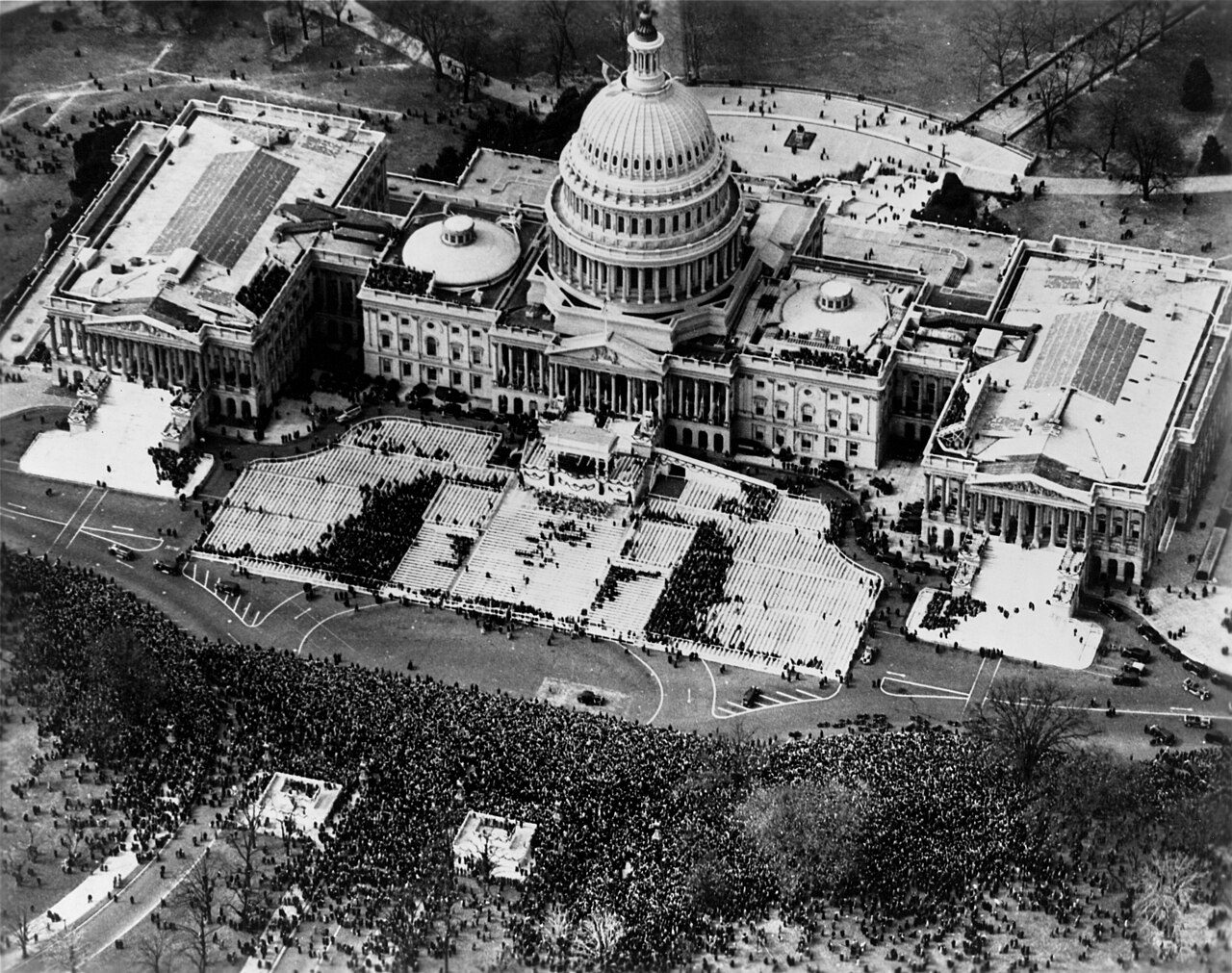
On 4 March 1933, with banks failing across the country and a quarter of the workforce idle, Franklin D. Roosevelt took the oath as the 32nd president of the United States and delivered the most famous inaugural address of the century: 'the only thing we have to fear is fear itself.' It was the last inauguration ever held on March 4. The date is also Lincoln's inauguration day, the day the Constitution took effect, and the day the 1918 flu pandemic first surfaced.
Choose another date: open the On This Day calendar to browse events, births and deaths for any day of the year.
At a Glance
- The setting
- The worst moment of the Great Depression: thousands of banks failed since 1930 and state after state declaring bank holidays
- The speech
- Roosevelt's first inaugural address, promising 'action, and action now' and naming fear itself as the enemy
- The oath
- Administered by Chief Justice Charles Evans Hughes on the east portico of the Capitol
- The ride
- Roosevelt travelled to the Capitol with the outgoing president, Herbert Hoover, in a famously frosty open car
- The date's end
- The last March 4 inauguration: the Twentieth Amendment, ratified weeks earlier, moved Inauguration Day to 20 January
- What followed
- A national bank holiday within two days, the first fireside chat within eight, and the Hundred Days of New Deal legislation
Events on this day
- 1461Edward of York is proclaimed King Edward IV in London, deposing Henry VI in the Wars of the Roses.
- 1776American troops occupy Dorchester Heights above Boston overnight, fortifying the position that will force the British to evacuate the city.
- 1789The first Congress meets in New York as the United States Constitution takes effect.
- 1829Andrew Jackson's White House 'open house' after his inauguration turns into a legendary crush of thousands of citizens.
- 1861Abraham Lincoln is inaugurated as 16th president, with seven states already seceded from the Union.
- 1918A soldier at Fort Riley, Kansas reports sick with influenza-like symptoms — among the first recorded cases of the 1918 flu pandemic.
- 1933Franklin D. Roosevelt is inaugurated as 32nd president at the depth of the Great Depression — the featured story above.
- 1944Louis 'Lepke' Buchalter, head of the Murder, Inc. enforcement syndicate, is executed at Sing Sing.
- 1952Ernest Hemingway finishes The Old Man and the Sea, writing to his publisher that it is the best writing he has ever done.
- 1966John Lennon's remark that the Beatles are 'more popular than Jesus' is published in a London newspaper, igniting a scandal months later in America.
- 1974People magazine publishes its first issue, with Mia Farrow on the cover.
- 2005Martha Stewart is released from federal prison after serving five months for lying about a stock sale.
Born on this day
- 1678Antonio Vivaldi — Italian Baroque composer of The Four Seasons, born in Venice on the day of an earthquake.
- 1888Knute Rockne — Norwegian-born coach who made Notre Dame the most famous name in American college football.
- 1913John Garfield — American actor, a brooding star of film noir who died at 39.
- 1932Miriam Makeba — South African singer who carried Xhosa and Zulu song to the world and became a voice against apartheid.
- 1954Catherine O'Hara — Canadian comic actress of SCTV, Home Alone and Schitt's Creek.
Died on this day
- 1193Saladin — the Kurdish sultan who retook Jerusalem from the Crusaders, dead in Damascus, famed even among his enemies for chivalry.
- 1852Nikolai Gogol — Ukrainian-born Russian writer of Dead Souls and 'The Overcoat', dead at 42 after days of fasting.
- 1994John Candy — Canadian comic actor of Planes, Trains and Automobiles, dead of a heart attack at 43 while filming in Mexico.
- 1996Minnie Pearl — American country comedian of the Grand Ole Opry, famous for her hat with the price tag still on it.
- 2019Luke Perry — American actor of Beverly Hills, 90210 and Riverdale, dead at 52 after a stroke.
The featured story: Franklin D. Roosevelt is inaugurated, 4 March 1933
No president has taken office in a deeper emergency. By the morning of 4 March 1933 the American banking system was collapsing state by state: governors had closed the banks in most of the union to stop panicked withdrawals, thousands of banks had failed since 1930, and an estimated quarter of the workforce was unemployed. The outgoing president, Herbert Hoover, rode to the Capitol beside his successor in near silence. On the east portico, before Chief Justice Charles Evans Hughes and a crowd standing in the rain, Franklin Delano Roosevelt — paralysed by polio, standing locked into leg braces at the lectern — took the oath and began to speak.
The address was an act of deliberate theatre against despair. 'This great Nation will endure as it has endured, will revive and will prosper,' Roosevelt said. 'So, first of all, let me assert my firm belief that the only thing we have to fear is fear itself — nameless, unreasoning, unjustified terror which paralyzes needed efforts to convert retreat into advance.' He promised action, and action now; he asked Congress for power broad enough to wage war against the emergency as if against an invading army; and he put the money changers, in the speech's biblical phrase, as having fled from their high seats in the temple of civilisation. The country, listening on the radio in bank queues and breadlines, largely believed him.
The date itself was an anachronism he was the last to use. Since George Washington's second inauguration, presidents had taken office on 4 March, leaving a four-month gap after election day in which a defeated administration lingered powerless — exactly the paralysis of the winter of 1932–33, when Hoover and Roosevelt could not agree on emergency measures and the economy slid. The Twentieth Amendment, ratified in January 1933, moved the ceremony to 20 January; it came too late to change Roosevelt's first inauguration, but in 1937 he became the first president sworn in on the new date, and no president has been inaugurated in March since.
What the speech promised, the calendar delivered. Within two days Roosevelt proclaimed a national bank holiday; within eight he was on the radio in the first fireside chat, explaining the banking crisis so calmly that deposits flowed back when the banks reopened. Congress, in the special session he summoned, passed law after law through the spring — the Hundred Days that built the New Deal's foundations. Historians still argue over the New Deal's economics. About 4 March 1933 there is less argument: it was the day American government recovered its nerve, in a single sentence about fear.
Why this date matters
March 4 was for 144 years the hinge of American power: the Constitution took effect on it in 1789, Lincoln took the oath on it in 1861 with the Union already breaking, and Roosevelt took it in 1933 with the banks closed — after which the republic decided the date itself was part of the problem and abolished it. It is fitting that the same day also carried the first whisper of the 1918 flu at Fort Riley, an emergency nobody recognised, and the births of Vivaldi and Miriam Makeba, two musicians who carried their homelands' music across the world. Handover and hazard share this date.
Sources
- Encyclopaedia Britannica — On This Day: March 4
- HISTORY — What Happened on March 4
- White House Historical Association — President Roosevelt delivers his first inaugural address
- Roosevelt House, Hunter College — Highlights From the Collection: Roosevelt Memorabilia
The facts on this page were checked against these sources on 19 November 2026. The History Trail's permanent pages are researched and written for this site; the live profiles elsewhere on The History Trail are assembled automatically from Wikipedia and Wikidata.
About the Author
Researched and written by the The History Trail Editorial Team — the accountable editorial function behind this site's permanent story pages. The team works from the published sources cited on each page; it does not invent historians, reviewers or credentials, and it corrects errors openly.
Fact Check
Every load-bearing fact on this page traces to one of the sources listed above, and significant claims link to their source in the text. Our checking method is described on the methodology page; errors can be reported via the corrections page.
Sources & Citations
Cite this page as: The History Trail Editorial Team, The History Trail — this article's title, publication and update dates are shown beneath its headline. The full source list appears under Sources above; the site's source standards are on the sources page.