
On This Day
March 5 in History
On the night of 5 March 1770, outside the Customs House on King Street in Boston, British soldiers fired into a taunting, snowball-throwing crowd and killed five colonists — the Boston Massacre, the atrocity that turned imperial argument into revolutionary grievance. March 5 is also the day Churchill described an Iron Curtain descending on Europe, and the day Stalin died.
Choose another date: open the On This Day calendar to browse events, births and deaths for any day of the year.
At a Glance
- The place
- King Street, Boston, outside the Customs House, on the night of 5 March 1770
- The spark
- Weeks of friction between Boston's crowds and the British regiments garrisoned in the town since 1768, including a brawl three days earlier
- The dead
- Five colonists: Crispus Attucks, Samuel Gray, Samuel Maverick and James Caldwell killed that night, and Patrick Carr, who died of his wounds days later
- The trial
- Captain Thomas Preston and most of his men were acquitted; two soldiers were convicted of manslaughter. Their lawyer was John Adams
- The image
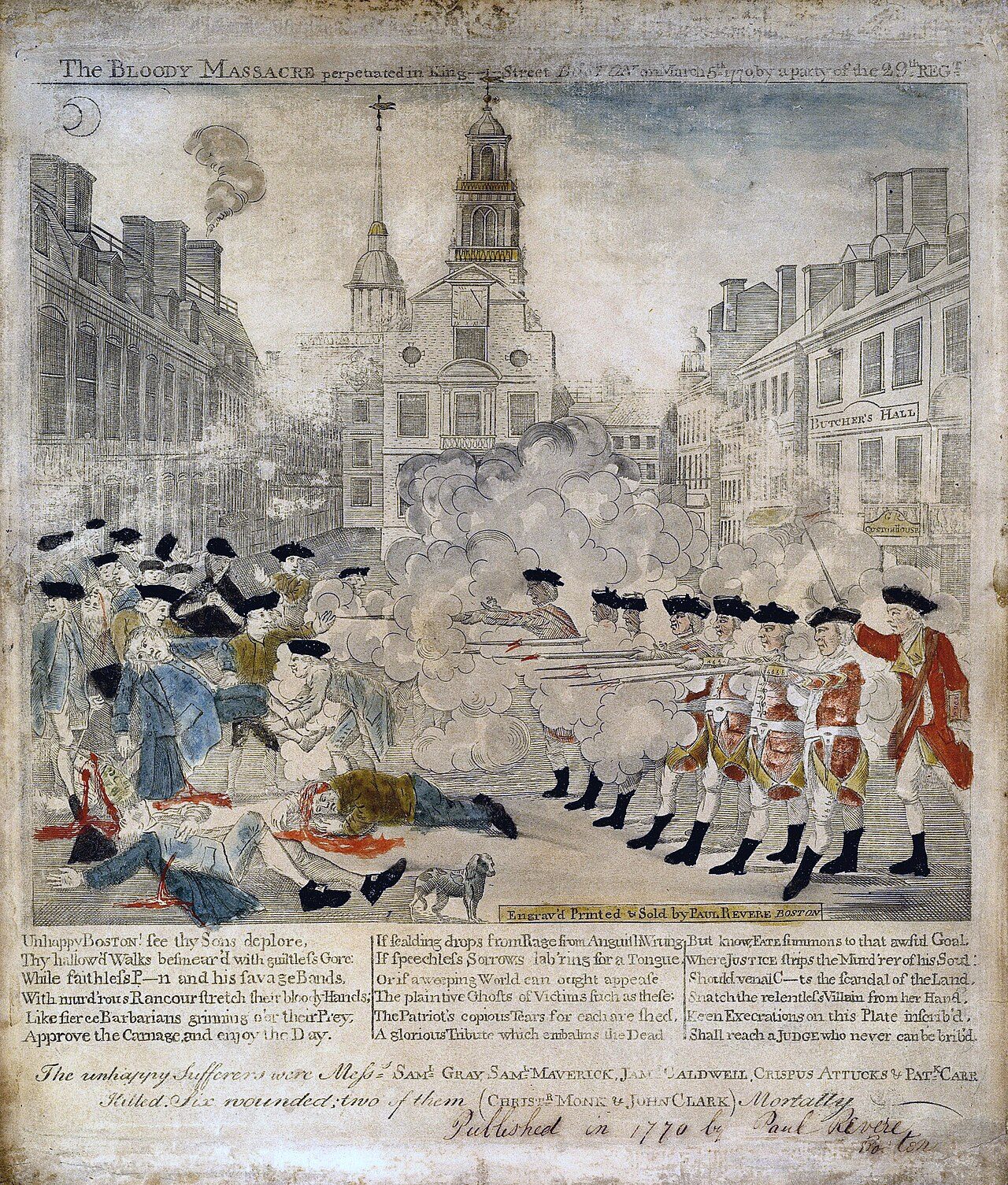
- Paul Revere's engraving of the shooting, sold within weeks, fixed the event in the colonies' imagination as a massacre
Events on this day
- 1770British soldiers fire on a crowd on King Street in Boston, killing five colonists in the Boston Massacre — the featured story above.
- 1839Charlotte Brontë writes to decline a marriage proposal from the Reverend Henry Nussey, choosing the hard life of a governess and writer instead.
- 1868The impeachment trial of President Andrew Johnson opens in the U.S. Senate, the first presidential impeachment trial in American history.
- 1908Ernest Shackleton's Nimrod expedition party sets out from its Antarctic base to climb Mount Erebus, the world's southernmost active volcano, reaching the summit five days later.
- 1917Swedish prime minister Hjalmar Hammarskjöld resigns, his strict neutrality policy in the First World War having brought hunger and unrest to Sweden.
- 1946Winston Churchill, speaking at Fulton, Missouri with President Truman beside him, declares that an 'iron curtain' has descended across Europe.
- 1953Joseph Stalin, ruler of the Soviet Union for three decades, dies in Moscow.
- 1960Alberto Korda photographs Ernesto 'Che' Guevara at a Havana memorial service, taking the image that becomes the most famous portrait of the revolutionary.
- 1963The Hula Hoop is patented by Arthur Melin of Wham-O, five years after the toy became a craze that sold an estimated 25 million hoops in four months.
- 1966Marvin Miller is elected the first full-time executive director of the Major League Baseball Players Association, beginning the union era in American sport.
Born on this day
- 1871Rosa Luxemburg — Polish-German Marxist theorist and revolutionary, murdered in Berlin in 1919.
- 1887Heitor Villa-Lobos — Brazilian composer who fused European forms with his country's folk music in more than 2,000 works.
- 1897Soong Mei-ling — Chinese political figure, wife of Chiang Kai-shek and a formidable diplomat in her own right.
- 1898Zhou Enlai — premier of the People's Republic of China from 1949 until his death in 1976.
- 1908Rex Harrison — English actor of My Fair Lady, on stage and screen.
- 1922Pier Paolo Pasolini — Italian poet and filmmaker whose work scandalised and electrified postwar Italy.
Died on this day
- 1953Joseph Stalin — Soviet dictator whose purges, camps and forced collectivisation killed millions, dead the same day as the composer he had tormented.
- 1953Sergei Prokofiev — Russian composer of Peter and the Wolf and Romeo and Juliet, whose death on the same day as Stalin's went almost unreported.
- 1963Patsy Cline — American country singer of 'Crazy' and 'I Fall to Pieces', killed in a plane crash at 30.
- 1982John Belushi — American comedian of Saturday Night Live and The Blues Brothers, dead of an overdose at 33.
- 2013Hugo Chávez — Venezuelan president whose 'Bolivarian revolution' reshaped his country, dead in office at 58.
The featured story: the Boston Massacre, 5 March 1770
Boston in 1770 was an occupied town in all but name. Some 2,000 British soldiers were garrisoned among 16,000 Bostonians to enforce Parliament's taxes, competing with locals for work and trading insults, brawls and worse — three days before, a fight between soldiers and ropemakers had left men on both sides nursing injuries. On the evening of 5 March a young apprentice berated a British officer over an unpaid bill; a sentry outside the Customs House struck the boy with his musket butt, and a crowd gathered, growing, jeering, pelting the lone soldier with snowballs, ice and oyster shells. The church bells that signalled fire rang out across the town, bringing more people into King Street.
Captain Thomas Preston marched a relief party of seven men to the sentry's aid and found himself ringed by a crowd of several hundred, daring the soldiers to fire. Something — a thrown club, a blow that knocked one soldier down — broke the standoff: shots rang out, whether ordered or not was never proved. Three colonists died where they stood: Crispus Attucks, a sailor of African and Native American descent; Samuel Gray; and Samuel Maverick, aged seventeen. James Caldwell died that night, and Patrick Carr lingered nine days before dying of his wound. Six more were wounded. The town's radicals, Samuel Adams foremost among them, had their atrocity, and Paul Revere's engraving — soldiers in a neat line, firing on command into a peaceful crowd — carried their version of it to every colony.
The trials that autumn were the event's most surprising act. John Adams, a patriot but a lawyer first, defended Preston and the soldiers, arguing that a mob had provoked them and that law, not vengeance, should decide. Preston and six men were acquitted; two soldiers, found to have fired into the crowd, were convicted of manslaughter and branded on the thumb. Adams later called the defence one of the most gallant and generous acts of his life. The verdicts calmed Boston for a season, but the funerals of the five — a procession of thousands — and the annual Massacre Day orations kept the grievance lit for five years, until the argument of King Street was settled by muskets at Lexington.
The massacre's arithmetic is small — five dead in a street fight that span out of control — and its consequences were not. It gave the American cause its first martyrs, Attucks chief among them, and a vocabulary: 'massacre' was the word the patriot press chose, and it stuck for 250 years. What happened on 5 March 1770 was less a battle than a warning of what happens when soldiers police civilians in a city that hates their presence — a lesson the empire learned too late.
Why this date matters
March 5 is the calendar's day for crowds and the men who face them. A Boston crowd faced muskets on it in 1770; Churchill used it in 1946 to name the crowd's opposite — a curtain, a continent divided by force; and on it in 1953 the century's most feared ruler died in private, his death announced to a crowd of millions who had been trained to mourn him. Even its quieter entries run on the theme: an impeachment trial opening in 1868, a photograph of Che Guevara taken in 1960 that would be carried by crowds for decades. Power and the street keep their appointments on March 5.
Sources
- Encyclopaedia Britannica — On This Day: March 5
- HISTORY — What Happened on March 5
- Massachusetts Historical Society — The Bloody Massacre perpetrated in King Street
- Colonial Williamsburg — The Bloody Massacre Perpetrated in King Street (object record)
The facts on this page were checked against these sources on 19 November 2026. The History Trail's permanent pages are researched and written for this site; the live profiles elsewhere on The History Trail are assembled automatically from Wikipedia and Wikidata.
About the Author
Researched and written by the The History Trail Editorial Team — the accountable editorial function behind this site's permanent story pages. The team works from the published sources cited on each page; it does not invent historians, reviewers or credentials, and it corrects errors openly.
Fact Check
Every load-bearing fact on this page traces to one of the sources listed above, and significant claims link to their source in the text. Our checking method is described on the methodology page; errors can be reported via the corrections page.
Sources & Citations
Cite this page as: The History Trail Editorial Team, The History Trail — this article's title, publication and update dates are shown beneath its headline. The full source list appears under Sources above; the site's source standards are on the sources page.