
On This Day
March 8 in History
On 8 March 1917 — 23 February by the calendar Russia still used — women textile workers in Petrograd poured into the streets demanding bread and peace, and within days their strike had become the February Revolution: soldiers mutinied, the Duma defied the tsar, and Nicholas II abdicated, ending three centuries of Romanov rule. March 8 is also the day of the first Marines landing at Da Nang, the Fight of the Century, and the disappearance of flight MH370.
Choose another date: open the On This Day calendar to browse events, births and deaths for any day of the year.
At a Glance
- The date
- 8 March 1917 in the Gregorian calendar; 23 February in Russia's Julian calendar — hence the 'February' Revolution
- The spark
- International Women's Day: women textile workers struck and marched over bread shortages and wartime rationing in Petrograd
- The escalation
- Factory workers joined in their tens of thousands; within days the Petrograd garrison's soldiers mutinied rather than fire on the crowds
- The fall
- Nicholas II abdicated on 15 March (Gregorian), ending the Romanov dynasty after 304 years
- The result
- A Provisional Government shared uneasy power with the Petrograd Soviet — the 'dual power' that collapsed into the October Revolution
Events on this day
- 1702Queen Anne takes the English throne on the death of William III, the last Stuart monarch to reign.
- 1782Pennsylvania militiamen murder 96 Christian Delaware Indians at the Moravian mission village of Gnadenhutten in the Gnadenhutten massacre.
- 1817The New York Stock & Exchange Board is formally established — the body that becomes the New York Stock Exchange.
- 1855The first train crosses John Roebling's Niagara suspension bridge, a locomotive and tender of some 23 tons rumbling over the gorge.
- 1917Strikes and demonstrations in Petrograd begin the February Revolution that will topple the tsar — the featured story above.
- 1918The Bolshevik Party formally renames itself the Russian Communist Party.
- 1942Japanese forces capture Rangoon in Burma; the same day, Dutch forces surrender Java in the East Indies.
- 1965The first U.S. combat troops arrive in Vietnam, as Marines land at Da Nang to defend its air base.
- 1971Joe Frazier defeats Muhammad Ali in the 'Fight of the Century' at Madison Square Garden, the first loss of Ali's career.
- 1979Philips and Sony publicly present the compact disc, the first digital audio format aimed at the mass market.
- 1983President Ronald Reagan calls the Soviet Union an 'evil empire' in a speech to evangelical Christians in Orlando.
- 2014Malaysia Airlines flight MH370 disappears on a flight from Kuala Lumpur to Beijing with 239 people aboard, beginning aviation's greatest modern mystery.
Born on this day
- 1841Oliver Wendell Holmes Jr. — American jurist, the 'Great Dissenter' of the U.S. Supreme Court.
- 1859Kenneth Grahame — Scottish author of The Wind in the Willows.
- 1943Lynn Redgrave — English actress of Georgy Girl and Gods and Monsters.
- 1945Micky Dolenz — American singer and drummer of the Monkees.
- 1958Gary Numan — English electronic musician of 'Cars' and Tubeway Army.
- 1976Freddie Prinze Jr. — American actor of She's All That and I Know What You Did Last Summer.
Died on this day
- 1869Hector Berlioz — French composer of the Symphonie fantastique, dead in Paris.
- 1874Millard Fillmore — 13th president of the United States, the last Whig to hold the office.
- 1917Ferdinand von Zeppelin — German count whose rigid airships bore his name, dead in Berlin as his creations bombed London.
- 1930William Howard Taft — the only man to serve as both U.S. president and chief justice, dead in Washington.
- 1999Joe DiMaggio — American baseball immortal of the 56-game hitting streak, dead at 84.
- 2016George Martin — English record producer who signed the Beatles and shaped their sound, dead at 90.
The featured story: the February Revolution begins, 8 March 1917
Petrograd was cold, hungry and tired of war. By the winter of 1916–17 the First World War had killed millions of Russian soldiers, the railways were failing, and the capital's bakeries could not keep bread in the shops; queues formed before dawn and sometimes dissolved into riots. On 8 March 1917 — International Women's Day, and 23 February by the Julian calendar Russia still used — the women of the city's textile mills made the queue into a movement. Thousands struck and marched, calling for bread and an end to the war, and they pulled the great Putilov engineering works and factory after factory out behind them. By the next day an estimated 200,000 workers were on strike, and the demonstrations had turned political: down with the tsar.
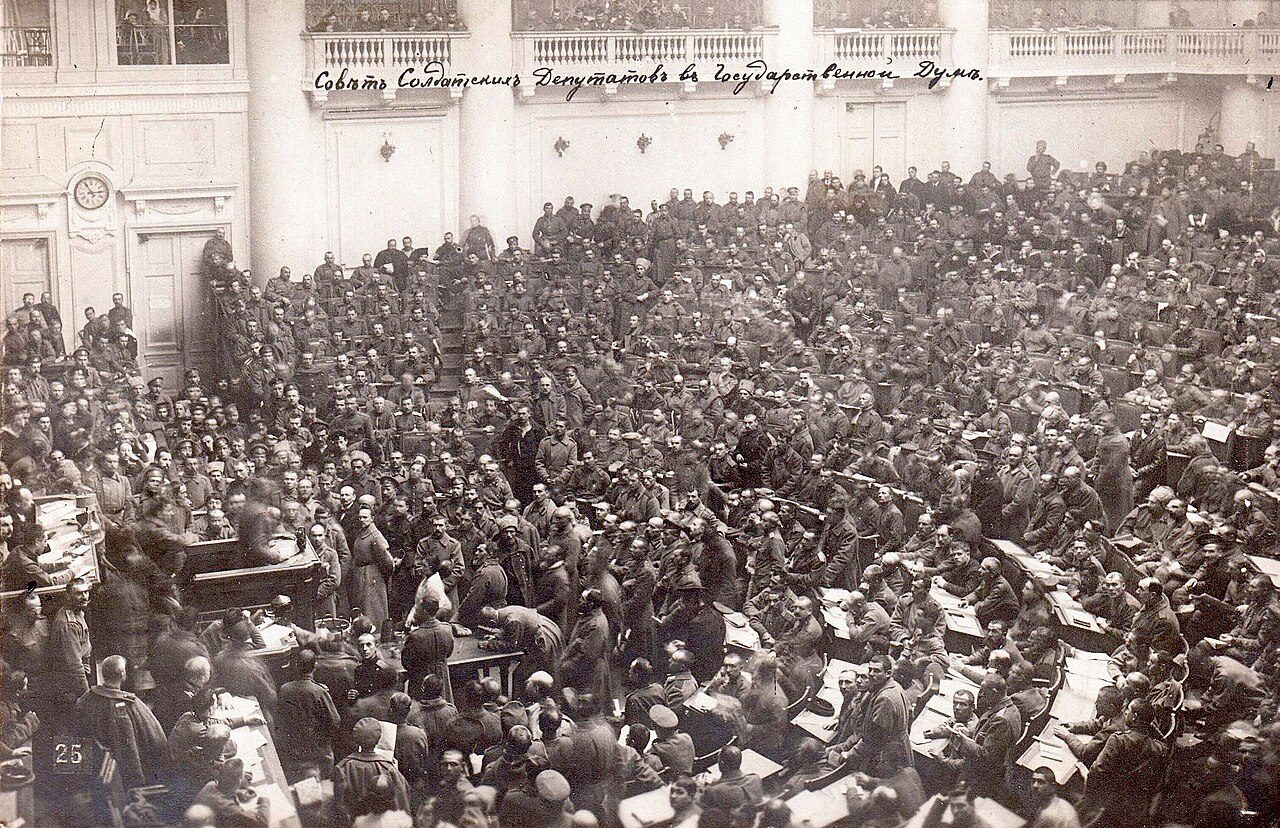
What made the February Revolution unstoppable was the soldiers. The Petrograd garrison — mostly raw recruits and convalescents — was ordered to clear the streets; on 11 March some units fired on the crowds, and that night the regiments began to mutiny, shooting officers who ordered them out and joining the demonstrations instead. A Soviet of workers' and soldiers' deputies formed in the Tauride Palace; in the same building, the Duma — the parliament the tsar had ordered dissolved — refused to disperse and appointed a Provisional Committee. Russia had two governments in one palace and an emperor stranded by rail strikes at his army headquarters, unable even to reach his capital.
On 15 March, in a railway carriage at Pskov, Nicholas II abdicated for himself and his haemophiliac son, passing the throne to his brother, who declined it the next day. The Romanov dynasty, which had ruled Russia for 304 years, ended not with an assault on the palace but with signatures and shrugs, a week after the women textile workers walked out. The Provisional Government that replaced it promised elections and continued the war; the Soviet, commanding the garrison and the factories, let it govern on sufferance. That unstable 'dual power' — a liberal government with authority and a socialist soviet with power — lasted eight months, until Lenin's Bolsheviks dissolved the arrangement in October.
The February Revolution is the rare revolution that genuinely began from below: no party planned it, the Bolsheviks' leaders were in exile or Siberia, and its first movers were working women demanding bread. Its lesson ran through the century that followed — regimes rarely fall when their enemies are strongest, but when their own soldiers will no longer fire. On 8 March 1917 the tsar's soldiers made that choice, and an empire older than the United States was gone in a week.
Why this date matters
March 8 is International Women's Day, and its history keeps the theme: in 1917 the women of Petrograd quite literally started the revolution that ended an empire, demanding bread on the day set aside for them. The rest of the date is about contests of legitimacy — a throne passing to Anne in 1702, an exchange incorporating itself in 1817, Ali losing for the first time in 1971, a president naming an 'evil empire' in 1983, and an airliner vanishing in 2014 into a mystery no authority has solved. Crowds, crowns and unanswered questions: March 8 rarely does quiet.
Sources
- Encyclopaedia Britannica — On This Day: March 8
- HISTORY — This Day in History: March 8
- Wikipedia — March 8
- Wikipedia — March 8
The facts on this page were checked against these sources on 19 November 2026. The History Trail's permanent pages are researched and written for this site; the live profiles elsewhere on The History Trail are assembled automatically from Wikipedia and Wikidata.
About the Author
Researched and written by the The History Trail Editorial Team — the accountable editorial function behind this site's permanent story pages. The team works from the published sources cited on each page; it does not invent historians, reviewers or credentials, and it corrects errors openly.
Fact Check
Every load-bearing fact on this page traces to one of the sources listed above, and significant claims link to their source in the text. Our checking method is described on the methodology page; errors can be reported via the corrections page.
Sources & Citations
Cite this page as: The History Trail Editorial Team, The History Trail — this article's title, publication and update dates are shown beneath its headline. The full source list appears under Sources above; the site's source standards are on the sources page.