
Years
1851 in History
1851 is remembered for display and print: on 1 May Queen Victoria opened the Great Exhibition at the Crystal Palace in London, the first world's fair, visited by some six million people. In September a sober penny paper, the New-York Daily Times, appeared in New York, and weeks later Herman Melville's Moby-Dick reached readers on both sides of the Atlantic — while gold found near Bathurst set off the Australian gold rushes.
At a Glance
- Defining event
- Queen Victoria opens the Great Exhibition at the Crystal Palace, 1 May 1851
- A paper is born
- First issue of the New-York Daily Times, 18 September — the future New York Times
- Gold rush
- Edward Hargraves finds gold near Bathurst, New South Wales, 12 February
- A novel lands
- Moby-Dick published in London as The Whale, 18 October, and in America, 14 November
- Industry at home
- Isaac Singer patents his sewing machine, 12 August
- Closed the year
- Fire guts about two-thirds of the Library of Congress's 55,000 volumes, 24 December
The defining story: the world on display, and a paper of record
The year opened in grief and gold. Mary Shelley, the author of Frankenstein, died in London on 1 February at 53. Eleven days later Edward Hargraves found gold near Bathurst in New South Wales, setting off the Australian gold rushes that would draw fortune-hunters from around the world and remake the colonies. Between those two February days the century's two impulses — imagination and extraction — were already running side by side.
On 1 May Queen Victoria opened the Great Exhibition at the Crystal Palace in London. It was the first world's fair, a glasshouse of industry and empire visited by some six million people, and it announced that manufactured things, shown well, could be a spectacle in themselves. The summer carried the theme into ordinary life: Britain abolished the Window Tax on 24 July, a levy in force since 1696 that had led generations of householders to brick up their windows, and on 12 August Isaac Singer patented the sewing machine design that made machine sewing practical in homes and factories alike.
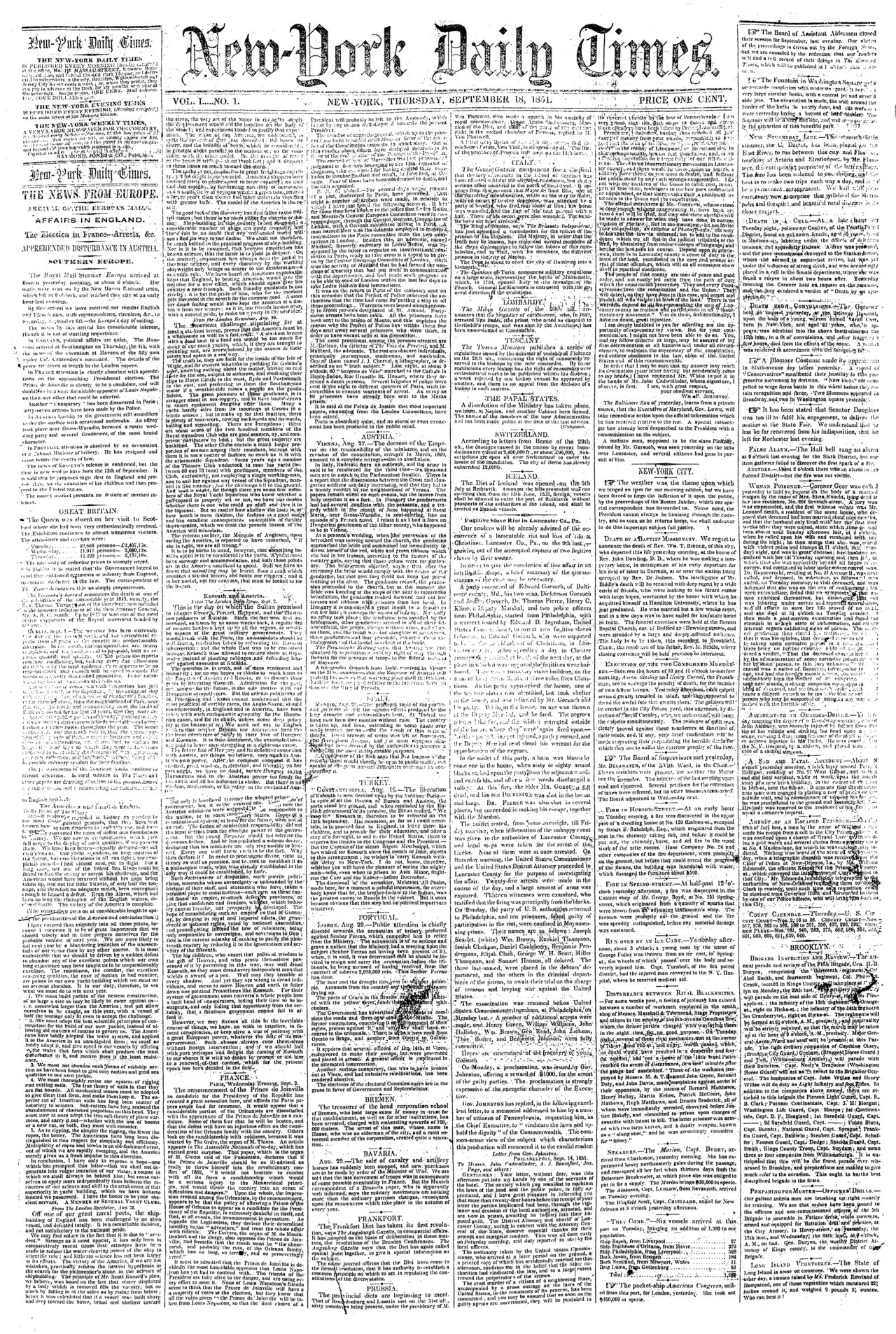
The autumn belonged to print and resistance. On 11 September, in the Christiana Resistance in Pennsylvania, Black residents and white abolitionists fought off a Maryland slaveholder's posse seeking four fugitive enslaved men. A week later, on 18 September, Henry Jarvis Raymond and George Jones published the first issue of the New-York Daily Times from Nassau Street: four pages, one cent, made up the night before in unfinished lofts by candlelight. Deliberately sober against rivals built on sensation and abuse, it pledged to cover every subject of public importance — the standard of the paper that became The New York Times.
Print closed the year in two registers. Melville's Moby-Dick appeared in London on 18 October under the title The Whale, and in the United States on 14 November; it sold poorly and was recognised as a masterpiece only after its author's death. Then, on Christmas Eve, fire destroyed about two-thirds of the Library of Congress's 55,000 volumes, including most of Thomas Jefferson's personal library, sold to the nation in 1815 — a reminder of how easily the printed record itself could vanish.
Timeline of 1851
- 1 February
Mary Shelley, English novelist and author of Frankenstein, dies in London at 53.
- 12 February
Edward Hargraves finds gold near Bathurst, New South Wales, setting off the Australian gold rushes.
- 1 May
Queen Victoria opens the Great Exhibition at the Crystal Palace in London, the first world's fair, visited by some six million people.
- 29 May
Sojourner Truth delivers her famous speech to the Ohio Women's Rights Convention in Akron.
- 10 July
Louis Daguerre, French inventor of the daguerreotype, the first practical photographic process, dies.
- 24 July
Britain abolishes the Window Tax, in force since 1696.
- 12 August
Isaac Singer patents his sewing machine, making machine sewing practical in homes and factories.
- 11 September
In the Christiana Resistance in Pennsylvania, Black residents and white abolitionists fight off a slaveholder's posse seeking four fugitive enslaved men.
- 13 September
Walter Reed, the American army physician who later proved yellow fever is carried by mosquitoes, is born.
- 18 September
The first issue of the New-York Daily Times is published in New York City.
- 18 October
Herman Melville's Moby-Dick is published in London under the title The Whale.
- 6 November
Charles Dow, co-founder of Dow Jones and creator of its Industrial Average, is born.
- 14 November
Moby-Dick is published in the United States; it sells poorly in Melville's lifetime.
- 24 December
Fire destroys about two-thirds of the Library of Congress's 55,000 volumes.
Why 1851 still matters
The Great Exhibition invented a genre: the world's fair, in which nations competed by displaying industry rather than only by arms, and its six million visitors made it a mass event, not a court one. Singer's patent pushed the same industrial logic into the home and the clothing factory, while the end of the Window Tax quietly admitted that a tax could darken a country's houses for a century and a half.
The year's print endured longest. The New-York Daily Times grew into The New York Times, a paper whose standard — complete without being shrill — was set in its first, imperfectly printed issue. Moby-Dick took the opposite path, failing commercially and rising after Melville's death to stand among the greatest American novels. Charles Dow and Melvil Dewey, both born in 1851, would later organise the world's markets and its libraries respectively.
The Christiana Resistance matters because it showed, a decade before civil war, that slavery's enforcement could be met with organised, armed refusal in the North itself. And Sojourner Truth's Akron speech remains a landmark of the women's rights movement — with a caution attached: the published version never contained the famous phrase 'Ain't I a Woman?', however firmly later memory attached it to her.
1851 on The History Trail
The Great Exhibition leads this year on The History Trail, with the birth of a newspaper and a novel alongside it.
- May 1 in History — Queen Victoria opens the Great Exhibition at the Crystal Palace.
- September 18 in History — The New-York Daily Times publishes its first issue.
- February 12 in History — Edward Hargraves finds gold near Bathurst, starting the Australian gold rushes.
- November 14 in History — Moby-Dick is published in the United States.
- August 12 in History — Isaac Singer patents his sewing machine.
- Moby-Dick — Melville's novel, published in London and America in the autumn of 1851.
Sources
- Encyclopaedia Britannica — On This Day: May 1
- Encyclopaedia Britannica — On This Day: September 18
- Encyclopaedia Britannica — On This Day: February 12
- Wikimedia — On This Day feed: November 14
- Encyclopaedia Britannica — On This Day: September 11
- Encyclopaedia Britannica — On This Day: December 24
The facts on this page were checked against these sources on 19 November 2026. The History Trail's permanent pages are researched and written for this site; the live profiles elsewhere on The History Trail are assembled automatically from Wikipedia and Wikidata.
About the Author
Researched and written by the The History Trail Editorial Team — the accountable editorial function behind this site's permanent story pages. The team works from the published sources cited on each page; it does not invent historians, reviewers or credentials, and it corrects errors openly.
Fact Check
Every load-bearing fact on this page traces to one of the sources listed above, and significant claims link to their source in the text. Our checking method is described on the methodology page; errors can be reported via the corrections page.
Sources & Citations
Cite this page as: The History Trail Editorial Team, The History Trail — this article's title, publication and update dates are shown beneath its headline. The full source list appears under Sources above; the site's source standards are on the sources page.