
On This Day
September 18 in History
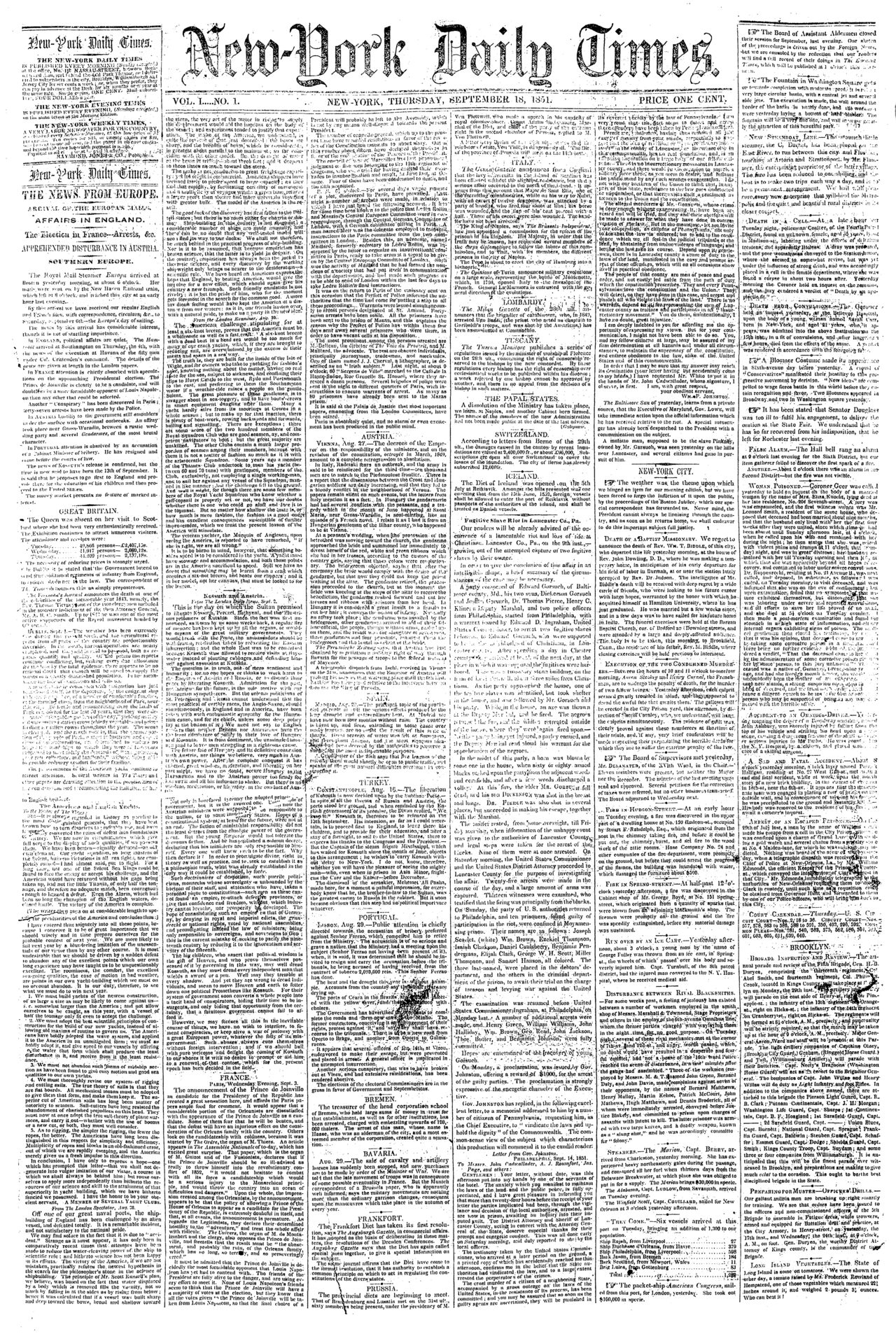
On 18 September 1851 a four-page penny newspaper called the New-York Daily Times, put together by candlelight in unfinished lofts on Nassau Street, appeared on the streets of New York — the first issue of the paper the world now knows as The New York Times. September 18 is also the day George Washington laid the cornerstone of the US Capitol, the CIA came into being, and Jimi Hendrix and Ruth Bader Ginsburg died.
Choose another date: open the On This Day calendar to browse events, births and deaths for any day of the year.
At a Glance
- The founders
- Journalist Henry Jarvis Raymond and banker George Jones, both formerly of Horace Greeley's New-York Tribune
- The paper
- The New-York Daily Times — four pages, priced at one cent, published every morning except Sundays
- The office
- A basement and lofts at 113 Nassau Street in lower Manhattan, where the first issue was made up the night of 17 September
- The name
- Shortened to The New-York Times in 1857; the hyphen was dropped in 1896, the year Adolph Ochs bought the paper
- The motto
- 'All the News That's Fit to Print', coined by Ochs, has stood on the front page since 1897
Events on this day
- 1793President George Washington, in Masonic regalia, lays the cornerstone of the United States Capitol in Washington, D.C.
- 1810A junta takes power in Santiago, the first step in Chile's independence from Spain, still celebrated as the start of the Fiestas Patrias.
- 1837Charles Lewis Tiffany and John B. Young open a stationery and fancy-goods store in New York — the beginning of Tiffany & Co.
- 1850Congress passes the Fugitive Slave Act, requiring the return of escaped enslaved people and penalising officials who refused to cooperate.
- 1851The first issue of the New-York Daily Times is published in New York City — the featured story above.
- 1927The Columbia Broadcasting System — CBS — makes its first broadcast, beginning as a radio network of sixteen stations.
- 1947The Central Intelligence Agency formally comes into existence under the National Security Act, and the US Air Force becomes an independent service.
- 1975Newspaper heiress Patty Hearst, kidnapped nineteen months earlier by the Symbionese Liberation Army, is arrested in San Francisco.
- 2014Scotland votes in an independence referendum, choosing by 55 to 45 percent to remain within the United Kingdom.
Born on this day
- 1709Samuel Johnson — English lexicographer whose Dictionary of 1755 set the standard for English, and the subject of Boswell's great biography.
- 1905Greta Garbo — Swedish-American film star of Anna Karenina and Ninotchka, the most enigmatic face of early Hollywood.
- 1971Jada Pinkett Smith — American actress and talk-show host, star of the Matrix sequels and Girls Trip.
- 1976Ronaldo Nazário — Brazilian footballer, 'O Fenômeno', a two-time World Cup winner and three-time world player of the year.
Died on this day
- 1180Louis VII — king of France for 43 years, crusader and first husband of Eleanor of Aquitaine.
- 1830William Hazlitt — English essayist and critic, one of the greatest prose stylists of the Romantic age.
- 1961Dag Hammarskjöld — secretary-general of the United Nations, killed in a plane crash in Northern Rhodesia while on a Congo peace mission.
- 1970Jimi Hendrix — American guitarist who reinvented the electric guitar, dead in London at 27.
- 2020Ruth Bader Ginsburg — associate justice of the US Supreme Court for 27 years and a leading voice on gender equality, dead at 87.
The featured story: The New York Times publishes its first issue, 18 September 1851
New York in 1851 was already a newspaper town of ferocious competition, where the Herald, the Tribune and the Sun fought for readers with sensation, politics and abuse. Into this market, on the morning of Thursday 18 September 1851, stepped a deliberately sober challenger: the New-York Daily Times, four pages at a penny a copy, founded by the journalist Henry Jarvis Raymond and the banker George Jones with $100,000 of capital. As the Smithsonian's history of the paper records, the first number was made up the night before in unfinished lofts at 113 Nassau Street, by candlelight, and printed on a new press in the basement — imperfectly, as the publishers admitted to their first readers, asking indulgence for an uneven first impression.
Raymond — a former lieutenant governor of New York and a founder-to-be of the Republican Party — set the paper's tone in its prospectus: it would report all subjects of public importance, avoid the personal warfare of its rivals, and be conservative in temper without being timid. The paper backed the Union through the Civil War, and in the 1870s won national standing with its relentless exposure of the Tweed Ring, the corrupt Democratic machine that had looted New York City — a campaign that helped send Boss Tweed to prison and established the Times as a paper whose facts could move governments.
By the 1890s, overextended and losing money, the paper was bought for $1 million in 1896 by Adolph Ochs, a publisher from Chattanooga. Ochs dropped 'Daily' from the name, cut the price, refused the yellow journalism then at its height, and put his famous promise on the front page: 'All the News That's Fit to Print.' Under Ochs and his descendants the paper grew into what its 175th-anniversary history calls a record of some 15 million articles — the self-styled paper of record for the United States, through world wars, the Pentagon Papers, and the digital transformation that carried it from Nassau Street's basement to a global subscription audience.
The first issue itself is a period piece: its front page carries no news at all, being filled, by the custom of the day, with advertisements and shipping notices. What Raymond and Jones were selling was not a layout but a standard — that a newspaper could be complete without being shrill. A century and three quarters later, through 61,000 editions, the standard is still the paper's argument for itself, and it began, fittingly, with an apology for the printing.
Why this date matters
September 18 is a day of institutions beginning and giants ending. A president laid a cornerstone in 1793 for a Capitol that still houses a legislature; two newspapermen launched a penny paper in 1851 that became a byword for the record itself; and the modern American security state quietly switched on in 1947. The same date closed the lives of Jimi Hendrix, who burned through music in four years, and of Ruth Bader Ginsburg, who spent a lifetime bending the law toward equality. Beginnings on this date tend to be modest — a stone, a four-page sheet — and outlast everyone.
Sources
- Encyclopaedia Britannica — On This Day: September 18
- HISTORY — This Day in History: September 18
- Smithsonian Magazine — The 175-Year History of the 'New York Times'
- Wikimedia — On This Day feed: September 18
The facts on this page were checked against these sources on 19 November 2026. The History Trail's permanent pages are researched and written for this site; the live profiles elsewhere on The History Trail are assembled automatically from Wikipedia and Wikidata.
About the Author
Researched and written by the The History Trail Editorial Team — the accountable editorial function behind this site's permanent story pages. The team works from the published sources cited on each page; it does not invent historians, reviewers or credentials, and it corrects errors openly.
Fact Check
Every load-bearing fact on this page traces to one of the sources listed above, and significant claims link to their source in the text. Our checking method is described on the methodology page; errors can be reported via the corrections page.
Sources & Citations
Cite this page as: The History Trail Editorial Team, The History Trail — this article's title, publication and update dates are shown beneath its headline. The full source list appears under Sources above; the site's source standards are on the sources page.