
On This Day
August 12 in History
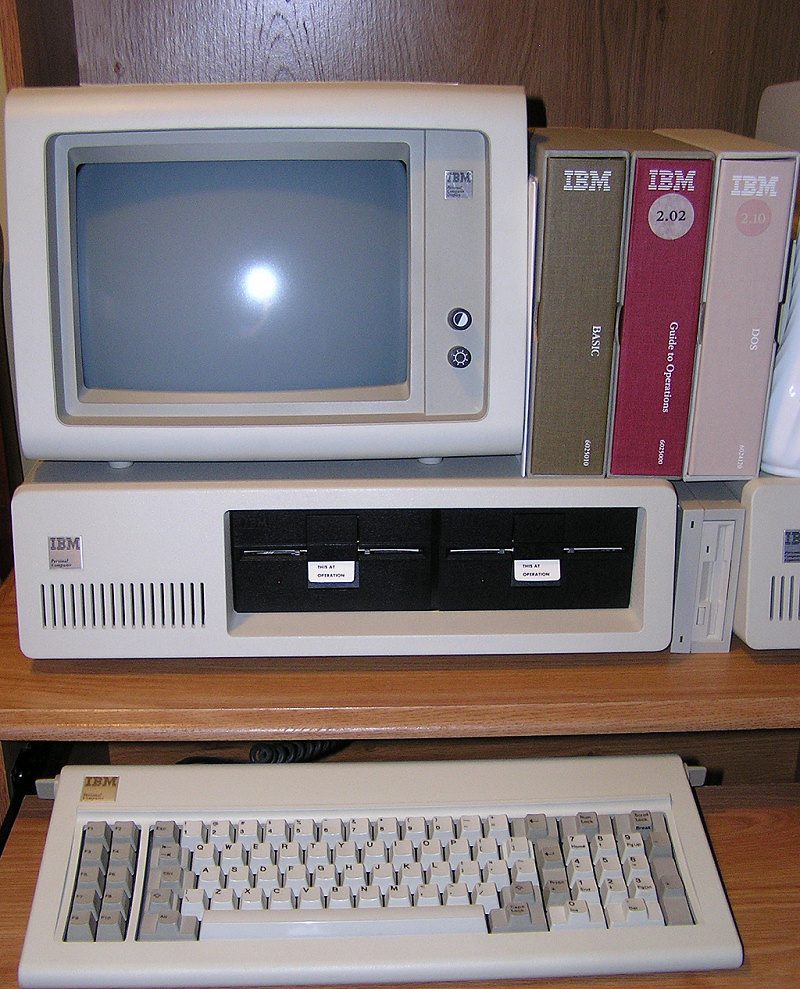
On 12 August 1981 IBM introduced its Personal Computer, the Model 5150 — the machine that took computing out of the hobbyist's workshop and put a standardised PC on office desks around the world. August 12 is also the day Zheng He's fleet brought a giraffe to China, Japan Air Lines Flight 123 crashed, and the T. rex called Sue was found.
Choose another date: open the On This Day calendar to browse events, births and deaths for any day of the year.
At a Glance
- Introduced
- 12 August 1981, unveiled at the Waldorf Astoria hotel in New York
- The machine
- The IBM Personal Computer, Model 5150, built around an Intel 8088 processor
- Base price
- $1,565, in a basic configuration with 16 KB of memory and no hard disk
- The design
- Five expansion slots and an open architecture that invited other companies to build add-ons and software
- Built by
- A small IBM team in Boca Raton, Florida, led by Don Estridge, in about a year
- Production run
- Discontinued on 2 April 1987, by which time 'PC' had become the generic name for the type
Events on this day
- 1415Zheng He's treasure fleet returns to China from its fourth voyage, bringing among its wonders a giraffe from Africa, presented at court as the mythical qilin.
- 1676King Philip's War in New England effectively ends when the Wampanoag leader Metacom, known to the English as King Philip, is killed.
- 1851Isaac Singer patents his sewing machine, the design that made machine sewing practical in homes and factories alike.
- 1898An armistice ends the fighting in the Spanish-American War, four months after it began; a formal peace treaty follows in December.
- 1941Franklin D. Roosevelt and Winston Churchill meet aboard warships at Placentia Bay, Newfoundland, and agree the Atlantic Charter, setting out their aims for the postwar world.
- 1960NASA launches Echo 1, a giant balloon satellite that bounces radio signals between continents and can be seen from the ground as a bright moving star.
- 1981IBM introduces its Personal Computer, the Model 5150, at a press conference in New York — the featured story above.
- 1985Japan Air Lines Flight 123 crashes into mountains north-west of Tokyo; of 524 people aboard, only four survive, in the deadliest single-aircraft accident in history.
- 1990Fossil hunter Susan Hendrickson discovers the skeleton of a Tyrannosaurus rex in South Dakota; 'Sue' becomes the most complete T. rex ever found.
- 1994Major League Baseball players go on strike; the dispute wipes out the rest of the season and forces the cancellation of the World Series.
- 2000The Russian nuclear submarine Kursk sinks in the Barents Sea after explosions in its torpedo room; all 118 members of the crew are lost.
Born on this day
- 1881Cecil B. DeMille — American film director and producer, a founder of the Hollywood spectacle with epics such as The Ten Commandments.
- 1887Erwin Schrödinger — Austrian physicist, a founder of quantum mechanics, famous for his wave equation and his thought experiment of the cat.
- 1949Mark Knopfler — British guitarist and singer, the frontman of Dire Straits.
- 1971Pete Sampras — American tennis player who won 14 Grand Slam singles titles.
- 1975Casey Affleck — American actor who won an Academy Award for Manchester by the Sea.
Died on this day
- 1827William Blake — English poet and artist, creator of Songs of Innocence and of Experience.
- 1944Joseph P. Kennedy Jr. — eldest brother of John F. Kennedy, a US Navy pilot killed in action during the Second World War.
- 1964Ian Fleming — English author who created James Bond.
- 1982Henry Fonda — American actor, star of The Grapes of Wrath, who died months after winning his only Oscar, for On Golden Pond.
- 1988Jean-Michel Basquiat — American artist whose graffiti-rooted paintings made him a defining figure of 1980s art; dead at 27.
- 2014Lauren Bacall — American actress, the smoky-voiced star of To Have and Have Not, dead at 89.
The featured story: IBM introduces its Personal Computer, 12 August 1981
By 1981 the personal computer already existed, but business did not take it seriously. Machines from Apple, Commodore and Tandy were bought by hobbyists and enthusiasts, while the world's offices ran on paper, typewriters and the big mainframe computers of IBM itself. When IBM — the most powerful company in computing — decided it wanted a small machine of its own, it could not afford to spend the usual years developing one. Instead it handed the job to a small team at Boca Raton, Florida, led by Don Estridge, gave them about a year, and let them break IBM's own rules: instead of building everything in-house, they would assemble the machine largely from other companies' components, and leave its design open for others to build on.
The result was unveiled on 12 August 1981 at the Waldorf Astoria hotel in New York: the IBM Personal Computer, model number 5150. It was built around an Intel 8088 processor, and the basic machine cost $1,565, in a configuration with just 16 kilobytes of memory. There was no hard disk — programs and data lived on cassette tapes or on optional floppy disks. What it did have was five expansion slots in the back, an open invitation for other firms to make add-on cards that would give the machine new abilities, from better graphics to extra memory.
The Smithsonian's National Museum of American History, which holds the machine in its collection, calls it a milestone in personal computing, and the reason is the name as much as the hardware. Because it was an IBM, company purchasing departments that would never have risked an unknown hobbyist brand ordered it in quantity; because the design was open, an entire industry of software writers and accessory makers grew up around it, and rival manufacturers soon built machines that could run the same programs. The personal computer stopped being a hobby and became standard office equipment — and the initials PC, which IBM used almost casually, became the generic name for the whole class of machine.
IBM kept the 5150 in production until 2 April 1987, by which time it had been joined and overtaken by a crowd of faster descendants and imitators. But the pattern set on 12 August 1981 — a standard design, built from widely available parts, improved by an army of outside suppliers — dominated desktop computing for decades afterwards. The day is remembered not for a technical breakthrough but for an industrial one: the day the biggest name in computing declared that the future would sit on a desk, and everyone else arranged themselves around that fact.
Why this date matters
August 12 keeps staging encounters between the old world and the new. A giraffe arrives at the Ming court as a creature of legend in 1415; a war of colonists and Native nations ends in New England in 1676; and in the twentieth century the date turns to machines that shrink distance — a balloon satellite in 1960 and a desktop computer in 1981. It is also a day shadowed by sudden loss, from Flight 123 to the Kursk. But its lasting claim is 1981: the day computing's establishment blessed the personal computer, and the desk, rather than the machine room, became the centre of working life.
Sources
- Encyclopaedia Britannica — On This Day: August 12
- HISTORY — This Day in History: August 12
- Smithsonian National Museum of American History — IBM Personal Computer
- Wikimedia — On This Day feed: August 12
The facts on this page were checked against these sources on 19 November 2026. The History Trail's permanent pages are researched and written for this site; the live profiles elsewhere on The History Trail are assembled automatically from Wikipedia and Wikidata.
About the Author
Researched and written by the The History Trail Editorial Team — the accountable editorial function behind this site's permanent story pages. The team works from the published sources cited on each page; it does not invent historians, reviewers or credentials, and it corrects errors openly.
Fact Check
Every load-bearing fact on this page traces to one of the sources listed above, and significant claims link to their source in the text. Our checking method is described on the methodology page; errors can be reported via the corrections page.
Sources & Citations
Cite this page as: The History Trail Editorial Team, The History Trail — this article's title, publication and update dates are shown beneath its headline. The full source list appears under Sources above; the site's source standards are on the sources page.