
Things
Moby-Dick
Moby-Dick; or, The Whale is an 1851 novel by Herman Melville, a former whaleship sailor, in which Ishmael tells of Captain Ahab's obsessive hunt for a white sperm whale. Published in London and New York in 1851, it was a commercial failure, sold only a few thousand copies, and was out of print when Melville died - until critics of the 1920s revived it as a classic.
At a Glance
- Author
- Herman Melville (1819-1891), American novelist, who had served aboard the whaleship Acushnet out of New Bedford from January 1841
- Full title
- Moby-Dick; or, The Whale - published in London first, as The Whale, and under its definitive title in New York
- First publication
- London: Richard Bentley, 18 October 1851, as The Whale, three volumes, 500 copies, without the epilogue; New York: Harper and Brothers, 14 November 1851, one volume at 1.50 dollars
- The fiction
- The sailor Ishmael narrates Captain Ahab's obsessive hunt, aboard the Pequod, for the white sperm whale that took his leg; the novel runs to 135 chapters of narrative mixed with essays on whaling
- The real sources
- The sinking of the whaleship Essex, rammed by a sperm whale on 20 November 1820 and described in Owen Chase's 1821 Narrative, and Reynolds's 1839 account of the white whale Mocha Dick
- First reception
- A commercial failure: Britannica gives lifetime sales as fewer than 4,000 copies in total, and the book was out of print when Melville died in 1891
- The revival
- The 1919 Melville centenary, Raymond Weaver's 1921 biography, and champions including Carl Van Doren and D. H. Lawrence restored the novel in the 1920s; Rockwell Kent's illustrated Lakeside Press edition followed in 1930
Introduction
The novel opens with three of the most famous words in American literature: its narrator begins, "Call me Ishmael." Everything after that opening is fiction - Ahab, the Pequod and the white whale are Melville's inventions - but the book was built from documented things: his own years on a whaleship, a real white whale reported in print, and a real whaleship sunk by a whale in 1820. This page traces the book itself: its materials, its publication in 1851, its failure, and its recovery seventy years later.
In the fiction, Ishmael signs aboard the Nantucket whaler Pequod, whose captain, Ahab, is consumed by his hunt for Moby Dick, the giant white sperm whale that took his leg on an earlier voyage. The novel runs to 135 chapters in which, as Britannica describes it, narrative and essay-like portions on whaling intermingle, and it ends, in the American edition, with an epilogue explaining how Ishmael alone survives to tell the story.
The Sailor's Materials: Acushnet, the Essex and Mocha Dick
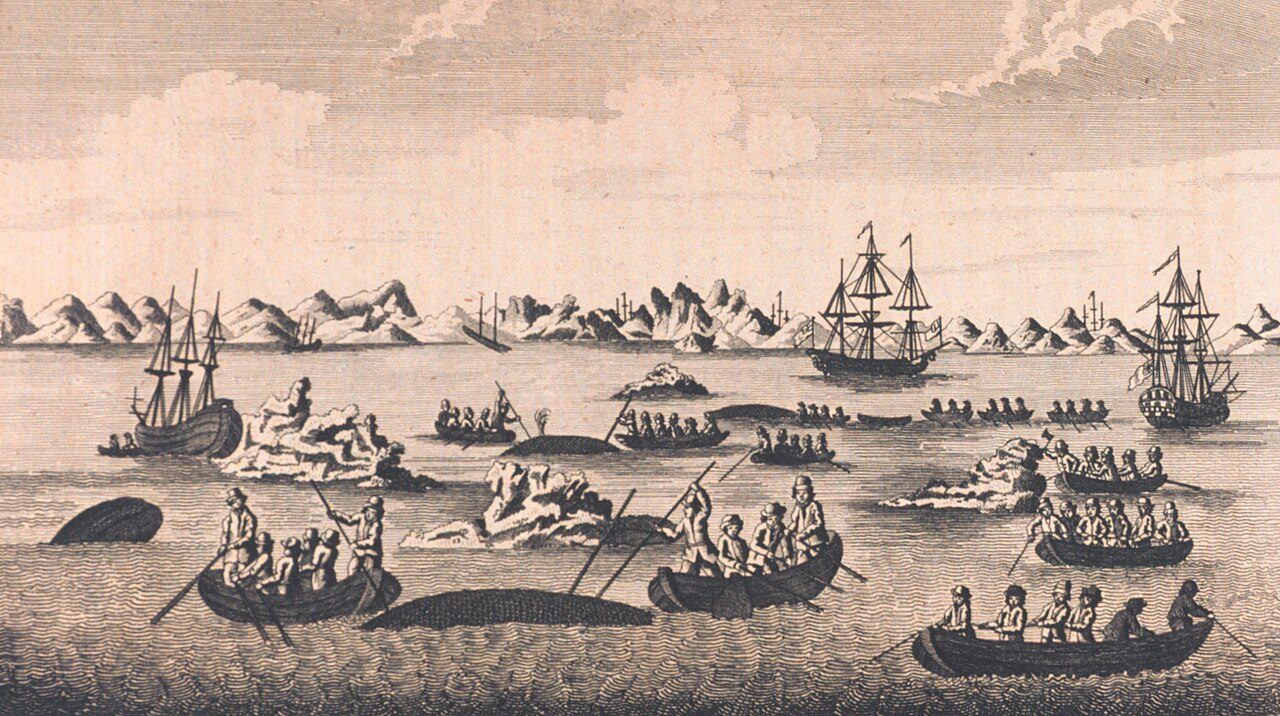
Melville knew whaling from inside. In January 1841, aged 21, he sailed from New Bedford, Massachusetts, aboard the whaling ship Acushnet, and spent some eighteen months aboard before leaving the ship in the Marquesas Islands in the South Pacific. New Bedford's Seamen's Bethel, where he worshipped before sailing, became the Whaleman's Chapel of the novel's early chapters. His sea years gave him its working knowledge: how whales were sighted, chased, killed and cut up, and how a crew lived.
Two printed accounts supplied the whale. The first was Owen Chase's Narrative of the Most Extraordinary and Distressing Shipwreck of the Whale-Ship Essex, published in 1821 and held among Melville's research materials at Yale's Beinecke Library. The Essex, out of Nantucket, was rammed twice by a large sperm whale on 20 November 1820, in the Pacific west of the Galapagos, and sank; Chase survived months in open boats to write the account. The second was J. N. Reynolds's "Mocha Dick, or the White Whale of the Pacific," published in Knickerbocker magazine in 1839: the story of a real, famously white and aggressive sperm whale, named for the island of Mocha off Chile, that whalers had repeatedly encountered and failed to kill. Britannica likewise records that Melville consulted the story of Mocha Dick, whose whiteness, aggression and name are plainly behind his fictional whale.
Publication in 1851: Two Editions, One Missing Epilogue
Melville began the book in February 1850 and took some eighteen months over it, far longer than planned. During the writing he befriended Nathaniel Hawthorne, and Britannica records that the friendship led him to revise the narrative dramatically, making it more complex; the novel is dedicated to Hawthorne. To secure copyright on both sides of the Atlantic it was published almost simultaneously in two countries, in two forms, as Yale's Beinecke Library sets out.
In London, Richard Bentley published it on 18 October 1851 as The Whale, in three volumes, in an edition of 500 copies. In New York, Harper and Brothers published it on 14 November 1851 as Moby-Dick; or, The Whale, in a single volume priced at 1.50 dollars, in a first printing the Beinecke puts at 915 copies. The two texts differ in roughly 600 places, and the British edition is some 2,000 words shorter. Most seriously, the British edition has no epilogue: the passage explaining that Ishmael survived is missing, so British reviewers were left to wonder how a narrator who apparently drowned with all hands could tell the tale at all. The Beinecke notes this deletion, possibly a printing error, may especially have shaped the book's poor British reception.
Timeline
- 20 November 1820
A sperm whale rams and sinks the Nantucket whaleship Essex in the Pacific; first mate Owen Chase's Narrative of the disaster appears in 1821.
- 1839
J. N. Reynolds publishes "Mocha Dick, or the White Whale of the Pacific" in Knickerbocker magazine - the account of a real white whale behind Melville's.
- January 1841
Herman Melville, 21, sails from New Bedford aboard the whaleship Acushnet; he leaves the ship in the Marquesas after some eighteen months.
- February 1850
Melville begins the novel that becomes Moby-Dick; the writing takes about eighteen months, and his friendship with Nathaniel Hawthorne reshapes it.
- 18 October 1851
Richard Bentley publishes the novel in London as The Whale, in three volumes and an edition of 500 copies - without the epilogue.
- 14 November 1851
Harper and Brothers publishes Moby-Dick; or, The Whale in New York, in one volume at 1.50 dollars, with the epilogue restored.
- 1891
Melville dies in New York, largely forgotten as a novelist; Moby-Dick is out of print and has sold, on Britannica's figures, fewer than 4,000 copies in total.
- 1919
The centenary of Melville's birth renews attention; Raymond M. Weaver writes on Melville in The Nation.
- 1921-1923
Weaver's biography Herman Melville: Mariner and Mystic (1921), Carl Van Doren's The American Novel (1921) and D. H. Lawrence's Studies in Classic American Literature (1923) drive the Melville revival.
- 1930
Chicago's Lakeside Press publishes the three-volume edition illustrated by Rockwell Kent, the revival's landmark collectors' edition.
- Since 1997
The New Bedford Whaling Museum holds its annual Moby-Dick reading marathon, marking the anniversary of Melville's sailing on the Acushnet.
Significance
The novel's significance is that it is two books fused into one: a working encyclopaedia of the nineteenth-century sperm-whale fishery - its ships, tools, oil and economics, drawn from Melville's own service and reading - and a meditation, in sermons, soliloquies and Shakespearean and biblical language, on obsession, fate and nature's indifference. That fusion defeated its first readers, and is exactly what the twentieth century prized.
It also preserves the world of American whaling at its height: New Bedford and Nantucket, the Bethel chapel, the multiracial crews, and an industry soon to be eclipsed. The New Bedford Whaling Museum, in the port Melville sailed from, now anchors that memory, holding its annual marathon reading each January.
Myths and disputes
Was there a real Moby Dick? Not as one animal. The fictional whale is a composite, and the page should say so plainly: its colour, name and reputation come from Mocha Dick, a real white sperm whale reported by Reynolds in 1839, while the novel's ending - a whale destroying the ship itself - comes from the documented sinking of the Essex in 1820. No source shows a single whale doing both, and Melville never claimed one did.
The sales figures also need care. Britannica gives the lifetime total as fewer than 4,000 copies, with fewer than 600 of them in the United Kingdom; other accounts put copies sold in Melville's lifetime at about 3,200. The figures differ because they count the two editions and later small printings differently. What no account disputes is the shape of the story: the book sold in the low thousands, earned its author little, and was out of print when he died. The missing British epilogue, finally, is a documented fact of the 1851 Bentley edition; whether it was a printing error or an editorial cut is, as the Beinecke notes, still not certainly known.
Legacy
Moby-Dick's legacy is the revival that would not end. The critics of the 1920s - Weaver, Van Doren, Van Vechten, Lawrence - remade a failed sea novel into what the Beinecke calls, within a few years, an undisputed classic of American literature, and it has stayed in print, in classrooms and in argument ever since: in Rockwell Kent's 1930 illustrations, in film and stage adaptations, in the marathon readings at New Bedford, and in a bronze statue of Melville unveiled outside Seamen's Bethel in 2026, in the port where his whaling life began.
Few novels have had two such separate lives. The first, in 1851, was a puzzled shrug and a few thousand copies. The second began with the author's birth centenary and made the book a permanent possession: the great American novel its own century declined to read. That distance is the real subject of its history - a book's fate is decided not once, at publication, but again by every generation that picks it up.
Sources
- Beinecke Rare Book and Manuscript Library, Yale University - Moby Dick: Context and Resources
- Encyclopaedia Britannica - Moby Dick
- Smithsonian Magazine - A New Statue Honors 'Moby-Dick' Author Herman Melville in the Massachusetts City Where His Whaling Adventures Began
- EBSCO Research Starters - Herman Melville's Moby-Dick Is Published
- New Bedford Whaling Museum - New Bedford Whaling Museum Launches Inaugural Moby-Dick Book Club in Partnership with Melville Society Scholars
The facts on this page were checked against these sources on 19 November 2026. The History Trail's permanent pages are researched and written for this site; the live profiles elsewhere on The History Trail are assembled automatically from Wikipedia and Wikidata.
About the Author
Researched and written by the The History Trail Editorial Team — the accountable editorial function behind this site's permanent story pages. The team works from the published sources cited on each page; it does not invent historians, reviewers or credentials, and it corrects errors openly.
Fact Check
Every load-bearing fact on this page traces to one of the sources listed above, and significant claims link to their source in the text. Our checking method is described on the methodology page; errors can be reported via the corrections page.
Sources & Citations
Cite this page as: The History Trail Editorial Team, The History Trail — this article's title, publication and update dates are shown beneath its headline. The full source list appears under Sources above; the site's source standards are on the sources page.