
Animals
Blue whale
No animal alive today, and none known from the fossil record, matches the blue whale. It outweighs the largest dinosaurs, yet it feeds almost entirely on shrimp-like krill a few centimetres long — and within living memory, industrial whaling very nearly removed it from the oceans altogether.
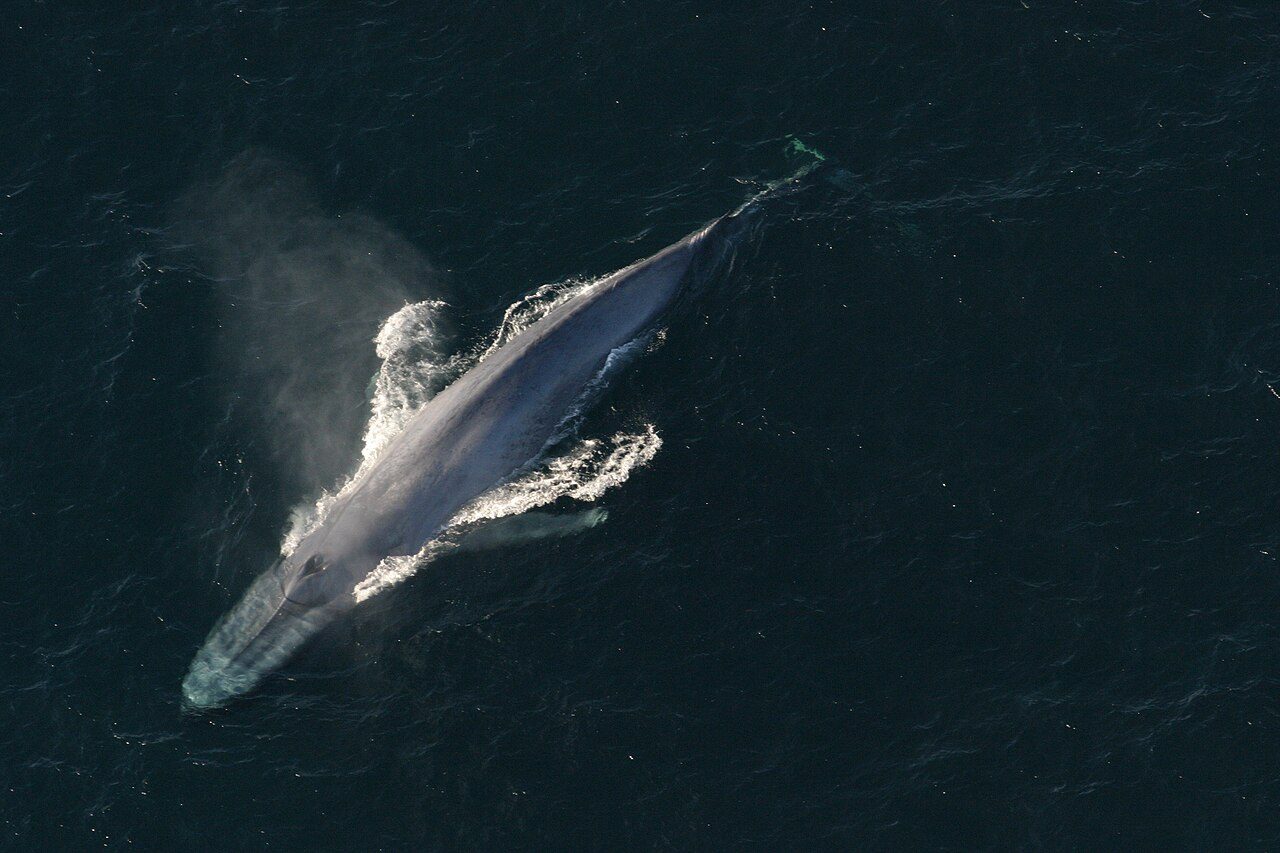
At a Glance
- Scientific name
- Balaenoptera musculus
- Length
- More than 30 metres (98 feet); largest accurately measured 29.5 metres
- Weight
- About 150 tons; the largest measured female weighed 180 metric tons
- Heart
- About 180 kg — the largest heart of any animal
- Diet
- Almost exclusively krill; the biggest individuals may eat up to 6 tons a day
- Lifespan
- Estimated at about 80 to 90 years
- Population
- Estimated at 10,000 to 25,000 worldwide
- Conservation status
- Endangered (IUCN Red List)
Introduction
The blue whale is a rorqual, the largest member of the baleen whale family, and the most massive animal ever to have lived. Adults weigh approximately 150 tons and may exceed 30 metres in length. The largest individual ever accurately measured was a female 29.5 metres long weighing 180 metric tons, and there are reports of catches 33 metres long that may have reached 200 metric tons. Females are generally larger than males, and the biggest animals of all live in the Southern Ocean around Antarctica.
Everything about the animal is scaled up. Its heart, at roughly 180 kilograms, is the largest of any animal. Its mouth carries up to 800 plates of baleen — the stiff, fringed sheets it uses instead of teeth — and a calf is born already about 8 metres long, then gains up to 90 kilograms a day on its mother's milk before being weaned at seven to eight months, by which time it measures about 15 metres.
Background
Blue whales are found alone or in small groups in all the world's oceans except the Arctic, with much larger populations in the Southern Hemisphere. Their year is built around krill, the small crustaceans that swarm in cold, productive waters. They spend the summer feeding in polar seas, lunging through krill concentrations with open mouths — sometimes rolling through a full turn to line up a swarm — and in winter they move toward the Equator to breed, after a gestation of about twelve months. A single adult may consume several tons of krill in a day at the height of the feeding season.
For an animal so large, the blue whale is also remarkably vocal. Its low-frequency pulses, groans and moans are among the loudest sounds made by any animal, and in the right conditions they can carry across entire ocean basins — NOAA notes that blue whale sounds may be heard by other whales up to 1,000 miles away. Scientists think the calls serve both communication and a kind of long-range orientation in dark ocean depths. Individuals can be recognised by the unique mottled pattern of blue-grey on their backs, which researchers use in photo-identification catalogues.
Timeline
- 1904
Industrial whaling begins in earnest in the Antarctic, initially led by Norwegian and Argentinian interests hunting from shore stations.
- 1925
Floating factory ships take whaling into the open ocean, removing the last refuge of the large whales on their offshore feeding grounds.
- 1930–31
In a single Antarctic season the worldwide kill of blue whales exceeds 29,000 animals — the peak of the slaughter.
- 1946
The International Whaling Commission is established to conserve whale stocks and regulate whaling internationally.
- 1966
Commercial hunting of blue whales is banned; the species has been protected from commercial whaling since the mid-1960s.
- 1986
The international moratorium on commercial whaling takes effect, a ban the United States recovery strategy still works to maintain.
- 1994
The Southern Ocean is designated a whale sanctuary, further prohibiting whaling by signatories of the moratorium.
- 1998
The US National Marine Fisheries Service publishes a blue whale recovery plan built on photo-identification, genetics and migration research.
- 2020
The US blue whale recovery plan is revised, setting out research on population structure, threats and habitat to guide the species' rebuilding.
Significance
The blue whale's ecological role is out of proportion even to its size, because it connects the smallest and largest ends of the ocean food web. Research highlighted by the Smithsonian shows that a blue whale can eat some 16 tonnes of krill in a day of heavy feeding, and that today's blue whales together consume over half a million tonnes of krill a year. Crucially, whales return nutrients — especially iron — to surface waters in their faeces, fertilising the plankton growth on which krill themselves depend. When whaling removed the whales, it disrupted that recycling loop as well.
That is why the blue whale became the defining test case for whether international law can save a species hunted by an entire industry. It was once the most important of the commercially hunted baleen whales, and whaling reduced its numbers by up to 90 percent. Protection came only when the animal was already rare. Its slow, partial recovery since — populations are increasing globally, according to NOAA — is now the benchmark against which every other whale recovery is measured.
Legacy
The blue whale remains listed as Endangered, and its numbers — an estimated 10,000 to 25,000 animals — are still a small fraction of what swam the oceans before modern whaling. The threats have changed rather than vanished: vessel strikes and entanglement in fishing gear are now the primary dangers NOAA identifies, with ocean noise, pollution and climate change behind them. Shipping lanes are being adjusted and whale-safe practices developed precisely because a recovered population must cross some of the busiest seas on Earth.
Yet the direction of travel is genuinely hopeful. A species that lost nine-tenths of its numbers within a single human lifetime is, under protection, increasing again — proof that even the most thorough industrial destruction of a wild population can be reversed when the hunting stops and stays stopped. The blue whale's legacy is that lesson, written at the largest possible scale.
Sources
- Encyclopaedia Britannica — Blue whale
- NOAA Fisheries — Blue Whale species directory
- Smithsonian Ocean — The Tons that Whales Eat... and Poop
- Nature Communications — Whale recovery and the emerging human-wildlife conflict over Antarctic krill
The facts on this page were checked against these sources on 19 November 2026. The History Trail's permanent pages are researched and written for this site; the live profiles elsewhere on The History Trail are assembled automatically from Wikipedia and Wikidata.
About the Author
Researched and written by the The History Trail Editorial Team — the accountable editorial function behind this site's permanent story pages. The team works from the published sources cited on each page; it does not invent historians, reviewers or credentials, and it corrects errors openly.
Fact Check
Every load-bearing fact on this page traces to one of the sources listed above, and significant claims link to their source in the text. Our checking method is described on the methodology page; errors can be reported via the corrections page.
Sources & Citations
Cite this page as: The History Trail Editorial Team, The History Trail — this article's title, publication and update dates are shown beneath its headline. The full source list appears under Sources above; the site's source standards are on the sources page.