
Years
2016 in History
2016 is remembered above all for two votes that broke the script: on 23 June British voters chose in a referendum to leave the European Union, by 52 to 48 percent, and on 8 November Donald Trump defeated Hillary Clinton to win the presidency of the United States, despite losing the popular vote. Around them fell a generation of icons — Bowie, Prince, Ali, Castro — and, in November, India withdrew its largest banknotes overnight.
At a Glance
- Defining events
- Brexit referendum, 23 June — Britain votes to leave the EU by 52 to 48 percent
- The election
- Donald Trump defeats Hillary Clinton on 8 November, despite losing the popular vote
- The currency shock
- November 2016 demonetisation withdraws India's 500 and 1,000 rupee notes at a day's notice
- The losses
- David Bowie, Prince, Muhammad Ali and Fidel Castro all die in 2016
- Opened the year
- David Bowie dies on 10 January, two days after his 69th birthday and his final album's release
- Closed the year
- Carrie Fisher dies on 27 December, two days after George Michael
The defining story: Brexit, Trump and a year of shocks
The referendum had been promised as a way to settle Britain's European argument; instead it split the country down the middle. On 23 June 2016 British voters chose to leave the European Union by 52 to 48 percent. A week earlier, on 16 June, the MP Jo Cox had been murdered in her constituency, at 41, in the campaign's final days. David Cameron, who had called the vote, resigned, and on 13 July Theresa May became prime minister, succeeding him with the task of carrying out a departure the government had campaigned against. The result — 'Brexit' — set British politics, and Britain's relations with its neighbours, on a course that dominated the years that followed.
America's script broke in the autumn. Hillary Clinton had been nominated at the Democratic National Convention on 26 July, the first woman nominated for president by a major American party. On 8 November Donald Trump defeated her to win the presidency, despite losing the popular vote — an outcome that, like Brexit, the polling and commentary of the season had largely failed to foresee. Between the two votes the year's other dramas accumulated: on 3 April the Panama Papers, more than 11 million leaked documents, were published by journalists worldwide, exposing the offshore finances of the rich and powerful; on 12 June a gunman murdered 49 people at the Pulse nightclub in Orlando, Florida, then the deadliest mass shooting in American history; and on 4 November, four days before the American election, the Paris Agreement on climate change entered into force.
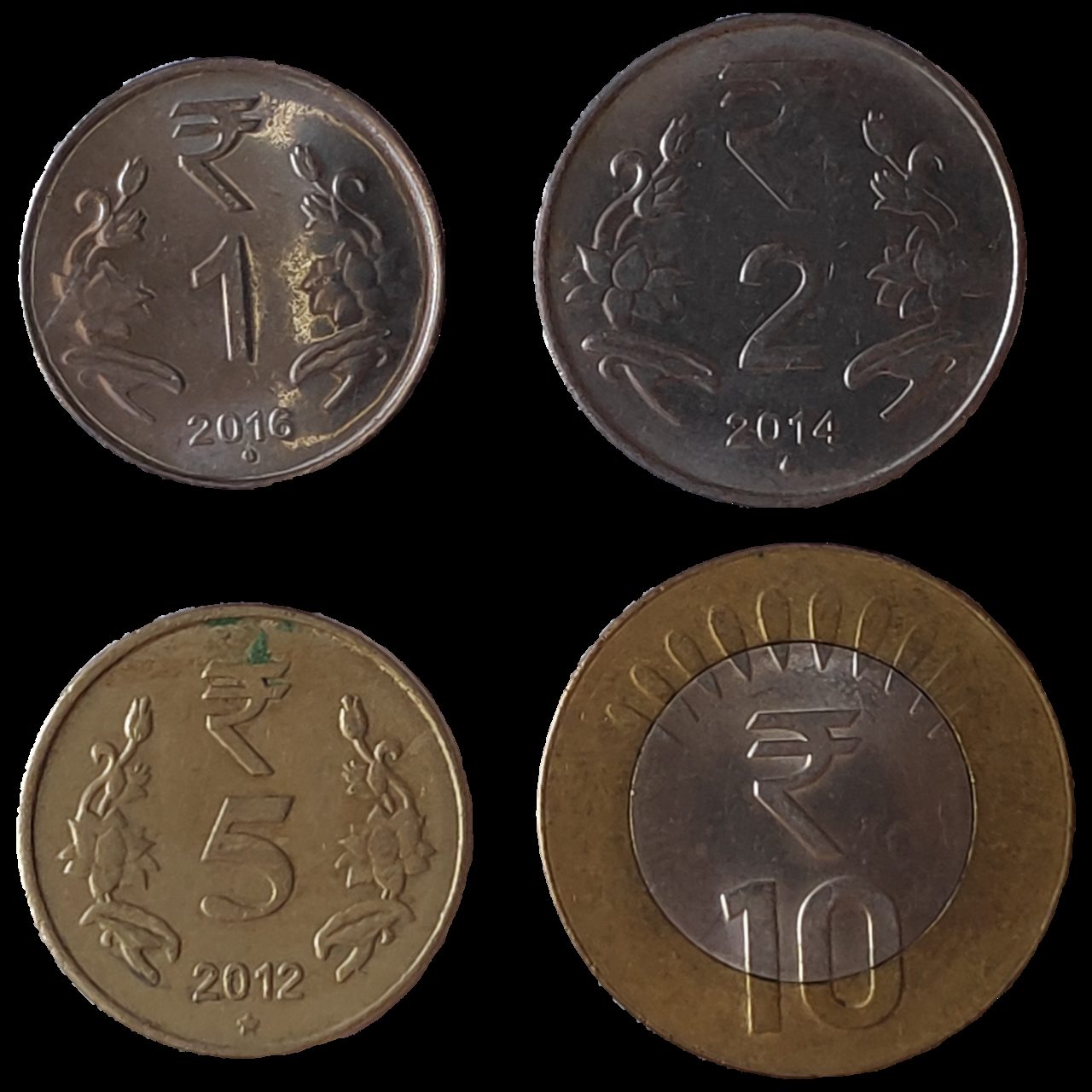
India supplied the year's most abrupt economic shock. In November 2016 the government withdrew the 500 and 1,000 rupee notes — the great majority of cash value in circulation — from legal tender at a day's notice, replacing them with a redesigned series in new sizes and colours: one of the largest currency operations ever attempted in a democracy, accepted by more than a billion users of a currency whose modern form the Reserve Bank of India, founded in 1935, had shaped for eighty years. The coins in this page's photograph are the small change of that currency — decimal for nearly seventy years, since the reform of 1 April 1957 replaced 16 annas with 100 paise.
What gave 2016 its elegiac tone was the roll of the dead. David Bowie died on 10 January, of cancer, two days after his sixty-ninth birthday and the release of his final album; Alan Rickman followed at 69 four days later. Harper Lee and Umberto Eco died on the same day, 19 February. Prince was found dead at Paisley Park on 21 April, at 57. Muhammad Ali, heavyweight champion and global sporting icon, died on 3 June at 74; Fidel Castro, who had governed Cuba for nearly half a century, died in Havana on 25 November at 90; and the year closed with George Michael on 25 December and Carrie Fisher, Star Wars' Princess Leia, on 27 December. A year of political rupture was also a year of farewell.
Timeline of 2016
- 10 January
David Bowie dies of cancer, two days after his sixty-ninth birthday and the release of his final album.
- 19 February
Harper Lee, author of To Kill a Mockingbird, dies at 89 — and Umberto Eco, author of The Name of the Rose, dies in Milan the same day.
- 3 April
The Panama Papers, more than 11 million leaked documents, are published worldwide, exposing offshore finances.
- 21 April
Prince, creator of Purple Rain, is found dead at Paisley Park at 57.
- 3 June
Muhammad Ali, American heavyweight boxing champion and global sporting icon, dies at 74.
- 12 June
A gunman murders 49 people at the Pulse nightclub in Orlando, Florida, then the deadliest mass shooting in US history.
- 23 June
British voters choose in a referendum to leave the European Union, by 52 to 48 percent.
- 13 July
Theresa May becomes prime minister of the United Kingdom, succeeding David Cameron after the Brexit referendum.
- 26 July
Hillary Clinton is nominated for president, the first woman nominated by a major American party.
- 14 August
Usain Bolt wins the 100 metres at the Rio Olympics, the first man to take the title at three consecutive Games.
- 4 November
The Paris Agreement on climate change enters into force, committing its signatories to limit global warming.
- 8 November
Donald Trump defeats Hillary Clinton to win the presidency of the United States, despite losing the popular vote.
- 25 November
Fidel Castro, Cuban revolutionary leader who governed Cuba for nearly half a century, dies at 90 in Havana.
- 27 December
Carrie Fisher, who played Princess Leia in Star Wars, dies at 60.
Why 2016 still matters
Brexit and Trump's victory together mark 2016 as the year the post-Cold War political settlement cracked in both of the English-speaking democracies at once. The referendum's 52-to-48 margin committed Britain to years of negotiation over its departure and its future relationship with Europe, consumed the governments of Cameron and then May, and made 'Brexit' the defining word of British public life. In the United States, a president elected while losing the popular vote took office promising to remake trade, alliances and immigration policy. The year's December coda — a gunman firing inside a Washington pizzeria in the grip of the false 'Pizzagate' conspiracy theory, injuring no one — became a landmark case study in online disinformation, the medium in which both campaigns had partly been fought.
The quieter stories compounded in other directions. The Paris Agreement's entry into force on 4 November turned 2015's promise into binding international law. India's demonetisation and its redesigned Mahatma Gandhi (New) Series notes showed the opposite face of state power over money to 1957's decimalisation — the rupee remade by law again, overnight. The Chicago Cubs' first World Series since 1908, won in the early hours of 3 November, and Usain Bolt's third consecutive Olympic 100 metres title gave the year its sporting grace notes. And the year's losses — Bowie, Prince, Ali, Lee, Eco, Castro, Fisher — removed, within twelve months, a disproportionate share of the twentieth century's surviving giants, which is why 2016 is so often remembered simply as the year everyone died.
2016 on The History Trail
The Brexit vote, the American election and the rupee behind this year's hero image are all on The History Trail.
- June 23 in History — British voters choose to leave the European Union, by 52 to 48 percent.
- November 8 in History — Donald Trump defeats Hillary Clinton to win the presidency.
- November 4 in History — The Paris Agreement enters into force.
- January 10 in History — David Bowie dies, two days after his final album's release.
- June 3 in History — Muhammad Ali dies at 74.
- Indian rupee — The currency whose largest notes were withdrawn in November 2016.
- Barbie — The doll whose makers reshaped her range in 2016.
Sources
- Encyclopaedia Britannica — On This Day: June 23
- HISTORY — What Happened on June 23
- Encyclopaedia Britannica — On This Day: November 8
- HISTORY — What Happened on November 8
- Encyclopaedia Britannica — On This Day: January 10
- Encyclopaedia Britannica — On This Day: April 3
- Encyclopaedia Britannica — On This Day: November 4
- Encyclopaedia Britannica — On This Day: June 12
The facts on this page were checked against these sources on 19 November 2026. The History Trail's permanent pages are researched and written for this site; the live profiles elsewhere on The History Trail are assembled automatically from Wikipedia and Wikidata.
About the Author
Researched and written by the The History Trail Editorial Team — the accountable editorial function behind this site's permanent story pages. The team works from the published sources cited on each page; it does not invent historians, reviewers or credentials, and it corrects errors openly.
Fact Check
Every load-bearing fact on this page traces to one of the sources listed above, and significant claims link to their source in the text. Our checking method is described on the methodology page; errors can be reported via the corrections page.
Sources & Citations
Cite this page as: The History Trail Editorial Team, The History Trail — this article's title, publication and update dates are shown beneath its headline. The full source list appears under Sources above; the site's source standards are on the sources page.