
Years
2015 in History
2015 is remembered for a single city in two registers: on 13 November, coordinated Islamic State attacks across Paris killed 130 people, the deadliest being the massacre at the Bataclan theatre; and on 12 December, in the same grieving city, nearly every country on Earth adopted the Paris Agreement, the first climate treaty committing them all to hold warming well below 2 degrees. Terror and agreement, four weeks apart.
At a Glance
- Defining event
- Paris attacks, 13 November — 130 killed in coordinated Islamic State attacks
- The agreement
- Paris Agreement adopted by consensus at COP21 on 12 December
- The year's opening wound
- Charlie Hebdo attack in Paris, 7 January — twelve people killed
- The disaster
- Nepal earthquake, 25 April — magnitude 7.8, nearly 9,000 killed
- The ruling
- Obergefell v. Hodges, 26 June — same-sex marriage a constitutional right across the United States
- Closed the year
- Paris Agreement adopted on 12 December, the treaty's road to force running into 2016
The defining story: one city, terror and treaty
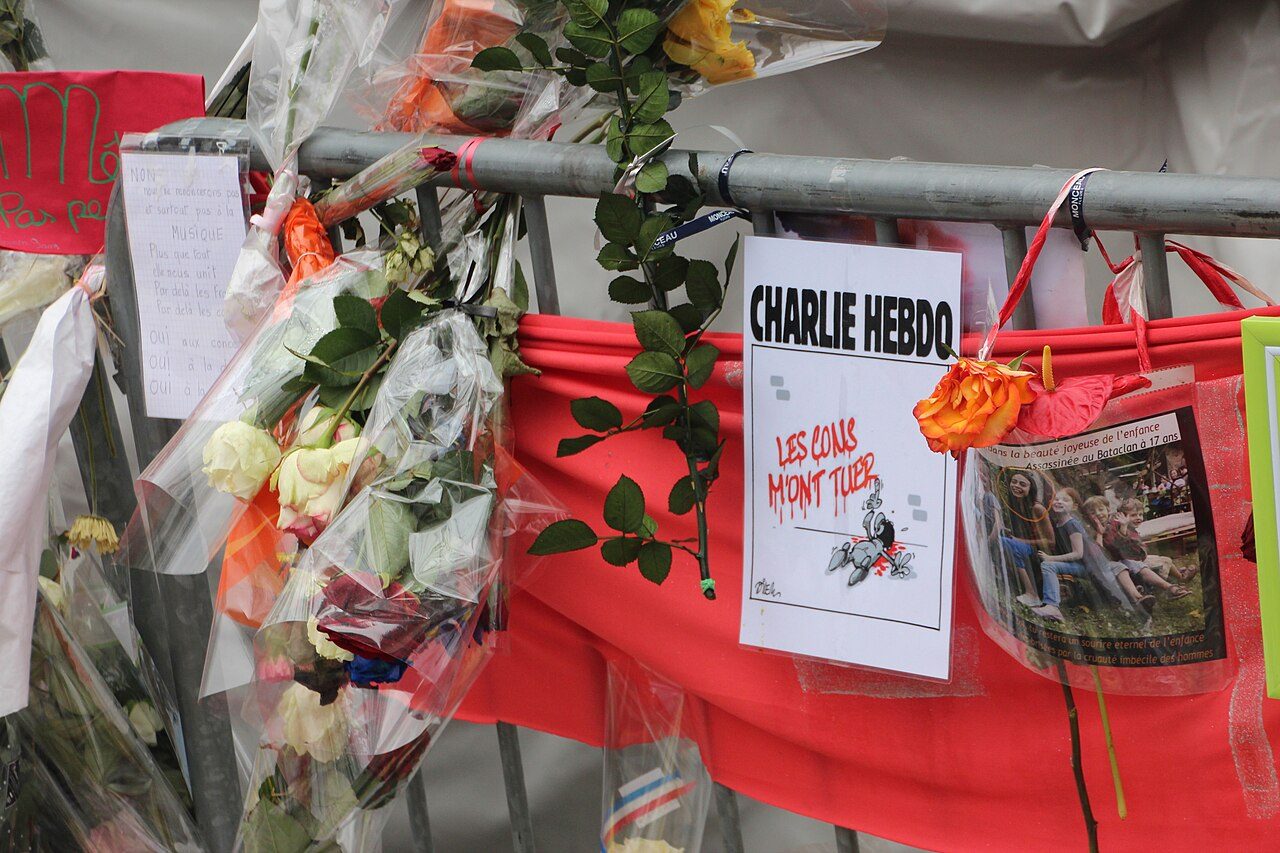
Paris on the night of Friday 13 November 2015 was doing ordinary things. France was playing Germany at football at the Stade de France, with President François Hollande in the crowd; café terraces in the 10th and 11th arrondissements were full; and at the Bataclan theatre some 1,500 people were watching the American rock band Eagles of Death Metal. The nine attackers, organised in three teams by a cell based largely in Belgium and directed from Syria, had chosen their targets to make the ordinary feel unsafe. The attacks began at about 9:20 p.m. with a suicide bombing outside the stadium. A second team drove from terrace to terrace shooting diners, and the third entered the Bataclan at about 9:47 p.m. and fired into the crowd — at least 89 people were killed there, in a siege lasting more than two hours before police stormed the hall shortly after midnight.
By then the night's toll stood at 130 dead and more than 350 injured — the deadliest day in France since the Second World War. Hollande, evacuated from the stadium, declared a state of emergency before the siege had even ended — the first nationwide emergency since 1961 — and ordered the borders closed. The next day the Islamic State claimed the attacks, and Hollande called them an act of war; the suspected organiser was killed in a police raid in Saint-Denis five days later, and the one surviving attacker was captured in Brussels the following March. It was Paris's second trauma of the year: on 7 January two gunmen had attacked the offices of the satirical magazine Charlie Hebdo, killing twelve people.
Four weeks after the attacks, the same city hosted the diplomacy that defined the year's other half. The climate conference at Le Bourget, presided over by foreign minister Laurent Fabius, brought nearly 200 parties — 195 states and the European Union — with national pledges in hand, determined to succeed where Copenhagen had failed in 2009. On the evening of 12 December the Paris Agreement was adopted by consensus: every country, rich and poor, would set its own nationally determined contribution to cutting emissions and update it every five years, together holding warming well below 2 degrees Celsius and pursuing efforts to limit it to 1.5 degrees. Developed countries pledged continued financial support to help poorer nations adapt. Unlike the Kyoto Protocol, the agreement imposed no top-down targets and no penalties; its force was to come from transparency, repetition and peer pressure.
The rest of the year filled the space between those Paris bookends. A magnitude 7.8 earthquake struck Nepal on 25 April, killing nearly 9,000 people, with a second major quake on 12 May. Ireland voted on 23 May to legalise same-sex marriage — the first country to do so by popular referendum — and on 26 June the U.S. Supreme Court ruled in Obergefell v. Hodges that same-sex couples have a constitutional right to marry across the United States. NASA's New Horizons probe flew past Pluto on 14 July, and on 9 September Queen Elizabeth II surpassed Queen Victoria to become Britain's longest-reigning monarch. A year that began and peaked in violence in Paris ended, in Paris, with the nearest thing to a planetary promise the century had produced.
Timeline of 2015
- 7 January
Two gunmen attack the Paris offices of the satirical magazine Charlie Hebdo, killing twelve people.
- 27 February
Leonard Nimoy, beloved worldwide as Mr. Spock in Star Trek, dies at 83.
- 24 March
Germanwings flight 9525 is flown deliberately into a mountainside in the French Alps by its co-pilot, killing all 150 people aboard.
- 25 April
A magnitude 7.8 earthquake strikes Nepal, killing nearly 9,000 people across the Kathmandu Valley.
- 23 May
Ireland votes to legalise same-sex marriage, becoming the first country to do so by popular referendum.
- 17 June
Nine Black worshippers are murdered at a Bible study at Emanuel AME Church in Charleston, South Carolina, by a white supremacist gunman.
- 26 June
In Obergefell v. Hodges, the Supreme Court rules that same-sex couples have a constitutional right to marry across the United States.
- 14 July
NASA's New Horizons probe flies past Pluto, completing the first reconnaissance of the classical Solar System.
- 9 September
Queen Elizabeth II surpasses Queen Victoria to become Britain's longest-reigning monarch.
- 24 September
A crush during the hajj pilgrimage at Mina, Saudi Arabia, kills 769 people by the official Saudi count; other estimates put the toll above 2,400.
- 13 November
Islamic State gunmen and bombers carry out coordinated attacks across Paris, killing 130 people.
- 12 December
The Paris Agreement on climate change is adopted by consensus at the COP21 conference.
Why 2015 still matters
The Paris Agreement changed the shape of climate policy: the first time virtually every nation on Earth signed up, in a single legal instrument, to the same destination, accepting that the world would be watching every five years to see if they were walking towards it. It opened for signature in New York on Earth Day, 22 April 2016, and entered into force with remarkable speed on 4 November 2016. Whether it succeeds will be judged not in Paris but in the decades of emissions that follow — yet its mechanism, national pledges ratcheted upward in public, remains the working frame of global climate diplomacy.
The attacks changed France just as durably. The state of emergency lasted, in renewed forms, almost two years, and much of it was later written into ordinary law; soldiers patrolling stations and streets became a fixture of French life, the Bataclan reopened a year later, and the trials of 2021–22 ended with the surviving attacker sentenced to life imprisonment. Around those poles, 2015 kept redrawing social maps: marriage equality arrived by referendum in Ireland and by court ruling across the United States within five weeks of each other, Sepp Blatter announced his resignation as FIFA president amid a corruption scandal in June, and New Horizons' Pluto flyby closed the first survey of the classical Solar System. Few years contain both a city's worst night and the world's broadest agreement, in the same streets, within a month.
2015 on The History Trail
The Paris attacks and the Paris Agreement — the year's two defining Paris stories — are told in full on The History Trail.
- November 13 in History — The Paris attacks — the stadium, the terraces and the Bataclan.
- December 12 in History — The Paris Agreement is adopted by consensus at COP21.
- January 7 in History — The Charlie Hebdo attack opens Paris's terrible year.
- June 26 in History — Obergefell v. Hodges establishes marriage equality across the United States.
- July 14 in History — New Horizons flies past Pluto.
- April 25 in History — A magnitude 7.8 earthquake strikes Nepal.
Sources
- Encyclopaedia Britannica — Paris attacks of 2015
- Encyclopaedia Britannica — On This Day: November 13
- Encyclopaedia Britannica — Paris Agreement
- Encyclopaedia Britannica — On This Day: December 12
- Encyclopaedia Britannica — On This Day: January 7
- Encyclopaedia Britannica — On This Day: June 26
- Encyclopaedia Britannica — On This Day: April 25
- Encyclopaedia Britannica — On This Day: September 9
The facts on this page were checked against these sources on 19 November 2026. The History Trail's permanent pages are researched and written for this site; the live profiles elsewhere on The History Trail are assembled automatically from Wikipedia and Wikidata.
About the Author
Researched and written by the The History Trail Editorial Team — the accountable editorial function behind this site's permanent story pages. The team works from the published sources cited on each page; it does not invent historians, reviewers or credentials, and it corrects errors openly.
Fact Check
Every load-bearing fact on this page traces to one of the sources listed above, and significant claims link to their source in the text. Our checking method is described on the methodology page; errors can be reported via the corrections page.
Sources & Citations
Cite this page as: The History Trail Editorial Team, The History Trail — this article's title, publication and update dates are shown beneath its headline. The full source list appears under Sources above; the site's source standards are on the sources page.