
On This Day
April 25 in History
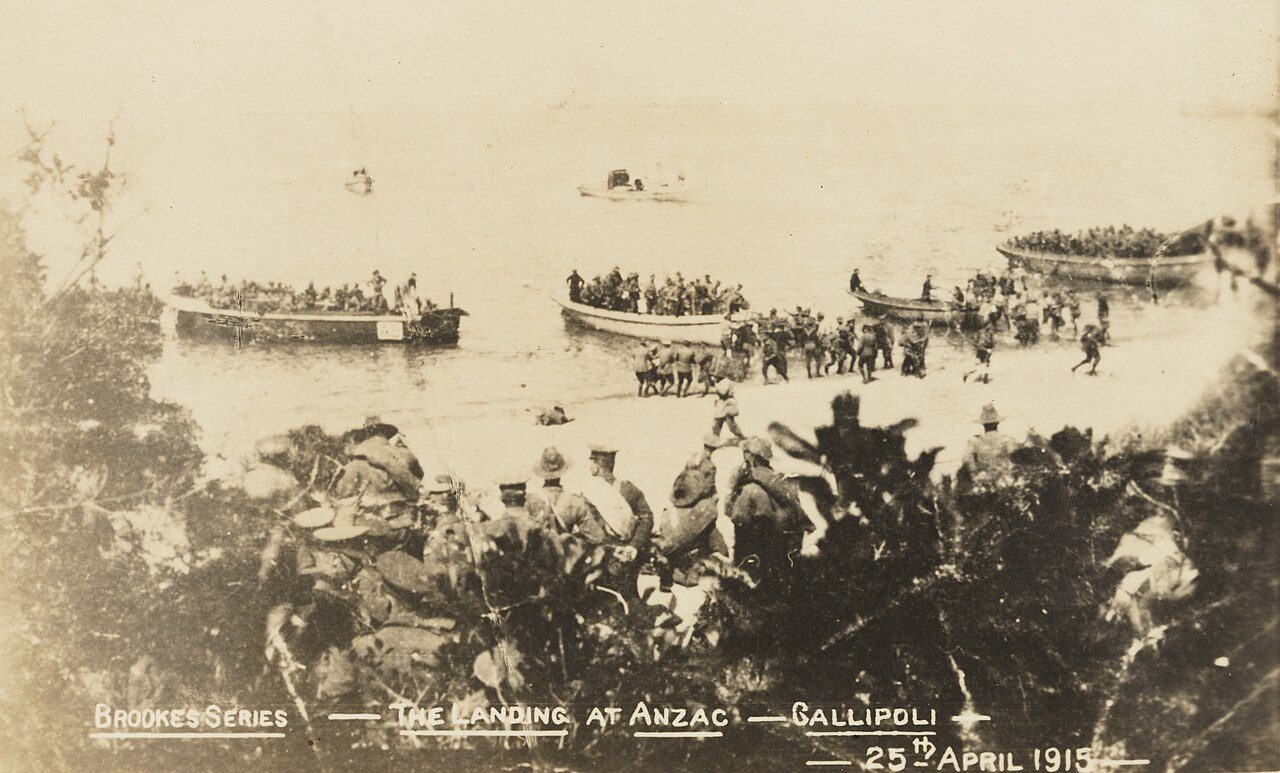
Before dawn on 25 April 1915, Australian and New Zealand troops — the ANZACs — stormed ashore on Turkey's Gallipoli Peninsula in an Allied attempt to knock the Ottoman Empire out of the First World War. The landing failed in its aims and began an eight-month campaign of attrition, yet its anniversary, Anzac Day, became the central day of remembrance for two nations. April 25 is also the day the Hubble telescope was deployed and Robinson Crusoe was published.
Choose another date: open the On This Day calendar to browse events, births and deaths for any day of the year.
At a Glance
- The plan
- Force the Dardanelles strait, take Constantinople and open a sea route to Russia, after a purely naval attack failed in March
- The landing
- Some 16,000 ANZAC troops ashore on the first day at the cove that took their name; British and French forces landed at Cape Helles
- The error
- In the darkness the first boats grounded about a kilometre north of the intended beach, beneath steep, broken ridges
- The first day
- By the evening of 25 April more than 2,000 ANZACs had been killed or wounded (National Museum of Australia)
- The campaign
- Eight months of stalemate; the Allies evacuated in December 1915 and January 1916, their one flawlessly executed operation
- The legacy
- Anzac Day, 25 April, is the national day of remembrance in Australia and New Zealand, marked with dawn services
Events on this day
- 1719Daniel Defoe's Robinson Crusoe is published in London — the shipwreck narrative that helps invent the English novel.
- 1859Ground is broken at Port Said for the Suez Canal, Ferdinand de Lesseps himself striking the first pickaxe blow.
- 1915Allied troops land on the Gallipoli Peninsula; the ANZACs come ashore at the cove that takes their name — the featured story above.
- 1945American and Soviet patrols meet on the Elbe at Torgau, Germany; the link-up cuts the Reich in two and is celebrated as Elbe Day.
- 1950The Boston Celtics draft Chuck Cooper, the first African American selected in an NBA draft.
- 1980A Dan-Air Boeing 727 crashes into a mountainside on Tenerife, killing all 146 people aboard.
- 1990The space shuttle Discovery's crew deploys the Hubble Space Telescope into orbit above the Earth.
- 1990Violeta Chamorro is inaugurated as president of Nicaragua, the first woman elected head of government in Central America.
- 2014Flint, Michigan switches its water supply to the Flint River; corrosive water leaches lead from pipes, opening a public-health crisis.
- 2015A magnitude 7.8 earthquake strikes Nepal, killing nearly 9,000 people and toppling temples and homes across the Kathmandu Valley.
Born on this day
- 1599Oliver Cromwell — English soldier and statesman who led Parliament to victory in the Civil War and ruled as Lord Protector.
- 1874Guglielmo Marconi — Italian inventor and pioneer of radio telegraphy, Nobel laureate in Physics.
- 1908Edward R. Murrow — American broadcast journalist whose wartime reports from London set the standard for the profession.
- 1917Ella Fitzgerald — American jazz singer, the 'First Lady of Song', whose voice defined an era of American music.
- 1940Al Pacino — American actor of The Godfather trilogy and Scarface, famed for his intensity on stage and screen.
Died on this day
- 1744Anders Celsius — Swedish astronomer who devised the temperature scale that bears his name, dead in Uppsala at 42.
- 1995Ginger Rogers — American dancer and actor, Fred Astaire's partner in ten films and an Oscar winner in her own right, dead at 83.
- 2006Jane Jacobs — American-Canadian writer whose The Death and Life of Great American Cities transformed urban planning, dead at 89.
The featured story: the Gallipoli landings, 25 April 1915
Gallipoli was a shortcut that became a siege. With the Western Front locked in trenches, Allied planners — Winston Churchill at the Admiralty chief among them — proposed forcing the Dardanelles, the strait guarding Constantinople, to knock the Ottoman Empire out of the war and open a warm-water route to Russia. A purely naval attempt in March 1915 failed with the loss of three battleships to mines. The task passed to the army, and to the volunteers of the Australian and New Zealand Army Corps — the ANZACs — training in Egypt, most of whom had never heard a shot fired in anger.
The Australian War Memorial describes the design: before dawn on 25 April, an armada assembled off the peninsula. The ANZACs were to land at Ari Burnu, on the Aegean coast, seize the ridges inland and cut across the peninsula while British and French divisions landed at its tip, Cape Helles. In the darkness and current, the towed boats of the first wave drifted north and grounded beneath steep, scrub-covered ridges at the cove that within days everyone called Anzac. The men scrambled up cliffs under fire, took the first ridge lines in small, mixed groups — and there the advance died, as Mustafa Kemal, the Turkish divisional commander who would found modern Turkey, fed his regiments into precisely the right ground.
By nightfall some 16,000 ANZACs were ashore and more than 2,000 were killed or wounded. They held a strip of land about a kilometre deep and two long — a battlefield so compressed that front line and beach were under the same guns. What followed was eight months of trench warfare in miniature: heat, flies, dysentery, the August offensive that briefly took Chunuk Bair and broke at Lone Pine's price, and snipers over every path. The campaign cost the Allies and the Ottomans roughly half a million casualties between them before the ANZACs were evacuated, silently and brilliantly, in December.
Failure on that scale might have been buried. Instead it was consecrated. The landing was the first great national undertaking of two young federations — Australia had federated only in 1901 — and official historian Charles Bean shaped the story of the citizen-soldier, the 'digger', into a founding myth of endurance and mateship. From 1916 the anniversary was marked, and Anzac Day grew into the most solemn date in both countries' calendars: dawn services at the hour of the landing, from the Australian War Memorial in Canberra to the cove itself, where Australians, New Zealanders and Turks now commemorate together above the beach.
Why this date matters
April 25 is the calendar's great day of landings and launchings: troops onto a Turkish beach in 1915, a telescope into orbit in 1990, a canal begun in the Egyptian sand in 1859 and a castaway launched into literature in 1719. It is also a day of reckonings — an earthquake that unmade a Himalayan capital in 2015, and a Michigan city whose poisoned water was switched on, unnoticed, in 2014. Beginnings, April 25 insists, are the easy part; what matters is the ground you land on.
Sources
- Encyclopaedia Britannica — On This Day: April 25
- HISTORY — What Happened on April 25
- National Museum of Australia — Gallipoli landing
- Australian War Memorial — The landing
The facts on this page were checked against these sources on 19 November 2026. The History Trail's permanent pages are researched and written for this site; the live profiles elsewhere on The History Trail are assembled automatically from Wikipedia and Wikidata.
About the Author
Researched and written by the The History Trail Editorial Team — the accountable editorial function behind this site's permanent story pages. The team works from the published sources cited on each page; it does not invent historians, reviewers or credentials, and it corrects errors openly.
Fact Check
Every load-bearing fact on this page traces to one of the sources listed above, and significant claims link to their source in the text. Our checking method is described on the methodology page; errors can be reported via the corrections page.
Sources & Citations
Cite this page as: The History Trail Editorial Team, The History Trail — this article's title, publication and update dates are shown beneath its headline. The full source list appears under Sources above; the site's source standards are on the sources page.