
Years
2003 in History
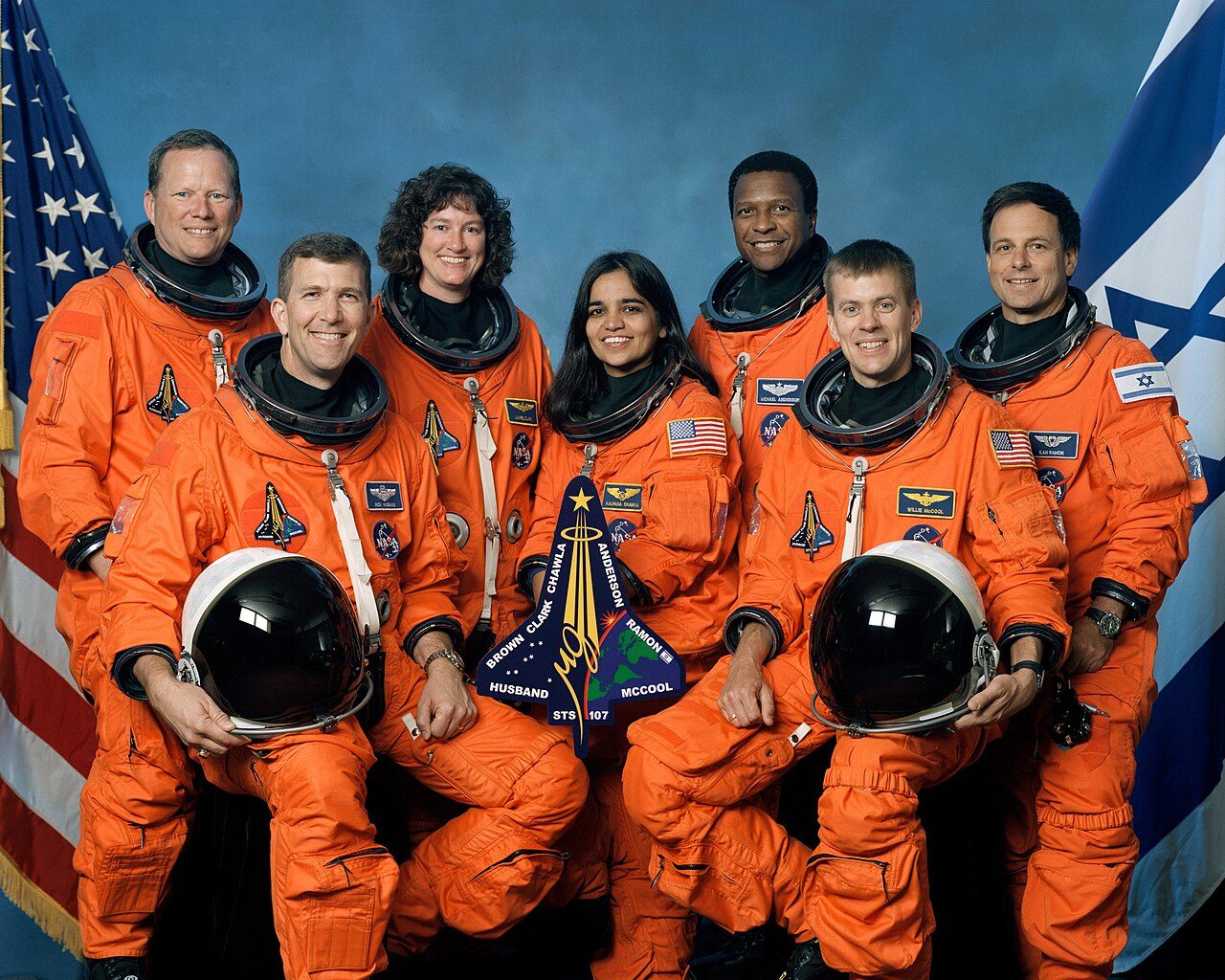
2003 is remembered for two shocks that bookended its spring: on 1 February the space shuttle Columbia broke up on re-entry, killing all seven astronauts aboard, and on 19 March President Bush announced the invasion of Iraq, whose first bombs fell on Baghdad within hours. Between and around them came the completion of the Human Genome Project, the end of Concorde, and the capture of Saddam Hussein in December.
At a Glance
- Defining event
- The U.S.-led invasion of Iraq begins, announced 19 March 2003
- The loss
- Space shuttle Columbia breaks up on re-entry, 1 February — all seven STS-107 astronauts killed
- The science milestone
- Human Genome Project declared complete on 14 April, two years ahead of schedule
- The farewell
- Concorde makes its final commercial flight on 24 October, ending supersonic passenger travel
- Opened the year
- Department of Homeland Security formally begins operations on 24 January
- Closed the year
- Saddam Hussein captured near Tikrit on 13 December
The defining story: invasion in Iraq, loss in orbit
The year began with America reorganising itself for a new kind of war: on 24 January the Department of Homeland Security formally began operations, with Tom Ridge as its first secretary. Nine days later the war on terror was overtaken by an older danger. Columbia, the oldest orbiter in NASA's fleet, was ending a sixteen-day science mission, STS-107, carrying seven astronauts — Rick Husband, William McCool, Michael Anderson, Kalpana Chawla, David Brown, Laurel Clark and Ilan Ramon — who had completed some eighty experiments in orbit. Eighty-two seconds after launch on 16 January, a piece of insulating foam had struck the leading edge of its left wing and punched a hole in its heat shield. On 1 February, as Columbia crossed the American Southwest toward a landing in Florida, superheated gas streamed into the wing and the orbiter disintegrated at some 200,000 feet. All seven died.
The inquiry that reported that August found the physical cause in the foam strike but the deeper cause in NASA itself: a culture that had normalised flying with known foam damage, seventeen years after the same kind of institutional failure had destroyed Challenger. The shuttle fleet was grounded for twenty-nine months. By then, however, the world's attention had moved to Iraq. On 5 February Secretary of State Colin Powell addressed the United Nations, arguing that Iraq possessed weapons of mass destruction. On 15 February millions of people in more than 600 cities marched against the impending invasion — to no effect. Inspectors had returned under UN Resolution 1441 but found no stockpiles, and on 17 March Bush gave Saddam Hussein 48 hours to leave Iraq.
On the evening of 19 March, Washington time, Bush announced that coalition forces were in the early stages of military operations; the first bombs fell on Baghdad in the early hours of 20 March local time. The ground invasion followed from Kuwait, Basra was secured in the south, and on 9 April resistance in Baghdad collapsed and Saddam's statue was pulled down in Firdos Square. On 1 May Bush declared an end to major combat operations beneath a 'Mission Accomplished' banner. The conventional war had taken six weeks; the war itself lasted eight more years, and no weapons of mass destruction were ever found.
The manhunt ended on 13 December, when American soldiers found Saddam Hussein hiding in a concealed hole six to eight feet deep near Ad-Dawr, outside Tikrit, and captured him without resistance, eight months after his regime fell. Around these events the year turned in other directions: the World Health Organization issued a global alert over SARS on 12 March, the Human Genome Project was declared complete on 14 April, China sent Yang Liwei into orbit on 15 October, and on 24 October Concorde made its final commercial flight from New York to London, ending supersonic passenger travel. A year of invasion and loss was also a year in which a genome was finished and an era of flight quietly closed.
Timeline of 2003
- 24 January
The U.S. Department of Homeland Security formally begins operations, with Tom Ridge as its first secretary.
- 1 February
The space shuttle Columbia breaks up on re-entry, killing all seven astronauts aboard.
- 5 February
Secretary of State Colin Powell addresses the United Nations, arguing that Iraq possesses weapons of mass destruction.
- 15 February
Millions of people in more than 600 cities around the world march against the impending invasion of Iraq.
- 12 March
The World Health Organization issues a global alert over SARS, the new respiratory disease spreading from Asia.
- 19 March
President Bush announces the invasion of Iraq; the first bombs fall on Baghdad in the early hours of 20 March local time.
- 14 April
The Human Genome Project is declared complete, two years ahead of schedule, having sequenced the human genetic code.
- 26 June
In Lawrence v. Texas, the United States Supreme Court strikes down the remaining state sodomy laws.
- 14 August
A cascading power failure blacks out much of the north-eastern United States and Ontario, leaving tens of millions without electricity.
- 15 October
Yang Liwei orbits the Earth aboard Shenzhou 5, becoming the first person sent into space by China's space programme.
- 24 October
Concorde makes its final commercial flight, from New York's JFK to London Heathrow, ending supersonic passenger travel.
- 13 December
Saddam Hussein is captured by U.S. soldiers near Tikrit, Iraq, hiding in a hole six to eight feet deep.
Why 2003 still matters
The Iraq War defined the decade that followed it. Britannica records some 4,500 American service members killed and some 32,000 wounded across the conflict, with Iraqi deaths far higher and still disputed, and the United States did not complete its withdrawal until December 2011. The invasion's central justification — stockpiles of weapons of mass destruction — was never borne out, and the argument over how the case was made has shaped trust in governments and intelligence ever since. The capture of Saddam in December closed the manhunt without closing the war: insurgency and sectarian violence grew in the years after his fall, far beyond anything the invasion's planners had predicted.
Columbia changed spaceflight just as permanently. The shuttle fleet returned to flight in 2005 under strict new rules and was retired in 2011 once the space station was complete; the disaster's lesson — that organisational culture, not only hardware, kills crews — is now taught far beyond NASA. The year's quieter milestones compounded slowly: the completed human genome became the reference for modern medicine, Lawrence v. Texas and Massachusetts' Goodridge ruling in November advanced gay rights in the United States, and Concorde's retirement on 24 October, followed by its final museum flight on 26 November, left scheduled supersonic passenger flight unreplaced. Even Dolly the sheep, the first mammal cloned from an adult cell, died that February at six years old — a reminder of how much of the future arrived, and ended, in a single year.
2003 on The History Trail
Columbia, the Iraq invasion and the capture of Saddam Hussein are all told in full on The History Trail.
- February 1 in History — The space shuttle Columbia disaster — the loss of STS-107 and its seven astronauts.
- March 19 in History — The Iraq War begins — Bush announces the invasion as the first bombs fall on Baghdad.
- December 13 in History — The capture of Saddam Hussein near Tikrit, eight months after his regime fell.
- April 14 in History — The Human Genome Project is declared complete.
- October 24 in History — Concorde makes its final commercial flight, ending supersonic passenger travel.
- Concorde — faster than the turning Earth — The supersonic airliner whose 27 years of service ended in 2003.
Sources
- Encyclopaedia Britannica — On This Day: February 1
- Smithsonian National Air and Space Museum — Reflections on the Loss of STS-107
- Encyclopaedia Britannica — On This Day: February 5
- Encyclopaedia Britannica — Iraq War (summary)
- Encyclopaedia Britannica — On This Day: March 19
- Encyclopaedia Britannica — On This Day: April 14
- Encyclopaedia Britannica — On This Day: October 24
- HISTORY — Saddam Hussein captured
The facts on this page were checked against these sources on 19 November 2026. The History Trail's permanent pages are researched and written for this site; the live profiles elsewhere on The History Trail are assembled automatically from Wikipedia and Wikidata.
About the Author
Researched and written by the The History Trail Editorial Team — the accountable editorial function behind this site's permanent story pages. The team works from the published sources cited on each page; it does not invent historians, reviewers or credentials, and it corrects errors openly.
Fact Check
Every load-bearing fact on this page traces to one of the sources listed above, and significant claims link to their source in the text. Our checking method is described on the methodology page; errors can be reported via the corrections page.
Sources & Citations
Cite this page as: The History Trail Editorial Team, The History Trail — this article's title, publication and update dates are shown beneath its headline. The full source list appears under Sources above; the site's source standards are on the sources page.