
On This Day
February 1 in History
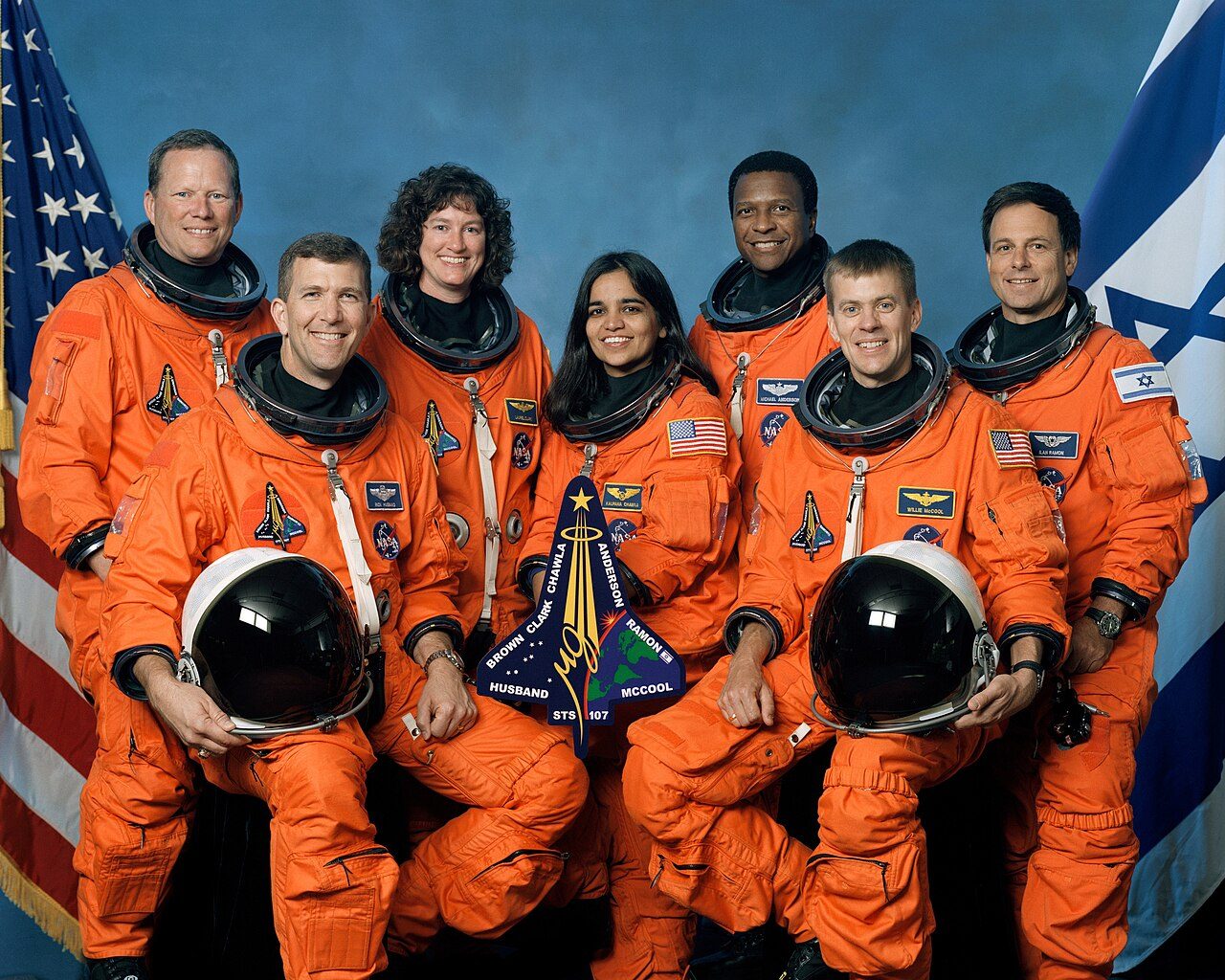
On 1 February 2003 the space shuttle Columbia broke up as it re-entered the atmosphere over Texas, minutes from landing, killing all seven members of its crew — the disaster that ended the shuttle era's innocence. February 1 is also the day the United States Supreme Court first sat, the Greensboro sit-ins began and Ayatollah Khomeini returned to Iran.
Choose another date: open the On This Day calendar to browse events, births and deaths for any day of the year.
At a Glance
- The mission
- STS-107, a 16-day science mission launched on 16 January 2003 with some 80 experiments aboard
- The crew
- Seven astronauts: Rick Husband, William McCool, Michael Anderson, Kalpana Chawla, David Brown, Laurel Clark and Ilan Ramon
- The cause
- A piece of insulating foam struck the leading edge of the left wing during launch, breaching its heat shield
- The loss
- Columbia broke apart at about 200,000 feet, travelling at roughly Mach 18, some 16 minutes before its scheduled landing
- The inquiry
- The Columbia Accident Investigation Board blamed both the foam strike and NASA's organisational culture
- The aftermath
- The shuttle fleet was grounded for more than two years and the programme was retired in 2011
Events on this day
- 1790The United States Supreme Court meets for the first time, in the Royal Exchange Building in New York, with Chief Justice John Jay presiding.
- 1923Benito Mussolini's Blackshirt paramilitaries are officially transformed into a national militia, the Voluntary Fascist Militia for National Security.
- 1884The first fascicle of the Oxford English Dictionary is published, the opening instalment of the most comprehensive dictionary of English ever attempted.
- 1887Harvey Wilcox officially registers the name Hollywood with the Los Angeles County recorder, giving the future film capital its legal start.
- 1896Giacomo Puccini's opera La Boheme premieres at the Teatro Regio in Turin and goes on to become one of the most loved operas ever written.
- 1917Germany resumes unrestricted submarine warfare, sinking neutral shipping without warning — a decision that helps bring the United States into the First World War.
- 1946Trygve Lie of Norway becomes the first Secretary-General of the newly founded United Nations.
- 1960Four Black students begin the Greensboro sit-ins at a segregated Woolworth lunch counter in North Carolina, sparking a wave of sit-ins across the South.
- 1979Ayatollah Ruhollah Khomeini returns to Iran in triumph after fifteen years of exile, two weeks after the shah fled the country.
- 1979Homebrewing beer and wine becomes legal in the United States, as a provision signed by President Jimmy Carter the previous October takes effect.
- 2003The space shuttle Columbia breaks up on re-entry, killing all seven astronauts aboard — the featured story above.
- 2021Myanmar's military seizes power in a coup, detaining Aung San Suu Kyi and ending a decade of partial civilian rule.
Born on this day
- 1901Clark Gable — American film star, the 'King of Hollywood', Oscar winner for It Happened One Night and Rhett Butler in Gone with the Wind.
- 1901Langston Hughes — American poet and leader of the Harlem Renaissance, the defining voice of jazz poetry.
- 1931Boris Yeltsin — first popularly elected president of Russia, who guided the country through the post-Soviet transition of the 1990s.
- 1933Reynolds Price — American novelist, poet and Duke University professor, author of A Long and Happy Life.
- 1972Tego Calderon — Puerto Rican rapper and actor, a pioneer of reggaeton.
Died on this day
- 1851Mary Shelley — English novelist, author of Frankenstein, dead in London at 53.
- 1944Piet Mondrian — Dutch painter and pioneer of abstract art, famed for his grids of black lines and primary colours, dead in New York.
- 2013Ed Koch — combative three-term mayor of New York City, dead at 88 on the day a documentary about his life was released.
- 2020Andy Gill — English guitarist and founding member of the post-punk band Gang of Four.
The featured story: the loss of the space shuttle Columbia, 1 February 2003
Columbia was the oldest orbiter in NASA's fleet and the first to fly in space, in 1981. Its twenty-eighth mission, STS-107, was unusual: a dedicated science flight rather than a construction trip to the International Space Station. Launched on 16 January 2003, it carried a Spacehab research module and a crew of seven who worked in two shifts around the clock, completing some eighty experiments in physics, biology and materials science. The crew — commander Rick Husband, pilot William McCool, payload commander Michael Anderson, mission specialists Kalpana Chawla, David Brown and Laurel Clark, and Israeli payload specialist Ilan Ramon — were, by every account, having an exceptionally productive flight.
Eighty-two seconds after launch, a briefcase-sized piece of insulating foam broke away from the external tank and struck the leading edge of Columbia's left wing. The impact was recorded on launch cameras and noticed the next day, but engineers could not determine how serious the damage was, requests for satellite imagery of the wing were not pursued, and the crew were never told there might be a problem. In fact the foam had punched a hole in one of the reinforced carbon-carbon panels that protect the wing from the heat of re-entry. For sixteen days the hole sat silent in orbit; it became lethal only when Columbia turned for home.
On the morning of 1 February, Columbia fired its engines over the Indian Ocean and began its descent toward the Kennedy Space Center, where families and NASA staff were waiting for a 9:16 a.m. landing. As the orbiter crossed California and the Southwest, superheated gas streamed into the damaged wing, melting its aluminium structure. Sensors began to fail in a cascade that ground controllers watched with growing alarm. At about 9:00 a.m. Eastern time, Husband's final, cut-off transmission — 'Roger, uh, bu—' — was followed by silence. Observers in Texas saw bright streaks breaking away across the sky: Columbia was disintegrating at some 200,000 feet and eighteen times the speed of sound. All seven astronauts died, and debris fell across hundreds of miles of Texas and Louisiana.
The Columbia Accident Investigation Board, reporting that August, found the physical cause in the foam strike but the deeper cause in NASA itself: a culture in which schedule pressure and past success had normalised flying with known foam damage, seventeen years after the same kind of institutional failure had destroyed Challenger. The shuttle fleet was grounded for twenty-nine months, returned to flight in 2005 under strict new rules, and was retired in 2011 once the space station was complete. A roll of film recovered from the wreckage held the crew's in-flight portrait — smiling, in their red and blue shirts — which became the disaster's defining image.
Why this date matters
February 1 keeps staging beginnings and endings at the same table. The Supreme Court sat for the first time on this day in 1790 and the Oxford English Dictionary began its long publication in 1884; Hollywood was registered in 1887 and the United Nations got its first Secretary-General in 1946. Yet the same date carries rupture: Germany's return to unrestricted submarine warfare in 1917, Khomeini's return to Iran in 1979, a coup in Myanmar in 2021 — and, above all, the morning in 2003 when Columbia and her seven astronauts did not come home. It is a date about institutions starting, and about how suddenly they can be tested.
Sources
- Encyclopaedia Britannica — On This Day: February 1
- HISTORY — What Happened on February 1
- Smithsonian National Air and Space Museum — Reflections on the Loss of STS-107
- NASA — Remembering STS-107 and Her Crew
The facts on this page were checked against these sources on 19 November 2026. The History Trail's permanent pages are researched and written for this site; the live profiles elsewhere on The History Trail are assembled automatically from Wikipedia and Wikidata.
About the Author
Researched and written by the The History Trail Editorial Team — the accountable editorial function behind this site's permanent story pages. The team works from the published sources cited on each page; it does not invent historians, reviewers or credentials, and it corrects errors openly.
Fact Check
Every load-bearing fact on this page traces to one of the sources listed above, and significant claims link to their source in the text. Our checking method is described on the methodology page; errors can be reported via the corrections page.
Sources & Citations
Cite this page as: The History Trail Editorial Team, The History Trail — this article's title, publication and update dates are shown beneath its headline. The full source list appears under Sources above; the site's source standards are on the sources page.