
Years
1999 in History
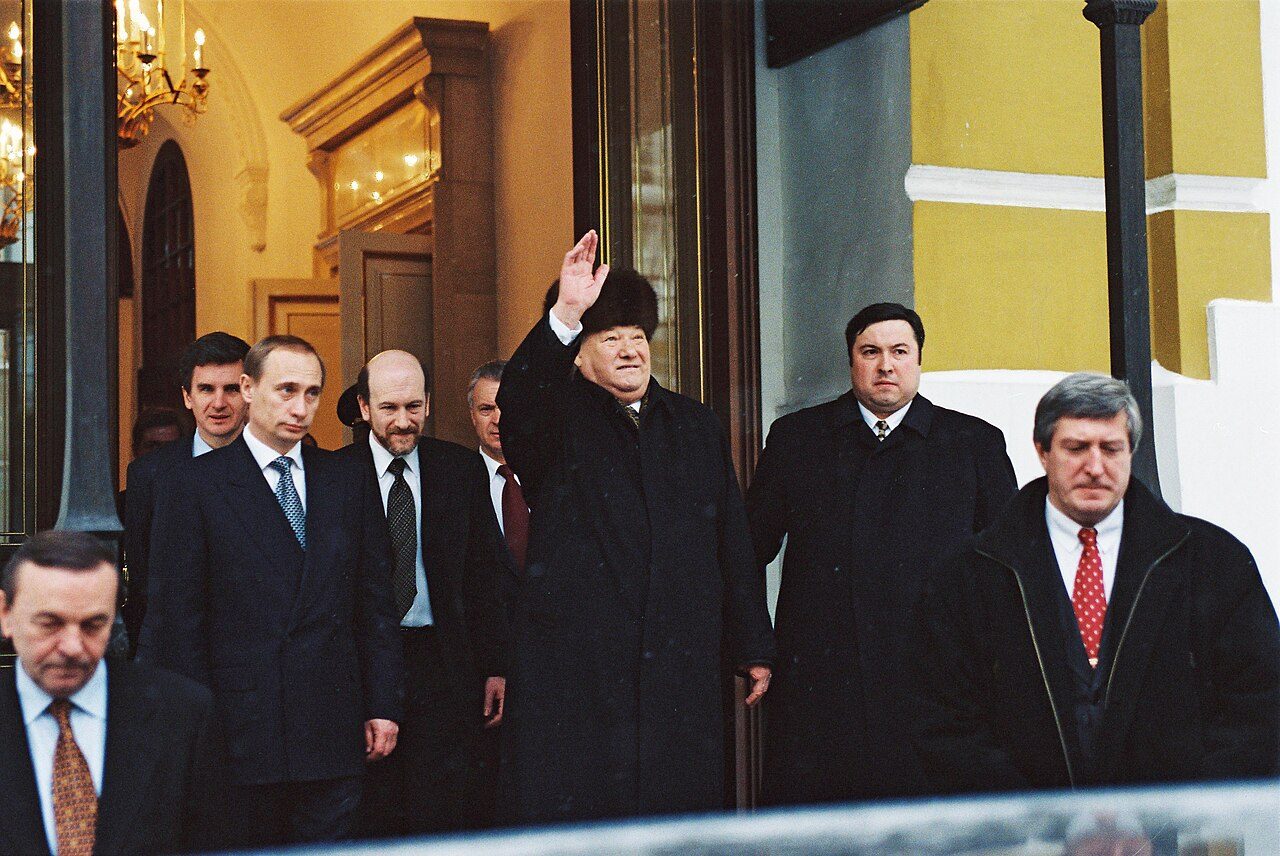
1999, the century's last year, closed with a transfer of power: on 31 December Boris Yeltsin resigned as president of Russia in a pre-recorded televised address, asked the nation's forgiveness, and handed power to Vladimir Putin as acting president. The year had opened with the euro's launch in 11 European countries and created Canada's territory of Nunavut in April.
At a Glance
- Defining event
- Boris Yeltsin resigns, 31 December; Vladimir Putin becomes acting president of Russia
- Opened the year
- The euro is introduced as an accounting currency in 11 European countries, 1 January
- New territory
- Nunavut is created on 1 April, a self-governing Inuit territory in Canada's eastern Arctic
- Acquitted
- The U.S. Senate acquits President Bill Clinton on 12 February, ending his impeachment trial
- Alliance expands
- Poland, Hungary and the Czech Republic join NATO on 12 March, its first expansion into the former Warsaw Pact
- Handover
- Portugal hands Macau back to China on 20 December, ending more than four centuries of administration
The defining story: the resignation nobody expected
Boris Yeltsin had dominated Russia for a decade: the man on the tank defying the 1991 coup, the first president of the post-Soviet state, re-elected in 1996 despite a heart attack he concealed from voters. By 1999 he was ailing and deeply unpopular — the economy had crashed in 1998, a new war burned in Chechnya, parliament had tried to impeach him, and he had cycled through five prime ministers in seventeen months. The last of them, appointed in August 1999, was a former intelligence officer almost unknown to the public: Vladimir Putin. As Putin's popularity rose with the Chechnya campaign, Yeltsin prepared his exit.
The manner of it was pure Yeltsin — theatre with real stakes. On 29 December, in near-total secrecy, he recorded his New Year address. On the morning of the 31st he told Putin, and at noon the tape was broadcast. He told a stunned country that he had taken a decision he had pondered long and painfully, that he was resigning on the last day of the departing century, and he asked forgiveness — for the dreams that had not come true, for the pain of the transition. Under the constitution, Prime Minister Putin would act as head of state until elections in three months.
It was something no Russian ruler had ever done: a voluntary resignation, delivered voluntarily, on television, at the century's end. At noon the same day, in a quieter ceremony an ocean away, the United States formally transferred the Panama Canal to Panama under the Carter–Torrijos treaties of 1977 — the century's two great handovers sharing a single New Year's Eve. By the time the Kremlin chimes rang in the year 2000, Russia already had a new acting president, and the post-Soviet era had its second act.
The year had begun with a founding of the opposite kind. On 1 January the euro was introduced as an accounting currency in 11 European countries: all electronic transactions switched to it, though national notes and coins still circulated. The euro was the only major currency that began life invisible — numbers in bank accounts for three years before a single note or coin existed — the Maastricht project of 1992 arriving, on schedule, at the century's end.
Timeline of 1999
- 1 January
The euro is introduced as an accounting currency in 11 European countries; all electronic transactions switch to it.
- 19 January
The first BlackBerry device, the 850 pager, is released — putting email in pockets years before the smartphone era.
- 7 February
Abdullah II becomes king of Jordan on the death of his father, King Hussein.
- 12 February
The U.S. Senate acquits President Bill Clinton on both articles of impeachment, ending his trial.
- 12 March
Poland, Hungary and the Czech Republic join NATO, the alliance's first expansion into the former Warsaw Pact.
- 1 April
Canada divides the Northwest Territories to create Nunavut, a self-governing territory in the eastern Arctic.
- 20 April
Two students murder 12 fellow students and a teacher at Columbine High School in Colorado.
- 27 May
The UN war crimes tribunal at The Hague indicts Yugoslav president Slobodan Milosevic for crimes in Kosovo.
- 23 July
Eileen Collins becomes the first woman to command a space shuttle, leading Columbia on mission STS-93.
- 30 August
East Timor votes overwhelmingly for independence from Indonesia in a United Nations referendum.
- 12 October
General Pervez Musharraf seizes power in Pakistan in a bloodless coup, overthrowing Prime Minister Nawaz Sharif.
- 2 December
Scientists announce that they have sequenced human chromosome 22, the first human chromosome to be fully decoded.
- 20 December
Portugal hands Macau back to China, ending more than four centuries of Portuguese administration.
- 31 December
Boris Yeltsin resigns as president of Russia and Vladimir Putin becomes acting president.
Why 1999 still matters
Yeltsin's resignation set the terms of the century that followed. The transfer he staged — secret recording, televised apology, a chosen successor installed as acting president in time to face elections three months later — became the founding scene of modern Russia, and Putin, the former intelligence officer almost unknown in August 1999, defined what followed it. December 31 is the calendar's great threshold, and 1999 filled it exactly: a presidency passed, live on television, from the man who buried the Soviet Union to the man who would define its successor state.
The year's constructive foundings were equally durable. The euro, launched invisibly on 1 January, became within three years the cash of more than 300 million people — a currency built by treaty, adopted voluntarily, state by state, with banknotes showing imaginary bridges rather than national heroes so that the money belonged to no single nation. Nunavut, created on 1 April, gave the Inuit a self-governing homeland covering a fifth of Canada's land mass under the 1993 Nunavut Act and Land Claims Agreement — the first change to Canada's map in fifty years, negotiated into existence rather than fought for.
The rest of 1999 reads as the old century settling its accounts: Clinton acquitted in February; NATO expanding into the former Warsaw Pact in March; Milosevic indicted at The Hague in May; East Timor voting for independence in August; Musharraf seizing power in Pakistan in October; Macau handed back in December. And on 2 December scientists announced the sequencing of human chromosome 22, the first to be fully decoded — the new century's science arriving, like the euro, just before the calendar turned.
1999 on The History Trail
Yeltsin's resignation and the euro's launch lead this year on The History Trail.
- December 31 in History — Boris Yeltsin resigns; Vladimir Putin becomes acting president — a featured story of 1999.
- April 1 in History — The territory of Nunavut is created — the year's other featured story.
- January 1 in History — The euro is introduced in 11 European countries.
- January 19 in History — The first BlackBerry device is released.
- December 20 in History — Portugal hands Macau back to China.
- Euro — The currency built by treaty and launched, without cash, in 1999.
- Microsoft — The company whose software age framed the century's final year.
Sources
- Encyclopaedia Britannica — On This Day: December 31
- Encyclopaedia Britannica — On This Day: April 1
- Encyclopaedia Britannica — On This Day: January 1
- Encyclopaedia Britannica — On This Day: December 20
- Encyclopaedia Britannica — On This Day: March 12
The facts on this page were checked against these sources on 19 November 2026. The History Trail's permanent pages are researched and written for this site; the live profiles elsewhere on The History Trail are assembled automatically from Wikipedia and Wikidata.
About the Author
Researched and written by the The History Trail Editorial Team — the accountable editorial function behind this site's permanent story pages. The team works from the published sources cited on each page; it does not invent historians, reviewers or credentials, and it corrects errors openly.
Fact Check
Every load-bearing fact on this page traces to one of the sources listed above, and significant claims link to their source in the text. Our checking method is described on the methodology page; errors can be reported via the corrections page.
Sources & Citations
Cite this page as: The History Trail Editorial Team, The History Trail — this article's title, publication and update dates are shown beneath its headline. The full source list appears under Sources above; the site's source standards are on the sources page.