
On This Day
December 20 in History
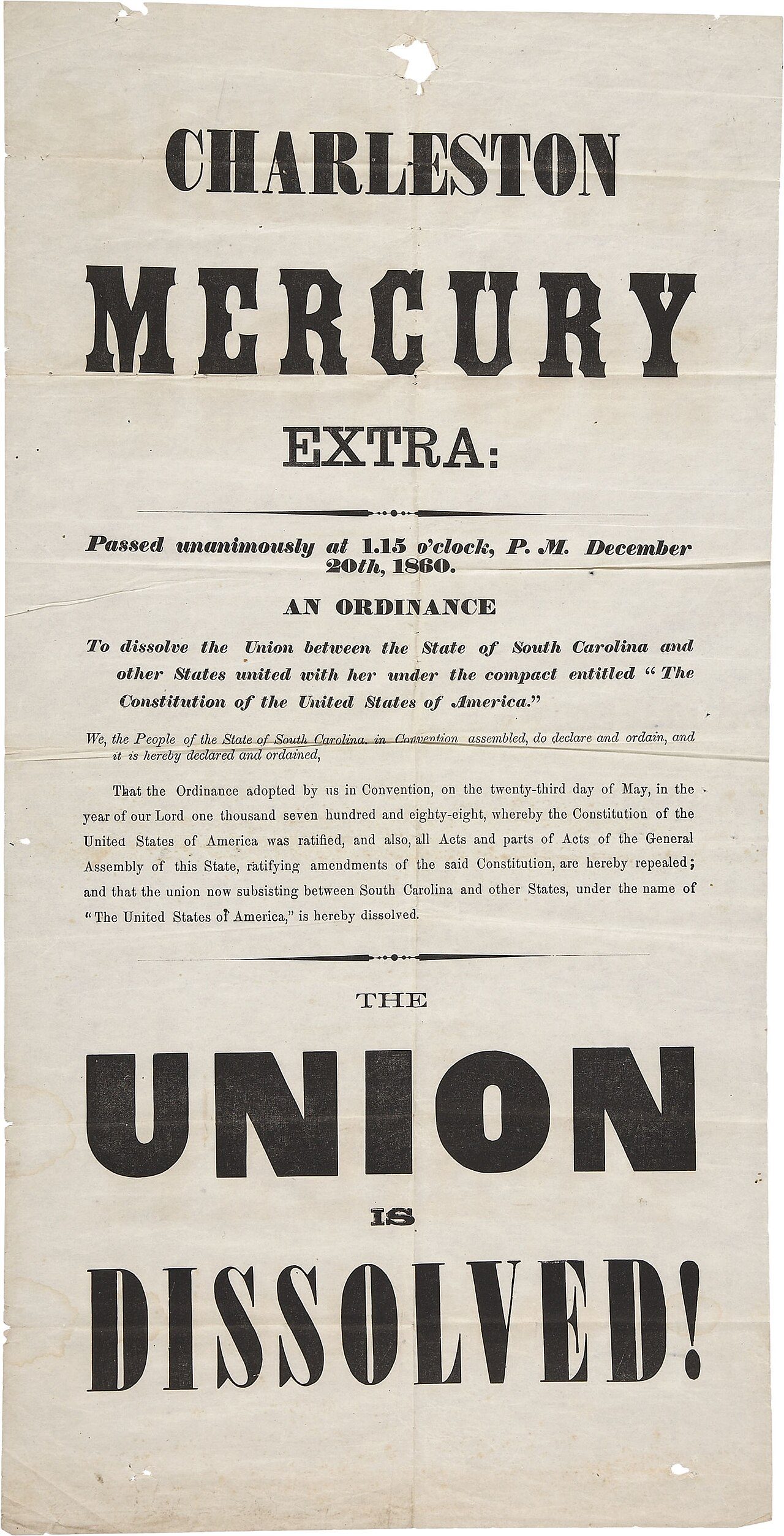
On 20 December 1860 a convention in Charleston voted unanimously, 169 to 0, to dissolve South Carolina's union with the United States — the first secession, six weeks after Abraham Lincoln's election, on the road to civil war. December 20 is also the day Louisiana was formally transferred to the United States in 1803 and It's a Wonderful Life premiered.
Choose another date: open the On This Day calendar to browse events, births and deaths for any day of the year.
At a Glance
- The vote
- Unanimous, 169–0, by South Carolina's secession convention at Charleston on 20 December 1860
- The act
- An ordinance repealing the state's 1788 ratification of the U.S. Constitution and declaring the union 'hereby dissolved'
- The trigger
- The election of Abraham Lincoln six weeks earlier, in November 1860
- The announcement
- The Charleston Mercury printed its 'The Union Is Dissolved!' broadside within about fifteen minutes of the vote
- The stated cause
- The convention's Declaration of Causes, issued 24 December, cited the non-slaveholding states' 'hostility… to the institution of slavery'
- What followed
- Six more Deep South states seceded by 1 February 1861; eleven states eventually formed the Confederacy
Events on this day
- 1803France formally transfers Louisiana to the United States at a ceremony in New Orleans, completing the Louisiana Purchase and nearly doubling the young republic's size.
- 1812The Brothers Grimm publish the first edition of their Children's and Household Tales — Grimm's Fairy Tales — in Berlin.
- 1860South Carolina becomes the first state to secede from the United States — the featured story above.
- 1941Adolf Hitler issues his 'no retreat' order to German armies before Moscow, forbidding any withdrawal in the face of the Soviet winter counteroffensive.
- 1946It's a Wonderful Life, Frank Capra's film starring James Stewart, premieres in New York; initially a modest success, it becomes the definitive American Christmas film.
- 1960The National Liberation Front — the Viet Cong — is formally established to fight the U.S.-backed government of South Vietnam.
- 1963The Berlin Wall is opened at Christmas for the first time, allowing West Berliners to visit relatives in the East for one-day passes.
- 1989The United States invades Panama in Operation Just Cause to depose military ruler Manuel Noriega.
- 1995NATO takes over peacekeeping duties in Bosnia from the United Nations, its first major deployment, after the Dayton peace agreement.
- 1999Portugal hands Macau back to China, ending more than four centuries of Portuguese administration of the enclave.
- 2019The United States Space Force is established as the sixth branch of the U.S. armed forces, the first new branch since 1947.
Born on this day
- 1629Pieter de Hooch — Dutch Golden Age painter of quiet, sunlit domestic interiors.
- 1838Edwin Abbott Abbott — English schoolmaster and theologian who wrote Flatland, the classic mathematical satire of Victorian society.
- 1841Ferdinand Buisson — French educator and politician who won the Nobel Peace Prize for his work on reconciliation after the First World War.
- 1898Irene Dunne — American actress, five times nominated for the Academy Award for Best Actress in the 1930s and 1940s.
- 1917David Bohm — American-British physicist whose interpretation of quantum mechanics challenged the Copenhagen orthodoxy.
- 1927Kim Young-sam — South Korean president who led the country's democratic consolidation in the 1990s.
- 1983Jonah Hill — American actor and filmmaker, Oscar-nominated for Moneyball and The Wolf of Wall Street.
Died on this day
- 1812Sacagawea — Shoshone woman who guided the Lewis and Clark expedition; she is generally believed to have died at Fort Manuel in present-day South Dakota, at about 24.
- 1968John Steinbeck — American novelist of The Grapes of Wrath and winner of the Nobel Prize in Literature, dead in New York at 66.
- 1973Bobby Darin — American singer of 'Mack the Knife' and actor, dead at 37 after heart surgery.
- 1996Carl Sagan — American astronomer whose Cosmos series brought the universe to hundreds of millions of viewers, dead at 62.
- 2001Léopold Sédar Senghor — poet and first president of Senegal, a founder of the Négritude movement, dead in France at 95.
- 2009Brittany Murphy — American actress of Clueless and 8 Mile, dead in Los Angeles at 32.
The featured story: South Carolina secedes, 20 December 1860
Abraham Lincoln's election in November 1860 was, for the slaveholding states of the Deep South, the signal they had long threatened to answer. Lincoln's Republican Party opposed the extension of slavery into the western territories, and South Carolina — the state of nullification, the cradle of secessionist doctrine — moved first and fastest. Its legislature called a state convention, and the convention assembled in Charleston, the city where the argument for disunion had been made loudest for thirty years. On 20 December 1860, at about a quarter past one in the afternoon, the 169 delegates voted unanimously to adopt an Ordinance of Secession.
The ordinance itself was short and legalistic, and all the more devastating for it. It repealed the ordinance of 1788 by which South Carolina had ratified the Constitution of the United States, repealed the state's ratifications of the Constitution's amendments, and declared 'that the union now subsisting between South Carolina and other States, under the name of the United States of America, is hereby dissolved.' Within about fifteen minutes the Charleston Mercury, the state's fiercely pro-secession newspaper, had its presses running: its broadside, headlined 'THE UNION IS DISSOLVED!', was the first printed announcement of secession and is regarded as the first Confederate imprint. Four days later, on 24 December, the convention issued its Declaration of the Immediate Causes, which stated plainly what the ordinance had left implicit: the state's grievance was the North's growing 'hostility on the part of the non-slaveholding States to the institution of slavery'. By one National Park Service-cited count, 153 of the 169 delegates who voted that day personally held enslaved people.
South Carolina did not stand alone for long. Mississippi, Florida, Alabama, Georgia and Louisiana followed in January 1861, and Texas on 1 February — seven states out before Lincoln had even taken office. They formed the Confederate States of America, and in April 1861 the argument became a war, opened by Confederate guns firing on Fort Sumter in Charleston's own harbour. The Civil War that followed lasted four years and killed more Americans than any other conflict in the nation's history; it ended with the Union preserved and slavery abolished — the precise opposite of everything the Charleston convention had voted for.
The broadside the Mercury printed that afternoon survives in museums as the birth announcement of a nation that lasted four years. The vote of 20 December 1860 is where the American Civil War truly begins: not with a battle but with a unanimous show of hands in a Charleston hall, by men who believed they were founding a republic to protect slavery, and who instead set in motion the process that destroyed it.
Why this date matters
December 20 is a date of transfers and beginnings at the hinge of the year. An empire hands a continent-sized territory across a table in New Orleans; two brothers in Kassel publish a book of tales told by firesides; West Berliners queue in the cold to see their families for a day; a new armed service is stood up in Washington. And at the centre stands the darkest transfer of all: a state handing itself out of a union, unanimously, in an afternoon. December 20 keeps showing how quickly the world can be rearranged by ceremony — a signature, a vote, a flag lowered and another raised.
Sources
- Encyclopaedia Britannica — On This Day: December 20
- HISTORY — This Day in History: December 20
- Gilder Lehrman Institute of American History — South Carolina Secedes from the Union
- National Park Service — Louisiana Territory Officially Transferred
- Smithsonian Institution — 'The Union is Dissolved!' Broadside
The facts on this page were checked against these sources on 19 November 2026. The History Trail's permanent pages are researched and written for this site; the live profiles elsewhere on The History Trail are assembled automatically from Wikipedia and Wikidata.
About the Author
Researched and written by the The History Trail Editorial Team — the accountable editorial function behind this site's permanent story pages. The team works from the published sources cited on each page; it does not invent historians, reviewers or credentials, and it corrects errors openly.
Fact Check
Every load-bearing fact on this page traces to one of the sources listed above, and significant claims link to their source in the text. Our checking method is described on the methodology page; errors can be reported via the corrections page.
Sources & Citations
Cite this page as: The History Trail Editorial Team, The History Trail — this article's title, publication and update dates are shown beneath its headline. The full source list appears under Sources above; the site's source standards are on the sources page.