
On This Day
December 31 in History
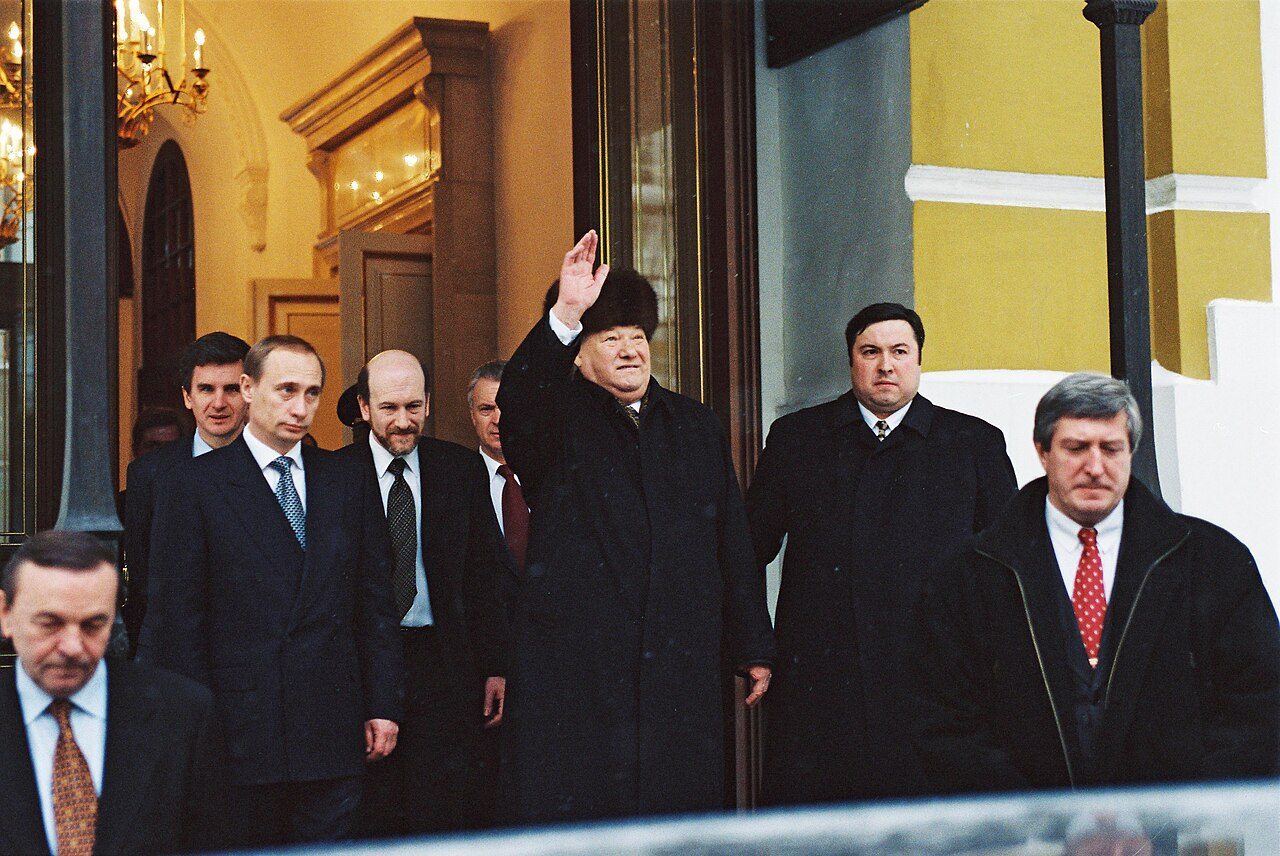
At noon on 31 December 1999, Russians preparing for the New Year heard their president do something no Russian ruler had ever done: Boris Yeltsin, in a televised address recorded in secret two days earlier, resigned voluntarily, apologised for his failures, and handed power to his prime minister, Vladimir Putin — the transfer that opened the twenty-first century in Russia. December 31 is also the day the East India Company was chartered, Edison first demonstrated his light bulb in public, and the Panama Canal changed hands.
Choose another date: open the On This Day calendar to browse events, births and deaths for any day of the year.
At a Glance
- The announcement
- A pre-recorded televised address broadcast at noon Moscow time on 31 December 1999, and repeated minutes before midnight in place of the traditional New Year address
- Recorded in secret
- Yeltsin taped the address on 29 December; only a handful of people knew before broadcast
- His apology
- 'I am resigning today, the last day of the departing century' — and he asked Russians' forgiveness for the dreams that had not come true
- The successor
- Prime Minister Vladimir Putin, in office only since August 1999, became acting president the same day
- The first decree
- As acting president, Putin signed a decree guaranteeing Yeltsin immunity from prosecution
- The election
- Putin was elected president in his own right on 26 March 2000
Events on this day
- 1600Queen Elizabeth I grants a royal charter to the East India Company, the trading corporation that will grow into the ruler of India.
- 1775American forces attack Quebec City in a snowstorm; General Richard Montgomery is killed and Benedict Arnold wounded in the failed assault.
- 1862The Union ironclad USS Monitor, hero of Hampton Roads, sinks in a storm off Cape Hatteras with the loss of sixteen of her crew.
- 1879Thomas Edison gives the first public demonstration of his incandescent lighting system, illuminating his Menlo Park laboratory and its street.
- 1907A ball is lowered in New York's Times Square for the first time to mark the New Year — an iron-and-wood sphere lit by a hundred bulbs.
- 1946President Harry Truman formally proclaims the end of the hostilities of the Second World War.
- 1951The Marshall Plan expires, having delivered more than $13 billion of American aid to rebuild Western Europe.
- 1968The Soviet Tu-144 supersonic airliner makes its first flight, two months before its rival Concorde.
- 1991The remaining institutions of the Soviet Union cease functioning as the state formally ends, eight years to the day before Yeltsin's resignation.
- 1992Czechoslovakia dissolves at midnight — the Velvet Divorce — splitting into the Czech Republic and Slovakia.
- 1999The United States formally transfers the Panama Canal to Panama at noon, under the Carter–Torrijos treaties of 1977.
- 1999Boris Yeltsin resigns as president of Russia and Vladimir Putin becomes acting president — the featured story above.
- 2019The World Health Organization's China office is informed of cases of pneumonia of unknown cause in Wuhan — the first official notice of what becomes COVID-19.
Born on this day
- 1869Henri Matisse — French artist whose colour revolutionised modern painting.
- 1908Simon Wiesenthal — Austrian Holocaust survivor who devoted his life to hunting Nazi war criminals.
- 1937Anthony Hopkins — Welsh actor, Oscar winner for The Silence of the Lambs.
- 1959Val Kilmer — American actor of Top Gun, Tombstone and Batman Forever.
- 1977Psy — South Korean singer, born Park Jae-sang, whose 'Gangnam Style' conquered the internet in 2012.
Died on this day
- 192Commodus — Roman emperor, strangled in his bath by the wrestler Narcissus after a failed poisoning.
- 1691Robert Boyle — Irish natural philosopher, founder of modern chemistry and formulator of Boyle's law.
- 1877Gustave Courbet — French painter, leader of the Realist movement, dead in exile in Switzerland.
- 1972Roberto Clemente — Puerto Rican baseball star, killed in a plane crash carrying earthquake relief to Nicaragua.
- 1985Rick Nelson — American singer and former teen idol, killed in a plane crash in Texas at 45.
The featured story: Yeltsin resigns and Putin takes over, 31 December 1999
Boris Yeltsin had dominated Russia for a decade: the man on the tank defying the 1991 coup, the first president of the post-Soviet state, re-elected in 1996 despite a heart attack he concealed from voters. By 1999 he was ailing and deeply unpopular — the economy had crashed in 1998, a new war burned in Chechnya, parliament had tried to impeach him, and he had cycled through five prime ministers in seventeen months. The last of them, appointed in August 1999, was a former intelligence officer almost unknown to the public: Vladimir Putin. As Putin's popularity rose with the Chechnya campaign, Yeltsin and his circle settled on the succession.
The manner of it was pure Yeltsin — theatre with real stakes. On 29 December, in near-total secrecy, he recorded his New Year address. On the morning of the 31st he told Putin, and at noon the tape was broadcast. 'I have taken a decision, one which I pondered long and painfully,' he told a stunned country. 'I am resigning today, the last day of the departing century.' He asked forgiveness — for the dreams that had not come true, for the pain of the transition — and announced that, under the constitution, Prime Minister Putin would act as head of state until elections in three months. In the Kremlin that afternoon he handed over the presidential briefcase with the nuclear codes, with the parting words: 'Take care of Russia.'
Putin moved at once. His first decree as acting president guaranteed Yeltsin and his family immunity from prosecution — the price, widely understood, of a peaceful handover. That night Russians heard two New Year addresses: Yeltsin's resignation, repeated before midnight, and then the new acting president's own greeting, in which Putin admitted his family had gathered to watch Yeltsin, 'but things took a different turn'. On 26 March 2000 Putin was elected president in the first round. He has dominated Russia ever since.
The transfer deserves its historical weight. Russia's rulers had died in office, been overthrown, or — in Gorbachev's case — had their state abolished beneath them; Yeltsin was the first to leave voluntarily, on camera, on a date of his own choosing, and to install an elected successor by constitutional process. That the successor became the system's permanent centre is the century's great irony: the most democratic act of Yeltsin's career opened the era that defined post-democratic Russia. It happened, fittingly, on the last day of the millennium year, with the whole country watching television.
Why this date matters
New Year's Eve is the calendar's great threshold, and December 31 fills it with transfers: a trading charter that will transfer a subcontinent, a canal handed from one nation to another, a federation dissolving at midnight, a ball descending over a square, and — in 1999 — the presidency of the world's largest country passed, live on television, from the man who buried the Soviet Union to the man who would define what followed it. It is a date of endings performed as ceremonies, of doors closing so that, at midnight, others can open.
Sources
- Encyclopaedia Britannica — On This Day: December 31
- HISTORY — What Happened on December 31
- Encyclopaedia Britannica — Boris Yeltsin
- Clinton White House Archives — Remarks by the President on Yeltsin, December 31, 1999
The facts on this page were checked against these sources on 19 November 2026. The History Trail's permanent pages are researched and written for this site; the live profiles elsewhere on The History Trail are assembled automatically from Wikipedia and Wikidata.
About the Author
Researched and written by the The History Trail Editorial Team — the accountable editorial function behind this site's permanent story pages. The team works from the published sources cited on each page; it does not invent historians, reviewers or credentials, and it corrects errors openly.
Fact Check
Every load-bearing fact on this page traces to one of the sources listed above, and significant claims link to their source in the text. Our checking method is described on the methodology page; errors can be reported via the corrections page.
Sources & Citations
Cite this page as: The History Trail Editorial Team, The History Trail — this article's title, publication and update dates are shown beneath its headline. The full source list appears under Sources above; the site's source standards are on the sources page.