
Years
1971 in History
1971 is remembered for secrets published and frontiers widened. The New York Times began printing the Pentagon Papers, the government's own secret history of the Vietnam War; Apollo 15's astronauts drove a car on the Moon for the first time; Bangladesh's independence was proclaimed amid a liberation war; and the United Nations seated the People's Republic of China in place of Taiwan.
At a Glance
- Defining event
- The New York Times begins publishing the Pentagon Papers, 13 June 1971
- Space first
- Apollo 15 astronauts drive the Lunar Roving Vehicle on the Moon, 31 July
- New nation
- Bangladesh's independence proclaimed 26 March; liberation war lasts until December
- Diplomatic turn
- Nixon announces he will visit China, 15 July; the UN seats Beijing over Taiwan, 25 October
- Voting age
- The Twenty-sixth Amendment lowers the United States voting age from 21 to 18, certified 5 July
- Closed the year
- Six Gulf emirates unite to form the United Arab Emirates, 2 December
The defining story: driving on the Moon, printing the secrets
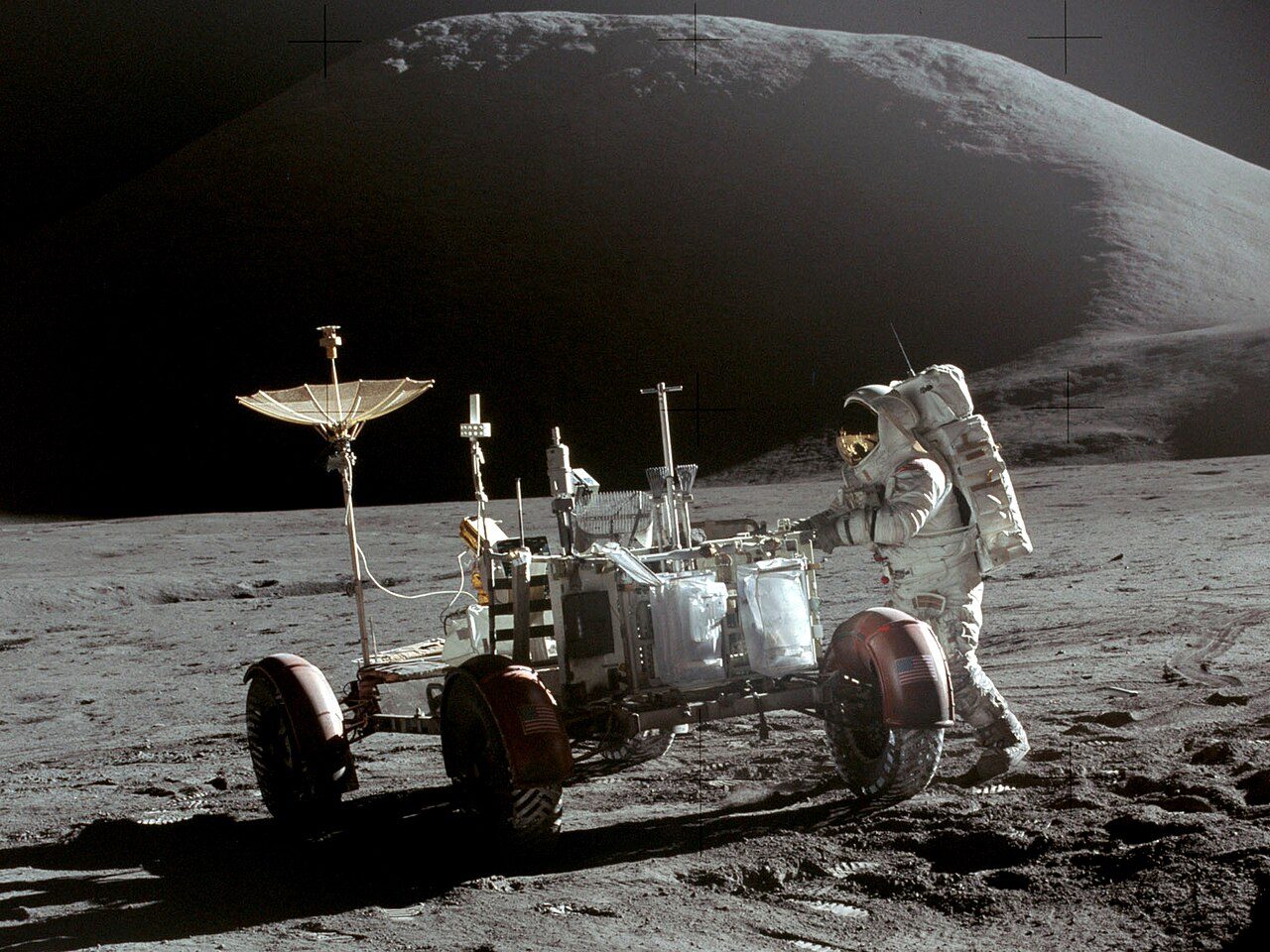
On 31 July 1971, on a grey plain at the foot of the lunar Apennines, two men unfolded a car. Apollo 15's Lunar Roving Vehicle had ridden to the Moon folded flat against the side of the lander Falcon, in a package the size of a wardrobe; commander David Scott and lunar module pilot James Irwin pulled the lanyards, locked the wheels and seats into place, and drove for the first time on another world — at walking pace, in silence, in vacuum. The photograph on this page shows Irwin at the rover during that first excursion, with Mount Hadley behind him, photographed by Scott.
The rover changed what a landing could be. Earlier crews had explored on foot, tethered by oxygen to a few hundred metres around the lander. The battery-powered vehicle — wire-mesh wheels, a T-handle for steering, a top speed of about 13 kilometres an hour — carried Scott and Irwin kilometres from Falcon, out to the edge of Hadley Rille and up the lower slopes of Mount Hadley Delta. Over three excursions they drove some 27.8 kilometres and gathered 77 kilograms of rock, including, at the rille's edge, the Genesis Rock, a piece of the Moon's original crust. Apollo 15 had landed at the Hadley-Apennine site the day before, the fourth crewed landing; the first drive, the record says, is the hinge on which exploration stopped being a walk and became a journey.
Six weeks earlier, the year's other defining act had happened in a newspaper office. On Sunday 13 June The New York Times began publishing the Pentagon Papers — a 7,000-page secret history of the Vietnam War, commissioned by the Pentagon itself, which showed that successive American governments had systematically misled the public about the war's aims, expansion and prospects. The study had been leaked by Daniel Ellsberg, a former Marine and defence analyst who had helped compile it. The Nixon administration obtained a restraining order — the first prior restraint on an American newspaper in the country's history — and the Washington Post, publishing its own copies, was restrained in turn.
On 30 June the Supreme Court ruled 6–3 that the government had not met the heavy burden required to stop the presses. The aftershocks were larger than the ruling: enraged by the leak, the White House created the Plumbers unit to discredit Ellsberg — and men from that unit were caught a year later inside the Watergate building, setting off the scandal that destroyed Nixon's presidency. Around those two stories the map itself moved: on 26 March Bangladesh's independence was proclaimed as Pakistan's army cracked down in Dhaka, beginning a liberation war that lasted until December; on 15 July Nixon announced on live television that he would visit the People's Republic of China; and on 25 October the United Nations voted to seat Beijing and expel Taiwan's government from China's seat.
Timeline of 1971
- 25 January
Army commander Idi Amin seizes power in Uganda in a military coup while President Milton Obote is abroad.
- 31 January
Apollo 14 lifts off for the Moon, with Alan Shepard, America's first man in space, in command.
- 8 February
The first Nasdaq trading session takes place, as the world's first electronic stock market begins operating.
- 26 March
Bangladesh's independence is proclaimed as Pakistan's army cracks down in Dhaka; the liberation war follows until December.
- 10 April
The United States table-tennis team arrives in China, the first American delegation invited since 1949, opening ping-pong diplomacy.
- 30 May
NASA launches Mariner 9, which becomes the first spacecraft to orbit Mars.
- 13 June
The New York Times begins publishing the Pentagon Papers, the government's secret history of the Vietnam War.
- 30 June
The three cosmonauts of Soyuz 11 are found dead on landing, killed by a loss of cabin air.
- 5 July
The Twenty-sixth Amendment is certified, lowering the United States voting age from 21 to 18.
- 15 July
President Nixon announces on live television that he will visit the People's Republic of China.
- 31 July
Apollo 15 astronauts drive the Lunar Roving Vehicle on the Moon for the first time.
- 9 September
Prisoners seize control of Attica prison in New York state, beginning a four-day uprising.
- 25 October
The United Nations votes to seat the People's Republic of China and expel Taiwan's government from China's seat.
- 2 December
Six Gulf emirates unite to form the United Arab Emirates.
Why 1971 still matters
The Pentagon Papers case, New York Times Co. v. United States, remains the landmark defence of press freedom against prior restraint — and its backstory is a warning about power's response to exposure: the effort to discredit one leaker built the unit that produced Watergate. Ellsberg himself walked free in 1973 not because the leak was ruled lawful, but because the government had burgled his psychiatrist's office and offered his trial judge the directorship of the FBI mid-trial; the judge dismissed all charges. The documents' central charge — that governments had misled the public about a war — reshaped how Vietnam, and official secrecy, were judged.
On the Moon, the rover's tracks are still printed in the dust of the Hadley plain, undisturbed by wind or rain, and all three rovers flown in 1971 and 1972 remain parked where their crews left them, the only cars ever driven on another world. Apollo 15's front steering failed on its first drive and was talked back to life by ground teams — a small rehearsal of the improvisation culture Apollo 13 had made famous the year before.
The year's geopolitics settled into shapes that lasted decades: Bangladesh emerged from the December end of its liberation war; China's seat at the United Nations, transferred in October, recognised where power in Asia actually lay, and Nixon's announced visit prepared the opening of 1972. At home, eighteen-year-olds gained the vote, Nasdaq began electronic trading, and Walt Disney World opened in Florida on 1 October — 1971's mixture of disclosure, exploration and commerce in a single calendar.
1971 on The History Trail
The Pentagon Papers and Apollo 15's first drive anchor this year on The History Trail.
- June 13 in History — The New York Times begins publishing the Pentagon Papers.
- July 31 in History — Apollo 15 astronauts drive the Lunar Roving Vehicle for the first time.
- March 26 in History — Bangladesh's independence is proclaimed in Dhaka.
- October 25 in History — The United Nations seats the People's Republic of China.
- United States dollar — The currency whose world changed in this era of floating money.
- Nike, Inc. — The company founded in this period of American sport and business.
Sources
- HISTORY — The New York Times publishes the 'Pentagon Papers'
- NASA — This Week in NASA History: First Use of the Lunar Roving Vehicle, July 31, 1971
- Encyclopaedia Britannica — On This Day: March 26
- Encyclopaedia Britannica — On This Day: October 25
- Encyclopaedia Britannica — On This Day: July 15
- Encyclopaedia Britannica — On This Day: December 2
- Encyclopaedia Britannica — On This Day: February 8
- Encyclopaedia Britannica — On This Day: September 9
The facts on this page were checked against these sources on 19 November 2026. The History Trail's permanent pages are researched and written for this site; the live profiles elsewhere on The History Trail are assembled automatically from Wikipedia and Wikidata.
About the Author
Researched and written by the The History Trail Editorial Team — the accountable editorial function behind this site's permanent story pages. The team works from the published sources cited on each page; it does not invent historians, reviewers or credentials, and it corrects errors openly.
Fact Check
Every load-bearing fact on this page traces to one of the sources listed above, and significant claims link to their source in the text. Our checking method is described on the methodology page; errors can be reported via the corrections page.
Sources & Citations
Cite this page as: The History Trail Editorial Team, The History Trail — this article's title, publication and update dates are shown beneath its headline. The full source list appears under Sources above; the site's source standards are on the sources page.