
On This Day
March 26 in History
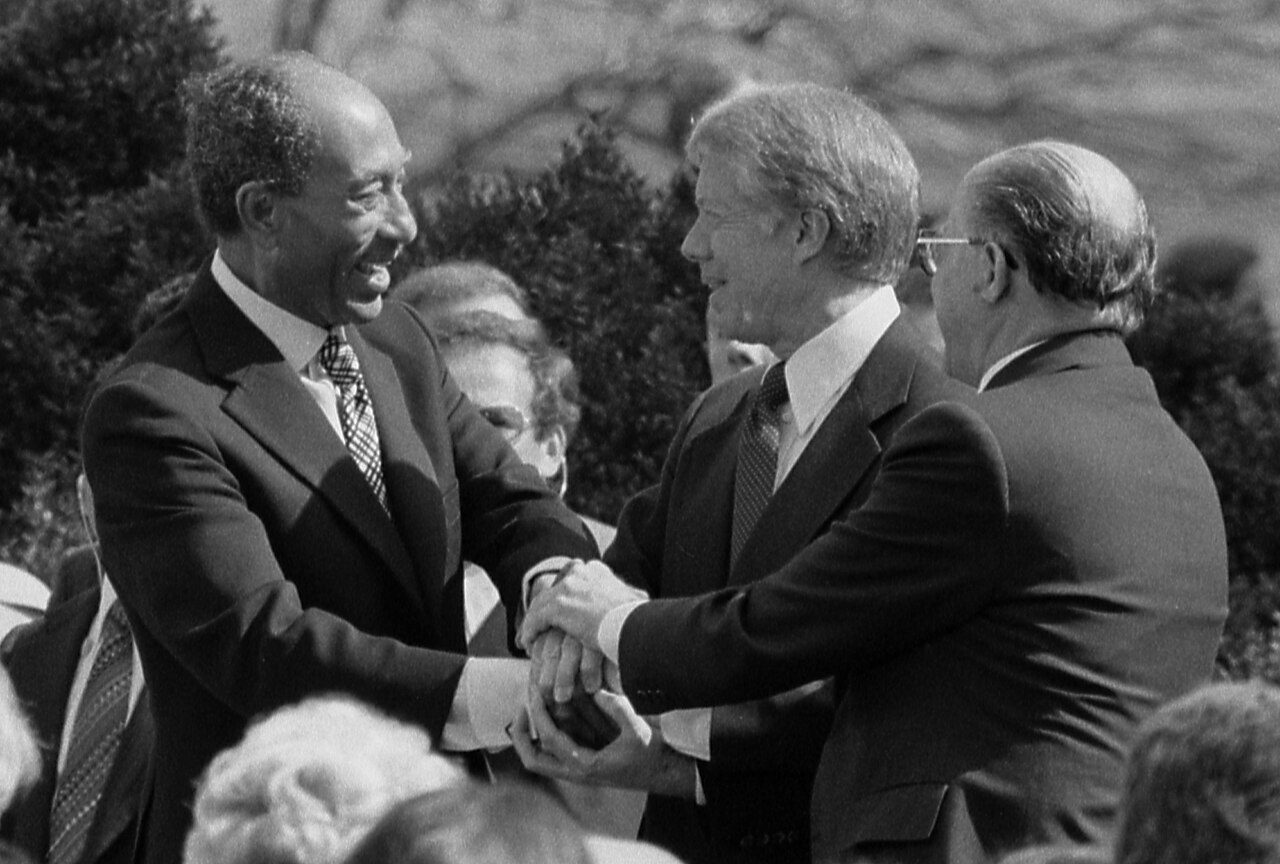
On 26 March 1979, on the North Lawn of the White House, Egyptian President Anwar Sadat and Israeli Prime Minister Menachem Begin signed a treaty of peace between their countries — the first ever between Israel and an Arab state, ending thirty years of war. President Jimmy Carter, who had brokered the deal through thirteen days at Camp David and months of shuttle diplomacy, signed as witness. The treaty has held ever since. March 26 is also the day Jonas Salk announced success for his polio vaccine and Bangladesh declared independence.
Choose another date: open the On This Day calendar to browse events, births and deaths for any day of the year.
At a Glance
- The road in
- Sadat's visit to Jerusalem in November 1977, then thirteen days of Camp David talks in September 1978 producing two framework accords
- The signing
- 26 March 1979, White House North Lawn, after six further months of negotiation; Carter signs as witness
- The exchange
- Israel to withdraw from the Sinai Peninsula, captured in 1967; Egypt to recognise Israel and open full diplomatic relations
- The men
- Sadat and Begin had shared the 1978 Nobel Peace Prize for the Camp David frameworks
- The cost to Egypt
- Suspension from the Arab League and isolation across the Arab world; Sadat was assassinated by Islamist soldiers in 1981
- The durability
- The treaty survived Sadat's assassination, wars in Lebanon and Gaza, and revolutions in Egypt — it remains in force
Events on this day
- 1752Britain enacts the Murder Act, adding posthumous dissection to the punishment for murder — an attempt to supply surgeons with bodies and deter killers by terror.
- 1812The Boston Gazette prints the 'Gerry-mander' cartoon, giving American politics the word gerrymander for districts drawn to favour one party.
- 1885Louis Riel's Métis forces clash with Canadian police at Duck Lake, Saskatchewan — the first fight of the North-West Rebellion.
- 1927Italy's Mille Miglia, the thousand-mile road race across the country, is run for the first time.
- 1953Jonas Salk announces that his killed-virus polio vaccine has been successfully tested, the first hopeful news against the disease that terrified every summer.
- 1971Bangladesh's independence is proclaimed as Pakistan's army cracks down in Dhaka; the liberation war that follows lasts until December.
- 1979Egypt and Israel sign their peace treaty in Washington — the featured story above.
- 1992Boxer Mike Tyson is sentenced to six years in prison in Indiana following his rape conviction.
- 1997Police in Rancho Santa Fe, California, find the bodies of 39 members of the Heaven's Gate group, dead by suicide in matching clothes and shoes.
- 2000Vladimir Putin is elected president of Russia for the first time, succeeding Boris Yeltsin.
- 2005Doctor Who returns to British television sixteen years after its cancellation, with Christopher Eccleston as the Doctor.
Born on this day
- 1874Robert Frost — American poet of rural New England, four-time Pulitzer Prize winner.
- 1911Tennessee Williams — American playwright of A Streetcar Named Desire and The Glass Menagerie.
- 1930Sandra Day O'Connor — first woman justice of the US Supreme Court, appointed in 1981.
- 1940Nancy Pelosi — American politician, the first woman Speaker of the US House of Representatives.
- 1941Richard Dawkins — British evolutionary biologist, author of The Selfish Gene.
- 1944Diana Ross — American singer, lead voice of the Supremes and a solo star.
Died on this day
- 1827Ludwig van Beethoven — German composer, dead in Vienna at 56, deaf for the last decade in which he wrote his greatest works.
- 1892Walt Whitman — American poet of Leaves of Grass, dead at Camden, New Jersey, at 72.
- 1923Sarah Bernhardt — French actress, the most famous stage performer of her age, dead in Paris at 78.
- 1959Raymond Chandler — American novelist who defined hard-boiled detective fiction with Philip Marlowe, dead at 70.
- 2011Geraldine Ferraro — American politician, the first woman nominated for vice president by a major US party, in 1984.
The featured story: the Egypt–Israel peace treaty, 26 March 1979
Egypt and Israel had fought four wars in thirty years — 1948, 1956, 1967 and 1973 — and the Sinai Peninsula, Egyptian land held by Israel since 1967, was both the prize and the obstacle. The break came from Cairo: in November 1977 President Anwar Sadat flew to Jerusalem and addressed the Israeli parliament, the first Arab leader to recognise Israel in deed. Negotiations then stalled for a year, until President Jimmy Carter staked his presidency on them, summoning Sadat and Prime Minister Menachem Begin to Camp David in September 1978. For thirteen days, as the State Department's history records, Carter shuttled between two men who would barely meet, and emerged with two framework accords — one for an Egypt–Israel treaty, one, vaguer, for Palestinian self-government.
Even then the treaty nearly failed. Six more months of argument over timetables, oil, settlements and wording followed, and Carter flew to Cairo and Jerusalem in March 1979 to close the last gaps in person. The final text was agreed on 13 March; Israel's Knesset approved it overwhelmingly, and on the afternoon of 26 March 1979 the three men sat down at a table on the White House North Lawn before some 4,000 guests. The treaty — a preamble, nine articles and annexes on withdrawal and security — ended the state of war, committed Israel to leave every part of Sinai, and committed Egypt to full peace: recognition, embassies, open borders and trade.
It was, and remains, a cold peace in places, but it is a real one. Israel completed the Sinai withdrawal in 1982, dismantling settlements to do it; Egypt regained its territory without another war. The Arab world punished Cairo — Egypt was suspended from the Arab League for a decade — and Sadat paid the highest price of all, assassinated in October 1981 by soldiers of Egyptian Islamic Jihad as he reviewed a parade celebrating the 1973 war. Begin and Sadat had shared the Nobel Peace Prize in 1978; the prize's other laureate outlived the treaty by decades of turbulence it survived anyway.
No Arab–Israeli document since has matched it. Jordan followed in 1994, and other agreements came and went, but the treaty of 26 March 1979 is still the load-bearing wall of the region's diplomacy: the first peace between Israel and an Arab state, kept by both sides through assassinations, revolutions and wars neither signatory lived to see. Carter called it the first step on a long and difficult road. It was signed, fittingly, in the open air — three signatures, one handshake joined by three hands, and thirty years of war closed with a pen.
Why this date matters
March 26 is a date of settlements, some signed and some imposed. A treaty in Washington in 1979 ended thirty years of war; a proclamation in Dhaka in 1971 began a war of independence; a statute in London in 1752 settled what would be done with murderers' bodies. Even its science is a settlement of fear — Salk's announcement in 1953 that polio could be beaten. The day's signature image is three men holding one handshake: the moment enemies agreed, on paper and in public, to stop.
Sources
- Encyclopaedia Britannica — On This Day: March 26
- HISTORY — This Day in History: March 26
- US Department of State, Office of the Historian — Camp David Accords and the Arab-Israeli Peace Process
- US Department of State, Office of the Historian — Foreign Relations of the United States, 1977–1980, Editorial Note on the Treaty Signing
The facts on this page were checked against these sources on 19 November 2026. The History Trail's permanent pages are researched and written for this site; the live profiles elsewhere on The History Trail are assembled automatically from Wikipedia and Wikidata.
About the Author
Researched and written by the The History Trail Editorial Team — the accountable editorial function behind this site's permanent story pages. The team works from the published sources cited on each page; it does not invent historians, reviewers or credentials, and it corrects errors openly.
Fact Check
Every load-bearing fact on this page traces to one of the sources listed above, and significant claims link to their source in the text. Our checking method is described on the methodology page; errors can be reported via the corrections page.
Sources & Citations
Cite this page as: The History Trail Editorial Team, The History Trail — this article's title, publication and update dates are shown beneath its headline. The full source list appears under Sources above; the site's source standards are on the sources page.