
Years
1952 in History
1952 is remembered for an accession that happened in a tree: on 6 February George VI died in his sleep at Sandringham, and his twenty-five-year-old daughter, spending the night in a treetop hotel in Kenya, became Queen Elizabeth II — beginning a reign of more than seventy years. The same year erased a Pacific island with the first hydrogen bomb, overthrew Egypt's monarchy, opened The Mousetrap in London, and closed with the Great Smog settling over the capital for five days.
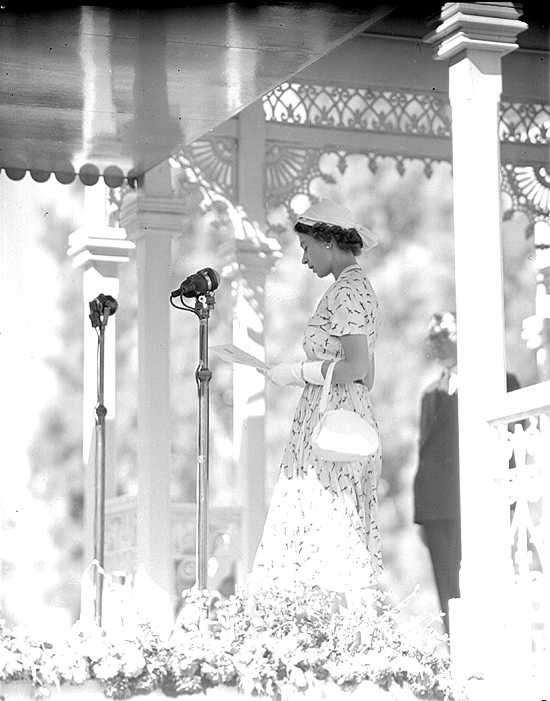
At a Glance
- Defining event
- Accession of Elizabeth II, 6 February: George VI dies and his daughter, in Kenya, becomes queen, beginning a reign of more than seventy years
- Arms race
- The United States detonates Ivy Mike, the first full-scale thermonuclear device, at Enewetak Atoll, 1 November — 10.4 megatons, vaporising the island of Elugelab
- Third power
- Britain tests its first atomic bomb, Operation Hurricane, off the Montebello Islands, Australia, 3 October
- Revolution
- Egypt's Free Officers seize power on 23 July, forcing King Farouk to abdicate within days
- Disaster
- The Great Smog settles over London from 5 December for five days; it is blamed for at least 4,000 deaths and drives Britain toward clean-air law
- Longest run
- Agatha Christie's The Mousetrap opens in London, 25 November — it becomes the longest-running play in history
The defining story: a princess in a tree becomes queen
George VI had never expected to be king, and the burden — a shy man with a stammer, thrust onto the throne by his brother's abdication in 1936, then through six years of total war — had consumed his health. By 1951 he had lung cancer, though he was not told its name. A planned Commonwealth tour was more than he could manage, so in January 1952 Princess Elizabeth and Prince Philip set out in his place. The king waved them off at London Airport on 31 January, standing bareheaded in the cold. It was the last time father and daughter saw each other.
In Kenya the royal couple spent the night of 5 February at Treetops, a small hotel built into the branches of a giant fig tree overlooking a waterhole, watching elephants and rhino by floodlight. In the early hours of 6 February, at Sandringham, George VI died in his sleep of a coronary thrombosis. By the law of succession his daughter became queen at that instant, asleep on another continent. The news reached Kenya slowly — broken first by a wire-service report, confirmed by official telegram — and it was Philip who told his wife, walking her in the garden of Sagana Lodge. The reign that began that morning, begun on 6 February 1952, lasted more than seventy years — the longest in British history.
The year's other transformations were less gentle. On 10 March Fulgencio Batista seized power in Cuba in a coup, cancelling elections three months before they were due. On 23 July Egypt's Free Officers seized power in a coup led by Muhammad Naguib and Gamal Abdel Nasser, forcing King Farouk to abdicate within days. On 3 October Britain tested its first atomic bomb, Operation Hurricane, detonated aboard HMS Plym off the Montebello Islands, Australia — joining the nuclear club the superpowers had founded. And on 1 November the United States detonated Ivy Mike at Enewetak Atoll: the first full-scale thermonuclear device, whose 10.4-megaton blast vaporised the island of Elugelab.
Ivy Mike was not a bomb anyone could drop. Nicknamed the 'Sausage', the device stood more than six metres tall and, with the refrigeration plant needed to keep its liquid deuterium fuel cold, weighed over 70 tonnes; it was assembled in a huge corrugated building on Elugelab and fired by remote control from a ship some 30 miles away. The question was simply whether staged radiation implosion would work at full scale — and the erased island answered it. The year ended at home in a different kind of darkness: on 5 December a thick, coal-smoke fog settled over London for five days. The Great Smog was blamed for at least 4,000 deaths in the weeks that followed, and it drove Britain toward clean-air law.
Timeline of 1952
- 19 January
The PGA votes to allow Black golfers to compete in its co-sponsored events, cracking golf's colour bar.
- 6 February
George VI dies in his sleep at Sandringham, and Princess Elizabeth, in Kenya, becomes Queen Elizabeth II.
- 10 March
Fulgencio Batista seizes power in Cuba in a coup, cancelling elections three months before they were due.
- 11 March
Douglas Adams is born — the English comic writer, creator of The Hitchhiker's Guide to the Galaxy.
- 23 July
Egypt's Free Officers seize power in a coup led by Muhammad Naguib and Gamal Abdel Nasser, forcing King Farouk to abdicate within days.
- 26 July
Eva Perón dies of cancer at 33 — Argentina's first lady 'Evita', revered by the country's poor.
- 13 August
Blues singer Willie Mae 'Big Mama' Thornton records 'Hound Dog' in Los Angeles, four years before Elvis Presley makes the song famous.
- 29 August
John Cage's 4'33 — four and a half minutes of performed silence — is premiered in Woodstock, New York.
- 3 October
Britain tests its first atomic bomb, Operation Hurricane, detonated aboard HMS Plym off the Montebello Islands, Australia.
- 8 October
Three trains collide at Harrow and Wealdstone station in London, killing 112 people in Britain's worst peacetime rail disaster.
- 1 November
The United States detonates Ivy Mike, the first full-scale thermonuclear device, at Enewetak Atoll; the blast vaporises the island of Elugelab.
- 25 November
Agatha Christie's murder mystery The Mousetrap opens at the Ambassadors Theatre in London; it becomes the longest-running play in history.
- 5 December
A thick, coal-smoke fog settles over London for five days — the Great Smog, blamed for at least 4,000 deaths in the weeks that follow.
Why 1952 still matters
Elizabeth II's accession matters because of its sheer duration: the reign that began in a Kenyan treetop hotel in February 1952 ran for more than seventy years, across the end of empire, the Cold War and the digital age, making her the fixed point of British public life for three generations. She was the first British sovereign to accede while abroad since the age of steam made it possible, and the Accession Council's proclamation of 6 February 1952 was the first ever to style the sovereign 'Head of the Commonwealth' — a title invented for a new kind of monarchy. Asked what name she would take, she answered in seconds: 'My own name, of course — what else?'
Ivy Mike opened the thermonuclear age in the same year. The 10.4-megaton device proved that fusion — the fire of the stars — could be weaponised, and the race to shrink Mike's physics into a bomb an aircraft could carry is what filled Cold War arsenals. It could never itself have been used in war: at more than 20 feet tall and over 70 tonnes with its refrigeration equipment, it was a building that exploded, not a weapon. Britain's Hurricane test in October made the arms race three-sided, and Egypt's July coup — Naguib and Nasser's Free Officers ending a monarchy within days — redrew the Middle East's map for the rest of the century.
The Great Smog closed the year with the oldest kind of disaster: coal smoke and fog, killing at least 4,000 Londoners in the weeks that followed and driving Britain toward the clean-air law that ended the age of the pea-souper. Between a treetop accession, an erased island and a poisoned capital, 1952 holds the postwar world's whole range — continuity, annihilation and the bill for industrial smoke, all in twelve months.
1952 on The History Trail
A queen's accession and a hydrogen bomb are this year's featured stories on The History Trail.
- February 6 in History — Accession of Elizabeth II in 1952 — a princess in a tree becomes queen.
- November 1 in History — The United States tests the first hydrogen bomb, Ivy Mike, in 1952.
- July 23 in History — Egypt's Free Officers seize power in 1952, on the date of the 1914 ultimatum to Serbia.
- October 3 in History — Britain tests its first atomic bomb in 1952, on the date Germany was reunified in 1990.
- December 5 in History — The Great Smog begins over London in 1952, on the date the world lost Nelson Mandela in 2013.
- Egypt — The country whose monarchy the Free Officers ended in July 1952.
Sources
- Encyclopaedia Britannica — On This Day: February 6
- The Royal Family — The Queen's Accession and Coronation
- Encyclopaedia Britannica — On This Day: November 1
- Encyclopaedia Britannica — On This Day: July 23
- Encyclopaedia Britannica — On This Day: October 3
- Encyclopaedia Britannica — On This Day: December 5
- Encyclopaedia Britannica — On This Day: November 25
The facts on this page were checked against these sources on 19 November 2026. The History Trail's permanent pages are researched and written for this site; the live profiles elsewhere on The History Trail are assembled automatically from Wikipedia and Wikidata.
About the Author
Researched and written by the The History Trail Editorial Team — the accountable editorial function behind this site's permanent story pages. The team works from the published sources cited on each page; it does not invent historians, reviewers or credentials, and it corrects errors openly.
Fact Check
Every load-bearing fact on this page traces to one of the sources listed above, and significant claims link to their source in the text. Our checking method is described on the methodology page; errors can be reported via the corrections page.
Sources & Citations
Cite this page as: The History Trail Editorial Team, The History Trail — this article's title, publication and update dates are shown beneath its headline. The full source list appears under Sources above; the site's source standards are on the sources page.