
Years
1864 in History
1864 is remembered for the autumn William Tecumseh Sherman cut loose from his supply lines and marched some 62,000 Union troops from burning Atlanta to the sea at Savannah — a campaign Britannica calls the modern era's first example of total war. The same year brought Lincoln's wartime re-election, the first sinking of a warship by a submarine, and, in August, the first Geneva Convention, which wrote protection for wounded soldiers into international law.
At a Glance
- Defining event
- Sherman's March to the Sea, 15 November – 21 December 1864
- Atlanta falls
- Hood evacuates the city on 1 September; it surrenders the next day
- Law of war
- First Geneva Convention signed by twelve nations, 22 August
- Under the sea
- Confederate submarine H. L. Hunley sinks USS Housatonic, 17 February — a submarine's first kill
- Re-election
- Lincoln re-elected on 8 November, carrying all but three states
- Closed the year
- Sherman offers Lincoln the captured city of Savannah as a Christmas gift, 22 December
The defining story: the March to the Sea
By 1864 the American Civil War had become a war of exhaustion, and its generals were learning new kinds of war. In February the Confederate submarine H. L. Hunley torpedoed the USS Housatonic off Charleston — the first time a submarine sank a warship — and was itself lost with its crew. In May Ulysses S. Grant met Robert E. Lee directly for the first time at the Battle of the Wilderness in Virginia, and on 3 June, at Cold Harbor, a frontal Union assault on entrenched Confederate positions was repulsed with thousands of casualties in under an hour. The war in the east had become a grinding siege of armies.
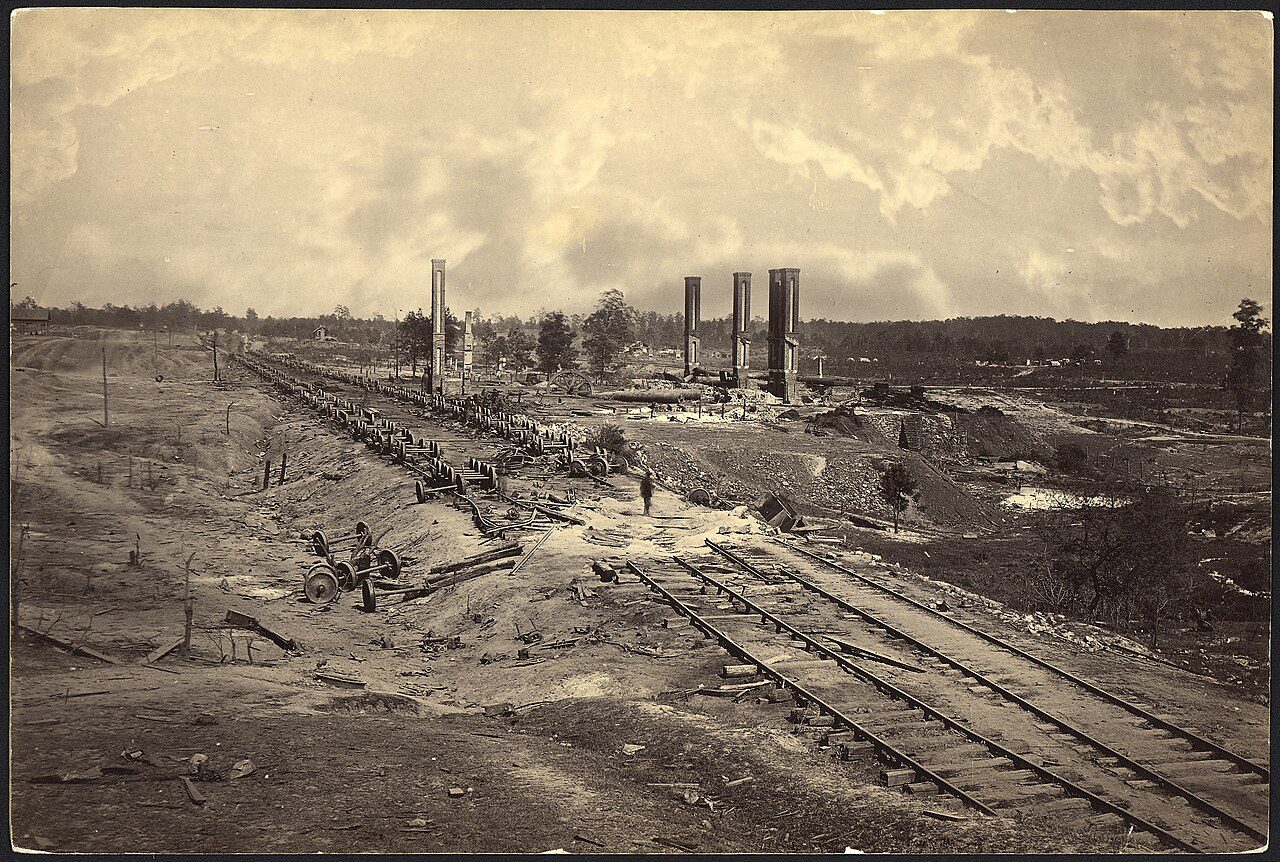
In the west, William T. Sherman closed on Atlanta, the Confederacy's rail and industrial hub. John Bell Hood's attack on Sherman's army outside the city on 22 July ended in a costly Confederate failure, and at sea Admiral Farragut won the Battle of Mobile Bay on 5 August; when Fort Morgan surrendered on 23 August, the Confederacy's last major Gulf port was closed. On 1 September Hood evacuated Atlanta, and the city surrendered the next day. On 7 September Sherman ordered Atlanta's civilian population to leave, ahead of his army's occupation.
In the middle of this hard war, a different kind of history was made in Switzerland. On 22 August twelve nations signed the first Geneva Convention, establishing neutral care for wounded soldiers and the Red Cross emblem — the fruit of Henry Dunant's horror at the battlefield of Solferino in 1859 and the book he published about it in 1862. The convention had just ten articles; protection for the wounded was now a legal obligation, not a courtesy.
Atlanta's fall helped carry Abraham Lincoln to re-election on 8 November, in the middle of a civil war, carrying all but three states. Sherman, meanwhile, chose not to chase Hood's army. On 11 November Union troops began the systematic destruction of Atlanta's railroads, factories and warehouses, and on 15 November some 62,000 men marched out of the burning city toward Savannah, 285 miles away, abandoning their supply lines and living off the country. The march's purpose was psychological as much as military: to prove the Confederacy could not protect its own heartland. It ended on 21 December, when Sherman's army entered Savannah — and on 22 December he telegraphed Lincoln: 'I beg to present you as a Christmas gift the City of Savannah.'
Timeline of 1864
- 17 February
The Confederate submarine H. L. Hunley sinks USS Housatonic off Charleston, a submarine's first kill — and is itself lost.
- 5 May
The Battle of the Wilderness opens in Virginia, the first clash between Grant and Lee.
- 3 June
At Cold Harbor a frontal Union assault is repulsed with thousands of casualties in under an hour.
- 22 July
Hood's Confederates attack Sherman outside Atlanta; the Battle of Atlanta ends in costly Confederate failure.
- 5 August
Union forces under Admiral Farragut win the Battle of Mobile Bay.
- 22 August
Twelve nations sign the first Geneva Convention, establishing neutral care for wounded soldiers.
- 1 September
Hood evacuates Atlanta as Sherman closes in; the city surrenders the next day.
- 8 November
Abraham Lincoln is re-elected president in wartime, carrying all but three states.
- 15 November
Sherman leaves burning Atlanta and begins the March to the Sea toward Savannah.
- 21 November
Lincoln writes his celebrated letter of condolence to Lydia Bixby, reported to have lost five sons.
- 29 November
At Sand Creek, Colorado volunteers attack a peaceful Cheyenne and Arapaho encampment, killing an estimated 150 or more.
- 21 December
The March to the Sea ends as Sherman's army enters Savannah, Georgia.
Why 1864 still matters
The March to the Sea fixed a new idea of war in the world's imagination: that an army could win not only by defeating armies but by destroying the economy and will that sustained them — railroads torn up and twisted into 'Sherman's neckties', mills and cotton gins burned, damage Sherman himself estimated at a hundred million dollars. Britannica's judgement, that the march was the modern era's first example of total war, is why 1864 is still argued over whenever the limits of warfare are debated. Sherman's own defence of the method was written before it began, in his September letter to Atlanta's mayor: 'War is cruelty, and you cannot refine it.'
Against that stands the year's other legacy, signed three months earlier and a world away. The first Geneva Convention began with one businessman's book and a committee of five in Geneva; its descendants — the four conventions of 1949 — have been ratified by every state in the world, and the red cross emblem agreed in the 1860s still marks the medics, hospitals and aid workers who must not be attacked. That 1864 produced both the doctrine of total war and the first treaty limiting war's cruelty is the year's central tension, and the modern laws of armed conflict still live inside it.
The year also proved that a democracy could hold an election in the middle of a civil war — and that the result could change the war. Lincoln's re-election, secured after Atlanta fell, settled that emancipation and Union would be pursued to the end. And in Colorado, the Sand Creek massacre of 29 November, in which volunteers killed an estimated 150 or more Cheyenne and Arapaho people, most of them women, children and the elderly, stands as the year's indictment of what that same war's logic did on the frontier.
1864 on The History Trail
Sherman's march dominates this year on The History Trail, with the Geneva Conventions told as a full story.
- November 15 in History — Sherman leads some 62,000 Union troops out of Atlanta on the March to the Sea.
- Geneva Conventions — The rules written for war's victims, from Solferino and Dunant's book to the 1949 treaties.
- August 22 in History — Twelve nations sign the first Geneva Convention in 1864.
- February 17 in History — The submarine H. L. Hunley sinks USS Housatonic — and is lost with its crew.
- November 8 in History — Lincoln is re-elected president in the middle of the Civil War.
- December 21 in History — Sherman's March to the Sea ends at Savannah, Georgia.
Sources
- Encyclopaedia Britannica — On This Day: November 15
- Encyclopaedia Britannica — On This Day: August 22
- Encyclopaedia Britannica — On This Day: June 3
- Encyclopaedia Britannica — On This Day: November 8
- Encyclopaedia Britannica — On This Day: February 17
- Encyclopaedia Britannica — On This Day: September 1
The facts on this page were checked against these sources on 19 November 2026. The History Trail's permanent pages are researched and written for this site; the live profiles elsewhere on The History Trail are assembled automatically from Wikipedia and Wikidata.
About the Author
Researched and written by the The History Trail Editorial Team — the accountable editorial function behind this site's permanent story pages. The team works from the published sources cited on each page; it does not invent historians, reviewers or credentials, and it corrects errors openly.
Fact Check
Every load-bearing fact on this page traces to one of the sources listed above, and significant claims link to their source in the text. Our checking method is described on the methodology page; errors can be reported via the corrections page.
Sources & Citations
Cite this page as: The History Trail Editorial Team, The History Trail — this article's title, publication and update dates are shown beneath its headline. The full source list appears under Sources above; the site's source standards are on the sources page.