
Things
Space Race
The Space Race was the Cold War contest between the United States and the Soviet Union to lead in spaceflight. It opened with the Soviet Union's Sputnik 1 on 4 October 1957, ran through Gagarin's first orbit and Kennedy's promise to reach the Moon, and was effectively decided by Apollo 11 in July 1969 - before the rivals formally closed it by docking together in 1975.
At a Glance
- The rivals
- The United States and the Soviet Union, competing in spaceflight as part of the Cold War
- The start
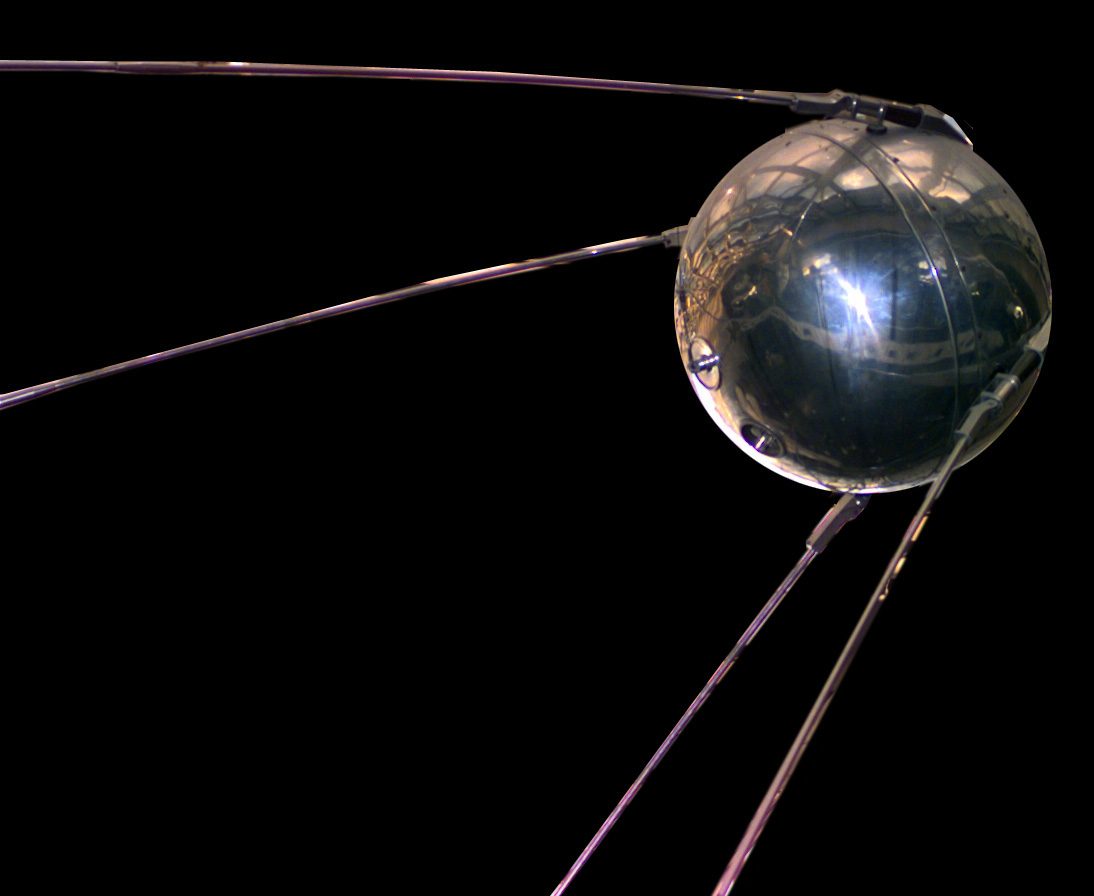
- Sputnik 1, launched by the Soviet Union on 4 October 1957 - the first artificial satellite
- America's answer
- Explorer 1 on 31 January 1958, and the creation of NASA, which began operations on 1 October 1958
- First human
- Yuri Gagarin (Soviet Union), 12 April 1961; Alan Shepard's first American flight followed on 5 May 1961
- The Soviet designer
- Sergei Korolev, chief designer of the early Soviet programme; his identity was a state secret until his death in 1966
- The decisive goal
- Kennedy's commitment of 25 May 1961 to land a man on the Moon before the end of the decade - met by Apollo 11 on 20 July 1969
- The close
- The Apollo-Soyuz Test Project, July 1975: the first docking of American and Soviet spacecraft
Introduction
The Space Race was never only about space. Each first - first satellite, first man, first woman, first spacewalk, first crew on the Moon - was scored in Washington and Moscow as evidence about which system worked better, and both governments funded their programmes accordingly. That is why the race produced so much, so fast: between Sputnik in 1957 and the first Moon landing in 1969, human beings went from no presence in orbit at all to standing on another world.
It is also why the race's history must be written from both sides. The Soviet programme was secret - its chief designer was not named in his lifetime, and its failures were hidden for decades - while the American programme was conducted in public, failures included. The record shows a genuine contest: a long run of Soviet firsts, then an American effort of unmatched scale that reached the Moon first.
Rocket Inheritance: V-2s and Peenemunde Scientists
Both programmes began with the same inheritance. Germany's V-2, the world's first long-range ballistic missile, was built at Peenemunde under Wernher von Braun. At the war's end, the United States took von Braun and many of his engineers to America, where his team built the Redstone and Jupiter rockets and later the Saturn V; the Soviet Union took V-2 hardware, production equipment and German specialists of its own, and set its designers to reproducing and then surpassing the missile.
The Soviet effort centred on Sergei Korolev, an engineer who had survived imprisonment under Stalin and became the programme's driving force as its chief designer. NASA's history notes that the Soviets kept his identity secret until after his death in 1966: the man behind Sputnik and Gagarin was known publicly only by his title. His R-7 rocket, designed as an intercontinental missile, became the launcher that opened the Space Age.
Sputnik and the American Shock
On 4 October 1957 the Soviet Union launched Sputnik 1, the first artificial satellite: a polished sphere 58 centimetres across and weighing 83.6 kilograms, in NASA's figures, whose radio beeps could be picked up by amateurs worldwide. A month later Sputnik 2 carried the dog Laika, the first living creature to orbit the Earth; she did not survive. The shock in the United States was strategic as much as scientific - a rocket that could orbit a satellite could also deliver a warhead.
America's first attempts stumbled in public, including a Vanguard rocket that exploded on its launch pad in December 1957. The recovery came on 31 January 1958, when Explorer 1, built by the Jet Propulsion Laboratory and launched on a von Braun Juno rocket, reached orbit and discovered the Van Allen radiation belts. In July 1958 Congress passed the National Aeronautics and Space Act, and NASA began work on 1 October 1958, gathering the civilian programme into one agency.
Gagarin, Shepard and the Moon Commitment
The human race began, again, with a Soviet first. On 12 April 1961 Yuri Gagarin made a single orbit of the Earth in Vostok 1 and became the first human in space. The American answer, on 5 May 1961, was Alan Shepard's 15-minute suborbital flight - a real achievement, but visibly a step behind. John Glenn's three orbits in February 1962 finally matched Gagarin, by which time the contest had already been redefined.
On 25 May 1961, six weeks after Gagarin, President Kennedy asked Congress to commit the United States to landing a man on the Moon before the end of the decade - choosing, deliberately, a goal so distant that the Soviet lead in rockets would not decide it. He repeated the commitment at Rice University in September 1962. The Mercury programme gave way to Gemini, which practised rendezvous, docking and long flights, and then to Apollo; the Soviet Union answered with its own firsts - Valentina Tereshkova, the first woman in space, in 1963, and Alexei Leonov's first spacewalk in 1965 - while working, in secret and with divided resources, on a Moon rocket of its own, the N-1.
Apollo 8, Apollo 11 and the Finish
The turn came in December 1968, when Apollo 8, the first crewed Saturn V mission, carried three astronauts around the Moon and back - the first humans to leave Earth orbit. The Soviet N-1, by contrast, failed in every test launch, a record hidden until long afterwards; Korolev's death in 1966, competing design bureaus and underfunding had weakened the Soviet Moon programme before it flew.
On 20 July 1969 Apollo 11 landed Armstrong and Aldrin on the Moon, and the race, as a contest to be first there, was over. The Soviet Union continued with real achievements of a different kind - the Salyut space stations from 1971 pioneered long stays in orbit - but the headline competition had been decided, and both sides began, cautiously, to talk about flying together.
Timeline
- 4 October 1957
Sputnik 1, the Soviet Union's polished 83.6 kg sphere, becomes the first artificial satellite.
- 3 November 1957
Sputnik 2 carries the dog Laika, the first living creature to orbit the Earth.
- 31 January 1958
Explorer 1 becomes the first American satellite and discovers the Van Allen radiation belts.
- 1 October 1958
NASA begins operations, created by the National Aeronautics and Space Act signed in July 1958.
- 12 April 1961
Yuri Gagarin orbits the Earth once in Vostok 1, the first human in space.
- 5 May 1961
Alan Shepard makes America's first crewed flight, a 15-minute suborbital mission.
- 25 May 1961
President Kennedy commits the United States to a crewed Moon landing before the end of the decade.
- 16 June 1963
Valentina Tereshkova becomes the first woman in space.
- 18 March 1965
Alexei Leonov performs the first spacewalk, from Voskhod 2.
- December 1968
Apollo 8 carries the first crew around the Moon.
- 20 July 1969
Apollo 11 lands the first crew on the Moon.
- 17 July 1975
An Apollo spacecraft docks with a Soviet Soyuz in orbit; the commanders shake hands.
Significance
The race compressed a century of rocket development into eighteen years and left permanent infrastructure behind it: NASA itself, the Soviet and later Russian programme that became a partner in the International Space Station, satellite industries, and a generation of engineers on both sides. Its costs were also real, in money and in lives - among them cosmonaut Vladimir Komarov, killed in Soyuz 1 in 1967, and the Apollo 1 crew, killed in a launch-pad fire the same year.
Myths and disputes
When did the race end? Two answers are both defensible, and this page gives both. If the race was the contest to land first on the Moon - the goal Kennedy set and the one both sides publicly chased - it ended on 20 July 1969. If it was the wider rivalry itself, its formal close came six years later, on 17 July 1975, when an American Apollo and a Soviet Soyuz docked in orbit for the Apollo-Soyuz Test Project and commanders Thomas Stafford and Alexei Leonov shook hands through the hatch - a mission NASA describes as the culmination of the Space Race, and one whose cooperation led, in time, to Shuttle-Mir and the International Space Station.
The second myth is that the United States won every stage. It did not, and the Soviet firsts are a matter of record: first satellite (1957), first living creature in orbit (1957), first spacecraft to reach the Moon and first photographs of its far side (1959), first man in space (1961), first woman (1963) and first spacewalk (1965). The American victory was real but specific: the United States was first to land people on the Moon, and did so six times between 1969 and 1972. A history that erases the Soviet lead cannot explain why Kennedy chose the Moon as the goal in the first place - he needed a contest that started level.
Legacy
The race's deepest legacy is that it ended in cooperation. Apollo-Soyuz proved rival spacecraft could be built to dock together, and the relationships and standards it created fed directly into the joint programmes that followed. The hardware tells the same story in museums: a Sputnik replica and the Apollo 11 command module Columbia stand in the Smithsonian's National Air and Space Museum, artefacts of two programmes that spent two decades trying to outdo each other - and finished by shaking hands in orbit.
Sources
- NASA History Office — Dawn of the Space Age
- NASA History Office — 65 Years Ago: The National Aeronautics and Space Act of 1958 Creates NASA
- NASA History Office — 45 Years Ago: Historic Handshake in Space
- Smithsonian National Air and Space Museum — Building a Moon Rocket
- Smithsonian Magazine — The Space Race
- Encyclopaedia Britannica — Who Won the Space Race?
- National Archives — Apollo 11 Flight Plan
The facts on this page were checked against these sources on 19 November 2026. The History Trail's permanent pages are researched and written for this site; the live profiles elsewhere on The History Trail are assembled automatically from Wikipedia and Wikidata.
About the Author
Researched and written by the The History Trail Editorial Team — the accountable editorial function behind this site's permanent story pages. The team works from the published sources cited on each page; it does not invent historians, reviewers or credentials, and it corrects errors openly.
Fact Check
Every load-bearing fact on this page traces to one of the sources listed above, and significant claims link to their source in the text. Our checking method is described on the methodology page; errors can be reported via the corrections page.
Sources & Citations
Cite this page as: The History Trail Editorial Team, The History Trail — this article's title, publication and update dates are shown beneath its headline. The full source list appears under Sources above; the site's source standards are on the sources page.