
Things
Moon
The Moon is one of the largest satellites in the solar system relative to its planet, and the only world beyond Earth that human beings have stood on. It was born in violence, it governs our tides and steadies our climate, and it is still — very slowly — leaving us.
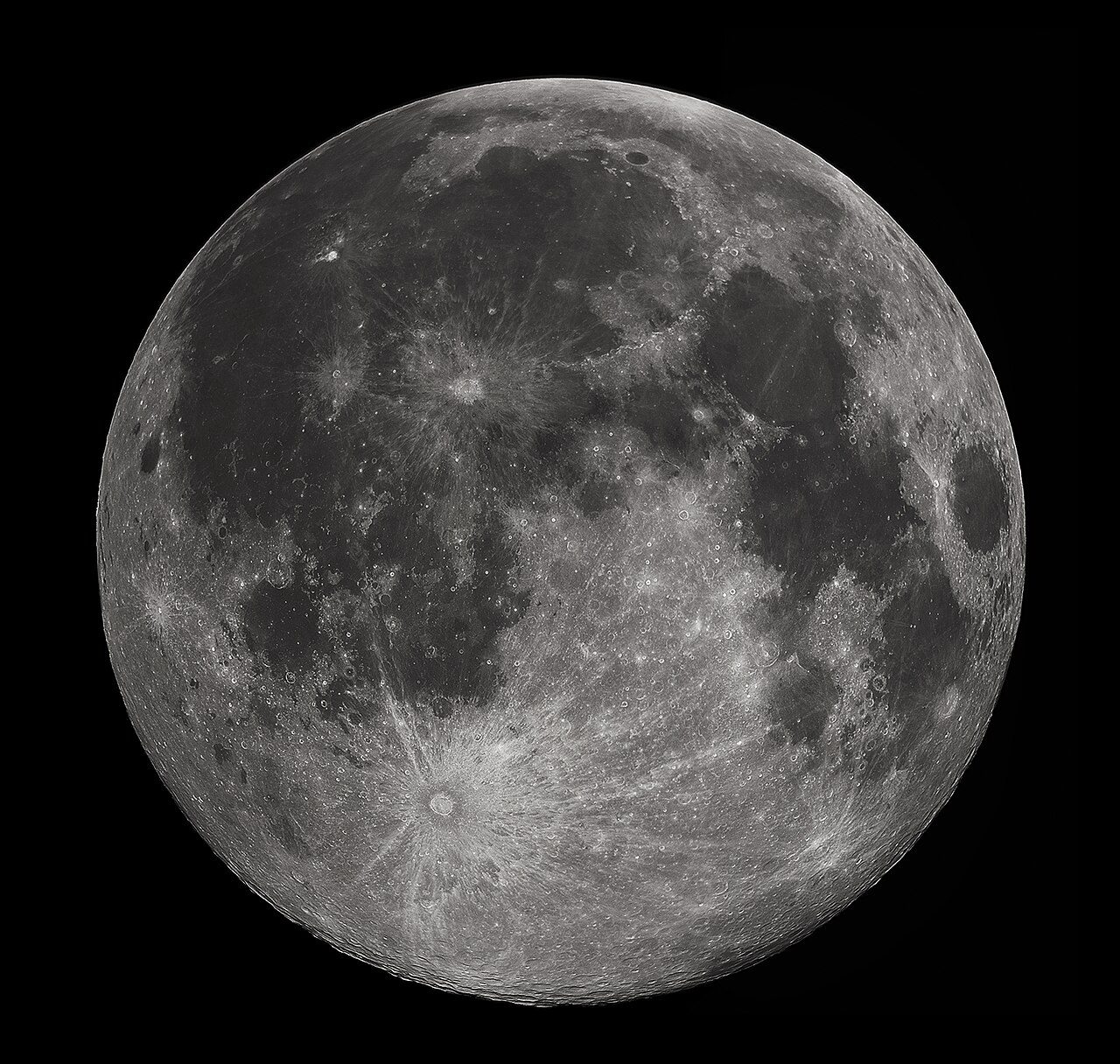
At a Glance
- Relation
- Earth's only natural satellite
- Radius
- About 1,740 km — less than a third of Earth's width
- Average distance
- 384,400 km — about 30 Earths fit between us and it
- Orbit and rotation
- 27.3 days each, locked together — the same face always toward Earth
- Surface gravity
- One-sixth of Earth's
- Origin
- Debris from a collision between the young Earth and a Mars-sized body
- Water
- Ice concentrated in permanently shadowed polar craters; water molecules confirmed on sunlit surfaces in 2020
- Temperature range
- About 127°C in full Sun to −173°C in darkness
Introduction
The Moon is the most familiar object in the night sky and, for most of human history, the only other world whose surface features anyone could see. It is a rocky body 3,480 kilometres across — less than a third of Earth's width, yet so large beside its planet that the Earth-Moon pair is sometimes described as a double planet. It circles us at an average distance of 384,400 kilometres, close enough that its light reaches us in little more than a second.
It shines only by reflected sunlight, and it shows us, always, the same face. The Moon rotates exactly once for each orbit, a synchrony called tidal locking, so the hemisphere turned toward Earth tonight is the one every human generation has ever seen. The far side — never visible from Earth until a spacecraft photographed it in 1959 — is not a dark side; it is lit and darkened by the same Sun, on the same cycle, simply facing away.
Background
The leading account of the Moon's origin is a catastrophe. Several billion years ago, as NASA summarises it, a Mars-sized body collided with the young Earth; debris from both worlds, flung into orbit, accumulated into the Moon. The newborn satellite was molten, and as its global magma ocean cooled, light rocks floated up to form the crust while dense material sank — giving the Moon its small iron core, its mantle, and a crust thicker on the far side than the near. The strongest evidence came back in Apollo sample bags: lunar rocks are strikingly like Earth's own mantle in composition.
With almost no atmosphere — only a tenuous exosphere that stops neither radiation nor impacts — the Moon's surface is an archive. Billions of years of strikes ground it into powdery regolith; the dark plains called maria are impact basins flooded with lava between about 4.2 and 1.2 billion years ago, and craters like Tycho, 85 kilometres wide, sit essentially uneroded. Temperatures swing from about 127°C in sunlight to −173°C in the dark. Yet the cold traps at the poles hoard a treasure: water ice in craters that sunlight never reaches.
Timeline
- 1959
The Soviet Luna 2 reaches the Moon — the first human-made object to arrive there; Luna 3 photographs the far side for the first time.
- 20 July 1969
Apollo 11 lands in the Sea of Tranquility and Neil Armstrong becomes the first human to walk on the Moon.
- December 1972
Apollo 17, the sixth and final Apollo landing, brings the total of moonwalkers to twelve; no one has walked on the Moon since.
- 1994–1999
Data from the Clementine and Lunar Prospector missions suggest water ice may be present at the lunar poles.
- 2008
India's Chandrayaan-1 makes the first definitive detection of water on the Moon, finding hydroxyl molecules across the surface, concentrated at the poles.
- 2009
NASA's Lunar Reconnaissance Orbiter begins the detailed mapping of the Moon that continues today.
- October 2020
NASA's SOFIA observatory confirms water molecules on the sunlit lunar surface for the first time, in Clavius Crater.
- 25 June 2024
China's Chang'e 6 returns the first samples ever collected from the Moon's far side.
- April 2026
The Artemis II crew loops around the Moon — the first crewed lunar voyage in over fifty years — travelling farther from Earth than any astronauts before them.
Significance
The Moon works for a living. Its gravity raises the tides — two bulges of ocean that most coastlines pass through twice a day — and its mass steadies Earth's axial wobble, keeping the climate far more stable over billions of years than it would otherwise be. NASA's summary is plain: in many ways, the Moon is responsible for making Earth such a great home. Life evolved under its rhythm; calendars, months and tides are still set by it.
It is also the solar system's best-kept diary. Because nothing erases its surface — no weather, no tectonics — the Moon preserves the impact history of the inner solar system, including the bombardment Earth endured but has since paved over. Apollo samples let scientists date that history precisely, and the reflectors Apollo crews left behind still return laser pulses from Earth, measuring the Moon's slow retreat — about 3.8 centimetres farther away every year — with millimetre precision.
Legacy
Exploration has entered a second age: orbiters have mapped the Moon in detail, far-side samples are in laboratories, water ice at the poles has gone from suspicion to inventory, and crewed flight has resumed with Artemis. The Moon is now planned as a proving ground — for deep-space life support, for using local ice, and for the longer voyage to Mars.
Yet its oldest role is untouched. The same face that timed the first calendars still governs the tides of a technological civilisation, still steadies the planet that made it, and still recedes — an inch and a half a year, unhurried — carrying the record of our beginnings slowly out of reach.
Sources
- NASA Science — Moon Facts
- NASA Science — Five Things to Know about the Moon
- NASA JPL — Earth's Moon (lithograph)
The facts on this page were checked against these sources on 19 November 2026. The History Trail's permanent pages are researched and written for this site; the live profiles elsewhere on The History Trail are assembled automatically from Wikipedia and Wikidata.
About the Author
Researched and written by the The History Trail Editorial Team — the accountable editorial function behind this site's permanent story pages. The team works from the published sources cited on each page; it does not invent historians, reviewers or credentials, and it corrects errors openly.
Fact Check
Every load-bearing fact on this page traces to one of the sources listed above, and significant claims link to their source in the text. Our checking method is described on the methodology page; errors can be reported via the corrections page.
Sources & Citations
Cite this page as: The History Trail Editorial Team, The History Trail — this article's title, publication and update dates are shown beneath its headline. The full source list appears under Sources above; the site's source standards are on the sources page.