
Things
Halley's Comet
No comet belongs to everyone the way Halley's does. Chinese chroniclers logged it in 240 BCE, English monks feared it in 1066, and in 1705 Edmond Halley realised the bright comets of history were one object returning — and predicted, correctly, when it would come again.
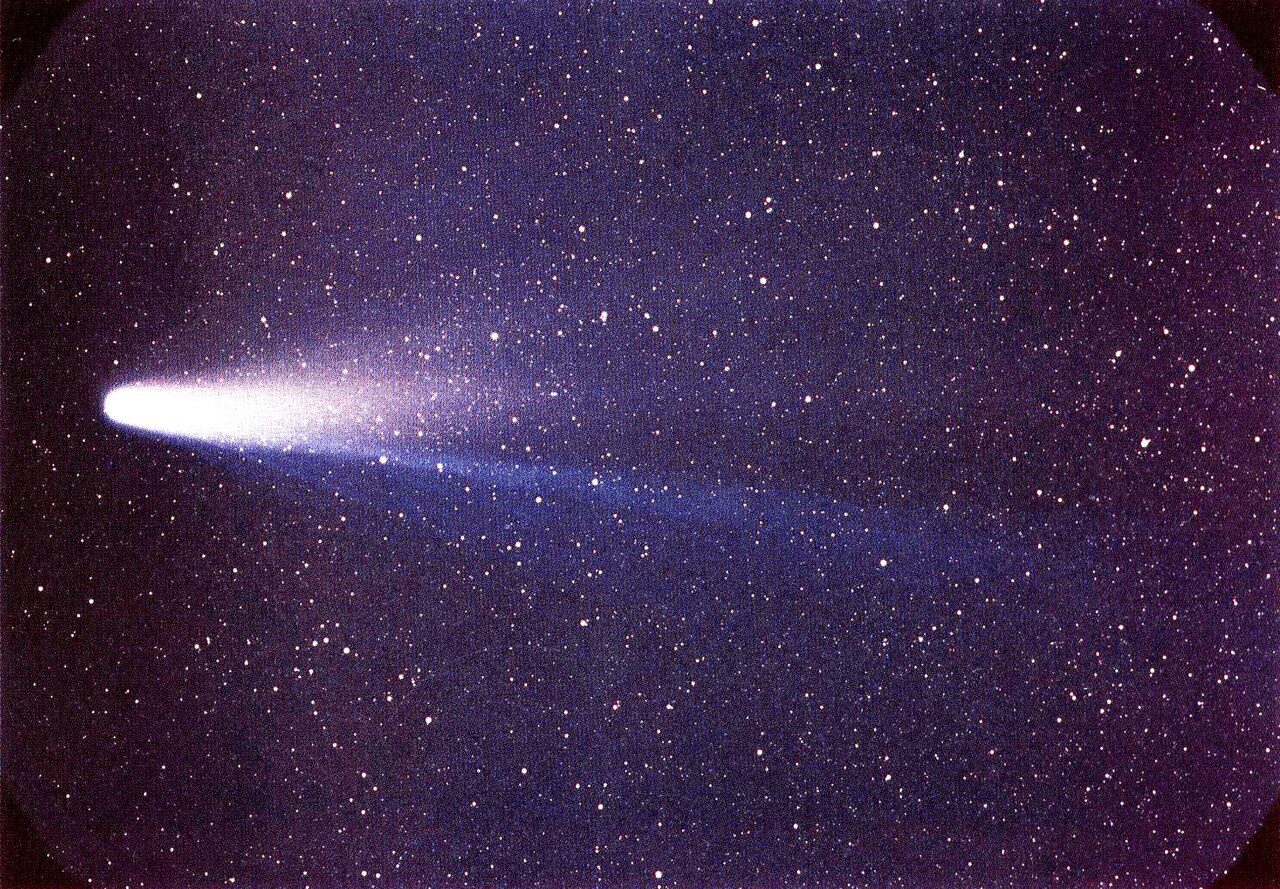
At a Glance
- Official designation
- 1P/Halley — the first recognised periodic comet
- Orbital period
- About 76 years on average; recorded returns vary from 74.4 to 79.3 years
- Earliest accepted record
- 240 BCE, in the Chinese chronicle Records of the Grand Historian
- Last perihelion
- 9 February 1986
- Next perihelion
- 28 July 2061
- Nucleus
- A dark, potato-shaped body about 15 × 8 km, reflecting only about 4% of sunlight
- Perihelion distance
- 0.587 AU — inside the orbit of Venus
- Meteor showers
- Parent body of the Eta Aquariid (May) and Orionid (October) showers
Introduction
Halley's Comet is a lump of ice and dust on a long, tilted loop around the Sun, and it is the most famous object in the sky that is not always there. Roughly every 76 years it swings in from beyond Neptune, rounds the Sun inside the orbit of Venus, grows a tail millions of kilometres long, and fades back into the dark for another human lifetime. Nearly everyone who has ever seen it has seen it once.
What makes Halley singular is not its brightness but its biography. It is the first comet whose return was predicted, the first to be recognised in records stretching back more than two thousand years, and the first to be met by spacecraft. Kings, chroniclers, painters and astronomers all left accounts of the same object without knowing it — until one man compared their stories and saw the pattern.
Background
The comet itself is modest: a nucleus of water and other volatile ices mixed with rocky and carbon-rich dust, about 15 by 8 kilometres, under a crust blacker than coal, reflecting only about 4 percent of sunlight. As it nears the Sun, heat drives jets of gas and dust from the active patches of its surface — only about a tenth of the surface was active in 1986 — building the glowing coma and tail. Its orbit is retrograde and highly elongated, and the planets' gravity keeps nudging it, so its period wanders between about 74 and 79 years.
For most of history, though, the comet was not an object but an omen. Its 1066 appearance was read in England as a portent of doom for King Harold and in Normandy as a sign of favour for William; the Bayeux Tapestry embroidered it above the worried court — the first known illustration of the comet. Its 1301 passage may have inspired the Star of Bethlehem in Giotto's Adoration of the Magi. Comets were weather in the sky, not members of the solar system, and nobody expected one to return.
Timeline
- 240 BCE
Chinese astronomers record a bright comet in the chronicle later known as the Records of the Grand Historian — the earliest accepted sighting of Halley.
- 1066
The comet blazes over Europe months before the Norman Conquest; it is embroidered into the Bayeux Tapestry as onlookers marvel at the star.
- 1301
The comet's passage is seen by the painter Giotto di Bondone, whose Star of Bethlehem in the Adoration of the Magi is modelled on it.
- 1705
Edmond Halley publishes his catalogue of comet orbits and shows that the comets of 1531, 1607 and 1682 were one object returning roughly every 76 years; he predicts a return in 1758.
- 1758–1759
The comet is sighted on Christmas night 1758 and passes perihelion in March 1759 — after Halley's death. It is named in his honour: the first predicted return in history.
- 1835
The comet returns; two weeks after its perihelion, Samuel Clemens — Mark Twain — is born in Missouri.
- 1910
The comet is photographed for the first time and Earth passes through its tail amid popular unease. Twain, who had joked he would go out with the comet, dies the day after perihelion.
- 16 October 1982
Astronomers recover the returning comet with the 200-inch Hale Telescope at Palomar, still beyond Saturn's orbit.
- March 1986
An international armada meets the comet: Soviet Vega probes image the nucleus, and ESA's Giotto passes just 596 km from it — the first close-up look at a comet's solid heart.
- December 2023
The comet reaches aphelion, its farthest point from the Sun beyond Neptune's orbit, and begins the long fall back inward.
- 28 July 2061
The comet's next predicted perihelion — this time with Earth on the same side of the Sun, promising a far better show than 1986.
Significance
Halley's prediction was a public proof of Newton's new physics. Halley had used Newton's gravitation and calculus to show that a comet — the very emblem of the unpredictable — obeyed the same laws as the planets, and the comet's punctual return in 1758, delayed a few months by the pulls of Jupiter and Saturn exactly as the theory allowed, converted comets from omens into citizens of the solar system. It remains the founding demonstration that the heavens run on schedule.
The 1986 encounter did the same for cometary science. Before Giotto, no one had seen a comet's nucleus; Fred Whipple's 1950 “dirty snowball” model was an educated guess. The armada's images confirmed a solid, dark, jetting body — and every comet mission since, including landings and sample returns, descends from that March. The dust it sheds along its orbit also produces the Eta Aquariid and Orionid meteor showers, so Earth meets Halley's debris twice a year even while the comet is decades away.
Legacy
Halley is now outbound, past its farthest point and falling sunward again, due back in 2061 with viewing geometry far kinder than the disappointing 1986 pass, when Earth and comet were on opposite sides of the Sun at perihelion. Astronomers already discuss what a new generation of spacecraft might do with the appointment.
Its deeper legacy is a calendar written across civilisations: Babylonian tablets, Chinese chronicles, an English tapestry, a Florentine fresco, a Missouri birth certificate. No other object in the sky has been watched, feared, painted and predicted by so many cultures for so long — and then, at last, visited.
Sources
- NASA History — 955 Years Ago: Halley's Comet and the Battle of Hastings
- NASA NSSDC — Giotto Mission Information
- Encyclopaedia Britannica — Halley's Comet (Scholars edition)
The facts on this page were checked against these sources on 19 November 2026. The History Trail's permanent pages are researched and written for this site; the live profiles elsewhere on The History Trail are assembled automatically from Wikipedia and Wikidata.
About the Author
Researched and written by the The History Trail Editorial Team — the accountable editorial function behind this site's permanent story pages. The team works from the published sources cited on each page; it does not invent historians, reviewers or credentials, and it corrects errors openly.
Fact Check
Every load-bearing fact on this page traces to one of the sources listed above, and significant claims link to their source in the text. Our checking method is described on the methodology page; errors can be reported via the corrections page.
Sources & Citations
Cite this page as: The History Trail Editorial Team, The History Trail — this article's title, publication and update dates are shown beneath its headline. The full source list appears under Sources above; the site's source standards are on the sources page.