
Events
Apollo 11 Moon Landing
Apollo 11 was the NASA mission that landed the first people on the Moon. On 20 July 1969 the lunar module Eagle touched down in the Sea of Tranquility; hours later Neil Armstrong, followed by Buzz Aldrin, walked on the surface while Michael Collins waited in orbit - and an estimated 600 million people watched.
At a Glance
- Crew
- Commander Neil Armstrong; command module pilot Michael Collins; lunar module pilot Edwin (Buzz) Aldrin
- Launch
- 16 July 1969, 13:32 UTC, on a Saturn V rocket from Kennedy Space Center, Florida
- Landing
- The lunar module Eagle landed in the Sea of Tranquility on 20 July 1969 at 20:17 UTC
- First step
- Armstrong stepped onto the surface at 02:56 UTC on 21 July 1969; Aldrin followed 19 minutes later
- Time on the surface
- About 21.5 hours at Tranquility Base, including a moonwalk of about two and a half hours
- Audience
- An estimated 600 million people watched the landing broadcast, as NASA and the Smithsonian state it
- Return
- Splashdown in the Pacific Ocean on 24 July 1969; the crew were then held in quarantine as a precaution
Introduction
Apollo 11 was the fifth crewed mission of NASA's Apollo programme and the one the whole programme had been pointed at since 1961. Its spacecraft had three parts: the command module Columbia, the only part that would return to Earth; the service module behind it; and the lunar module Eagle, built to land two men on the Moon and lift them back to orbit. The crew divided accordingly - Armstrong and Aldrin in Eagle, Collins alone in Columbia, keeping the ship that everyone needed for the journey home.
The mission's primary objective, in NASA's words, was to complete the national goal set by President John F. Kennedy on 25 May 1961: perform a crewed lunar landing and return to Earth. Everything else - the experiments, the samples, the photographs - was secondary to landing and coming back alive.
The Goal and the Machine
Kennedy set the goal before Congress on 25 May 1961, six weeks after Yuri Gagarin had become the first human in space, and committed the United States to landing a man on the Moon and returning him safely before the decade ended. In a second famous speech, at Rice University in September 1962, he defended the cost and difficulty of the enterprise. The commitment drove a programme that employed hundreds of thousands of people and produced the Saturn V, still among the most powerful rockets ever flown.
Apollo 11's Saturn V lifted off from Launch Complex 39A at Kennedy Space Center on 16 July 1969 at 13:32 UTC, watched by an estimated one million spectators near the site. After one and a half orbits of the Earth, the third stage fired again to send the spacecraft toward the Moon, and the crew rearranged their ship in flight, pulling Eagle out from the spent stage and docking nose-to-nose with Columbia for the three-day coast outward.
20 July 1969: The Eagle Has Landed
On 19 July Apollo 11 entered orbit around the Moon. The next day Armstrong and Aldrin crawled into Eagle, undocked, and began the powered descent to the Sea of Tranquility, while Collins stayed in Columbia. The descent was not smooth: programme alarms sounded from the guidance computer, which engineers on the ground judged safe to ignore, and Armstrong, seeing the computer was steering them toward a boulder-strewn crater, took manual control and flew beyond it, landing with little fuel to spare.
Eagle touched down at 20:17 UTC on 20 July 1969. Armstrong's report to Houston named the landing site in the same sentence: Tranquility Base. The National Archives' flight plan summary records the landing at 102 hours, 47 minutes into the flight, and a total stay on the Moon of 21 hours and 36 minutes.
One Small Step
The plan had allowed for rest before the moonwalk, but the crew asked to go out early. At 02:56 UTC on 21 July - the evening of 20 July in the United States - Armstrong descended Eagle's ladder and stepped onto the surface, speaking the words recorded as: That's one small step for [a] man, one giant leap for mankind. Aldrin joined him 19 minutes later. An estimated 600 million people watched the broadcast, as NASA and the Smithsonian record it - roughly a fifth of the world's population, the largest live audience there had ever been.
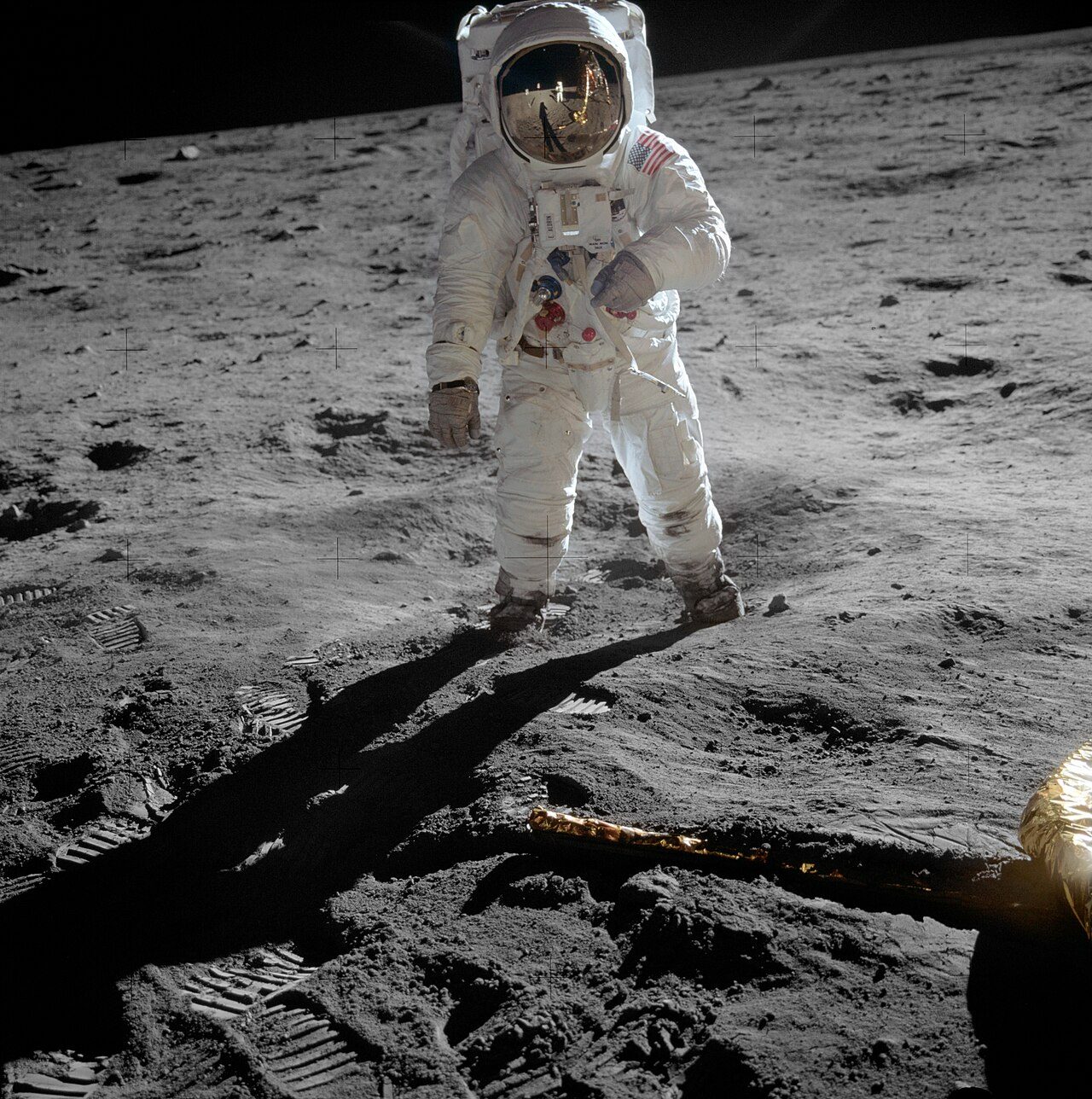
The moonwalk lasted about two and a half hours. Armstrong and Aldrin collected rock and soil samples, took the photographs that defined the mission - most of the famous surface pictures show Aldrin, because Armstrong held the camera - and set up the experiments Eagle had carried: a seismometer, a solar-wind collector, and a laser ranging retroreflector, an array of mirrors aimed back at Earth that scientists still use to measure the Moon's distance. Collins, orbiting alone in Columbia above them, kept station, photographed the surface and waited for the rendezvous on which all three lives depended.
Return, Splashdown and Quarantine
Eagle's ascent stage lifted off on 21 July, leaving its descent stage behind on the surface, and docked with Columbia in lunar orbit. After the journey home, Columbia splashed down in the Pacific Ocean on 24 July 1969, near the recovery ship USS Hornet, ending a mission of 8 days, 3 hours and 18 minutes by NASA's count. The command module itself is preserved today at the Smithsonian's National Air and Space Museum in Washington, D.C., where it is the centrepiece of the Destination Moon gallery.
As a precaution against any unknown lunar microbes, the crew were held in quarantine after splashdown - first in a mobile quarantine facility, then at Houston - before being released to a public welcome. No lunar germs existed, but in 1969 no one could yet prove that, and the ritual completed a mission that had been planned, from Kennedy's speech to the quarantine, as a single chain of managed risks.
Timeline
- 25 May 1961
President Kennedy commits the United States, before Congress, to landing a man on the Moon and returning him safely before the end of the decade.
- 12 September 1962
Kennedy's Rice University speech defends the Moon programme to the public.
- 16 July 1969
Apollo 11 launches on Saturn V from Kennedy Space Center at 13:32 UTC, crewed by Armstrong, Collins and Aldrin.
- 19 July 1969
Apollo 11 enters lunar orbit.
- 20 July 1969, 20:17 UTC
Eagle lands in the Sea of Tranquility; Armstrong reports from Tranquility Base.
- 21 July 1969, 02:56 UTC
Armstrong steps onto the surface; Aldrin follows 19 minutes later. The moonwalk lasts about two and a half hours.
- 21 July 1969
Eagle's ascent stage lifts off after about 21.5 hours on the surface and rejoins Collins in Columbia.
- 24 July 1969
Columbia splashes down in the Pacific near USS Hornet; the crew enter quarantine.
Significance
Apollo 11 fulfilled the most public scientific promise ever made by a government, on the deadline its maker had set, and it did so in front of the largest audience in history to that date. It effectively decided the Space Race: the Soviet Union, which had led in the early years, never landed a crew on the Moon. Five more Apollo landings followed by 1972, and the samples and instruments Apollo 11 left behind - the retroreflector above all - are still producing science more than half a century later.
Myths and disputes
The missing word is the honest dispute. Armstrong maintained that he said, and meant to say, one small step for a man - the indefinite article that gives the sentence its contrast between one man and all mankind. The broadcast recording, compressed and noisy, does not clearly carry it, and NASA's transcripts print it in brackets: for [a] man. Later audio analyses have argued both ways. This page prints the bracketed form, because that is what the record supports: the intention is documented, the sound is not certain.
The claim that the landing was faked is not a dispute among historians, and it is answered here briefly and factually. The evidence is physical and independent: the retroreflectors left by Apollo crews still return laser pulses fired from observatories on Earth; NASA's Lunar Reconnaissance Orbiter has photographed the landing sites, showing descent stages, equipment and tracks; the missions were tracked by independent stations, including in the Soviet Union, which never disputed them; and 382 kilograms of lunar rock returned by the six landing missions have been studied by scientists worldwide. A fabrication would have had to fake all of that, and to keep doing so for over fifty years.
Legacy
Apollo 11 set the template by which exploration is still imagined: a stated goal, a deadline, a machine built for one purpose, and a crew whose competence the world watched live. Its artefacts anchor the Smithsonian's collection, its landing site remains undisturbed on the Sea of Tranquility, and every later programme - including NASA's Artemis missions, which aim to return crews to the lunar surface - defines itself against July 1969.
Sources
- NASA — Apollo 11 Mission Overview
- NASA History Office — Apollo 11 chronology
- Smithsonian National Air and Space Museum — Command Module, Apollo 11
- National Archives — Apollo 11 Flight Plan
- National Archives — The Eagle Has Landed: The Apollo 11 50th Anniversary
- Encyclopaedia Britannica — Apollo 11
The facts on this page were checked against these sources on 19 November 2026. The History Trail's permanent pages are researched and written for this site; the live profiles elsewhere on The History Trail are assembled automatically from Wikipedia and Wikidata.
About the Author
Researched and written by the The History Trail Editorial Team — the accountable editorial function behind this site's permanent story pages. The team works from the published sources cited on each page; it does not invent historians, reviewers or credentials, and it corrects errors openly.
Fact Check
Every load-bearing fact on this page traces to one of the sources listed above, and significant claims link to their source in the text. Our checking method is described on the methodology page; errors can be reported via the corrections page.
Sources & Citations
Cite this page as: The History Trail Editorial Team, The History Trail — this article's title, publication and update dates are shown beneath its headline. The full source list appears under Sources above; the site's source standards are on the sources page.