
Events
Montgomery Bus Boycott
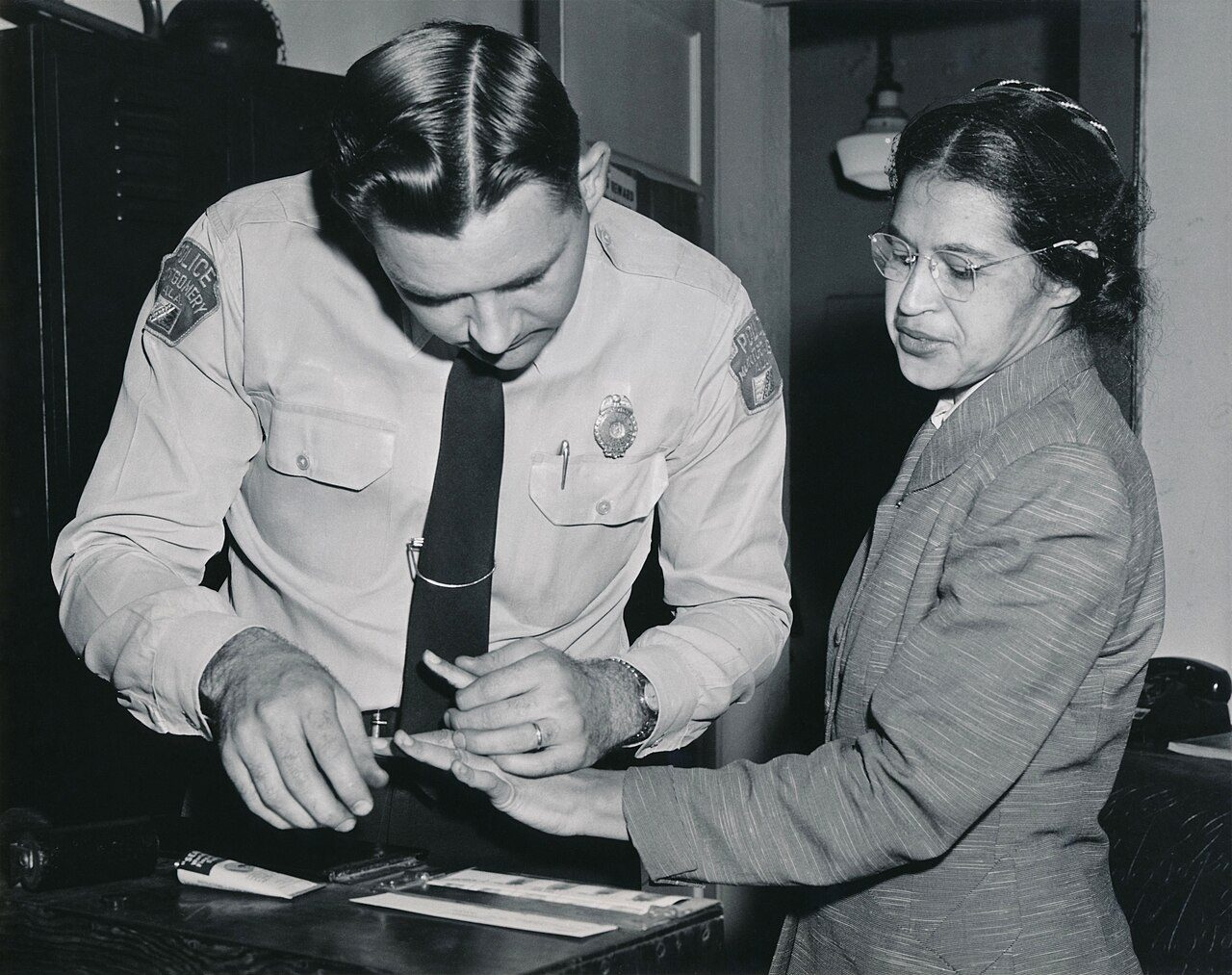
The Montgomery bus boycott ran for 381 days, from 5 December 1955 to 20 December 1956, after Rosa Parks - an experienced NAACP activist, not simply a tired seamstress - was arrested for refusing to give up her seat. It ended when the Supreme Court's ruling in Browder v. Gayle took effect and Montgomery's buses were desegregated.
At a Glance
- The spark
- Arrest of Rosa Parks, 1 December 1955, for refusing to give up her seat on a Montgomery, Alabama bus
- The boycott
- 5 December 1955 to 20 December 1956 - 381 days
- Organised by
- The Montgomery Improvement Association (MIA), formed 5 December 1955; the Women's Political Council issued the first boycott call
- MIA president
- Martin Luther King Jr., 26, pastor of Dexter Avenue Baptist Church - his first national platform
- How it was sustained
- A carpool of roughly 300 cars, Black taxi firms, church fundraising and tens of thousands walking
- How it ended
- Browder v. Gayle: federal panel ruled bus segregation unconstitutional on 5 June 1956; the Supreme Court affirmed, and the order reached Montgomery on 20 December 1956
- Before Parks
- Claudette Colvin (2 March 1955) and Mary Louise Smith had already been arrested for the same refusal
Introduction
On 1 December 1955, Rosa Parks, a 42-year-old seamstress coming home from her job at a Montgomery department store, refused a bus driver's order to give up her seat to a white passenger and was arrested. Four days later the Black residents of Montgomery, Alabama, began a boycott of the city's buses. They kept it up for 381 days, walking, sharing cars and organising their own transport system, until a federal court order desegregating the buses finally took effect on 20 December 1956.
The boycott was the first great mass protest of the modern civil rights movement. It proved a whole community could sustain nonviolent economic pressure for over a year, carried a 26-year-old pastor, Martin Luther King Jr., to national prominence, and ended not with a negotiated concession but with a ruling of the U.S. Supreme Court.
Rosa Parks: the activist on the bus
Parks was not a stranger to organised protest who happened to be tired. She had joined the Montgomery chapter of the NAACP in 1943 and served as its secretary, work that included investigating cases of racial violence, and in 1955 she had attended a workshop at the Highlander Folk School, a training centre for civil rights organisers. On the evening of 1 December she was sitting in the first row of the section reserved for Black passengers when the white section filled and the driver, James F. Blake, ordered her row to move back. Three passengers complied. Parks did not, and she was arrested and charged with violating the city's segregation laws.
Nor was she the first Montgomery passenger arrested for the same refusal. On 2 March 1955, nine months earlier, 15-year-old Claudette Colvin had been handcuffed and removed from a bus for refusing to give up her seat, and Mary Louise Smith was arrested for the same act that October. Local leaders had considered a test case around Colvin but judged the teenager a vulnerable public symbol. When Parks - respected, employed and experienced - was arrested, the Women's Political Council, led by Jo Ann Robinson, was ready: it had a boycott plan prepared and printed thousands of leaflets overnight calling for a one-day protest on 5 December, the day of Parks's trial.
381 days: the MIA, the carpools and the pressure
The one-day boycott of 5 December was so nearly total that Black leaders voted that evening to continue it and formed the Montgomery Improvement Association (MIA) to run it. They elected King, the young pastor of Dexter Avenue Baptist Church, as president, with E. D. Nixon, who had posted Parks's bail, as treasurer. The MIA's initial demands were modest - courteous treatment, first-come-first-served seating within the segregated pattern, and Black drivers on Black routes - but the city refused them, and the boycott settled in for a long campaign of mass meetings, fundraising and discipline.
What kept it alive was transport. Black taxi companies at first carried passengers for ten cents, the bus fare; when the city threatened their licences, the MIA built a carpool of roughly 300 private cars running between dozens of dispatch and pickup stations, funded by donations from across the United States. The city answered with pressure: police harassed carpool drivers, and in February 1956 a grand jury indicted 113 boycott leaders under an old anti-boycott law; King was tried and convicted. King's home was bombed on 30 January 1956, and Nixon's two days later; no one was killed, and King persuaded the angry crowd outside his own bombed house to stay nonviolent.
Browder v. Gayle: the lawsuit that ended it
The legal blow was struck by a separate case. On 1 February 1956 attorneys Fred Gray and Charles Langford filed Browder v. Gayle in federal court for four women arrested or mistreated on the buses: Aurelia Browder, Claudette Colvin, Susie McDonald and Mary Louise Smith. Parks was deliberately not a plaintiff, so the case attacked the segregation laws directly instead of depending on her criminal appeal. On 5 June 1956 a three-judge federal panel ruled two to one that bus segregation violated the Fourteenth Amendment. The city and state appealed, and on 13 November 1956 the Supreme Court affirmed. When the court's order reached Montgomery on 20 December 1956, the MIA voted to end the boycott, and on 21 December King and Parks rode in the front of an integrated bus.
Timeline
- 2 March 1955
Claudette Colvin, aged 15, is arrested for refusing to give up her bus seat - nine months before Rosa Parks.
- 1 December 1955
Rosa Parks refuses driver James F. Blake's order to move and is arrested; E. D. Nixon posts her bail that evening.
- 5 December 1955
The one-day boycott is almost total; Parks is convicted and fined. Black leaders form the MIA and elect King its president.
- 30 January 1956
King's home is bombed with his family inside; he calms an angry crowd and insists the protest stay nonviolent.
- 1 February 1956
Browder v. Gayle is filed in federal court for Browder, Colvin, McDonald and Smith, challenging bus segregation itself.
- 22 February 1956
More than 100 boycott leaders, Parks among them, are indicted under an anti-boycott law; King is later convicted.
- 5 June 1956
A three-judge federal panel rules in Browder v. Gayle that segregated buses violate the Fourteenth Amendment.
- 13 November 1956
The U.S. Supreme Court affirms the Browder ruling, declaring Alabama and Montgomery bus segregation laws unconstitutional.
- 20 December 1956
The Supreme Court order reaches Montgomery; after 381 days the MIA calls off the boycott.
- 21 December 1956
King, Parks and other leaders ride the front seats of Montgomery's newly integrated buses.
Significance
Montgomery changed what American protest could look like. Earlier campaigns had challenged segregation in court; this one added a disciplined mass movement that withheld money, built parallel institutions - a transport network, a fundraising machine, twice-weekly mass meetings - and held together under arrests and bombs for over a year. It also fused the movement's two weapons: while the boycott squeezed the bus company, the federal lawsuit removed the law itself, a combination later campaigns would copy.
It made King. The pastor chosen partly because he was new and uncommitted to local factions became, through his mass-meeting speeches, the movement's national voice, and his 1958 book Stride Toward Freedom carried the Montgomery model to the world. The networks built in 1956 went on to found the Southern Christian Leadership Conference in 1957.
Myths and disputes
The most durable myth is that Parks was simply a tired seamstress whose feet hurt. Parks corrected it herself in her autobiography: she was not physically tired, or no more tired than usual at the end of a working day, and she was 42, not old. In her words, the only tired she was, was tired of giving in. She was a trained NAACP activist, and her arrest landed in a community whose Women's Political Council had already drafted boycott plans. What was spontaneous was the moment, not the movement.
Two other points are often garbled. Parks was not sitting in the white section: she sat in the Black section's first row and refused an order to surrender it when the white section overflowed - the driver had legal power to redraw the line, which was precisely the humiliation at issue. And the boycott was not won by Parks's own court case: her conviction was a state criminal matter, and it was Browder v. Gayle, brought by four other women, that struck the laws down. Remembering it that way restores the organisers, drivers and plaintiffs the single-hero version leaves out.
Legacy
The boycott's template - mass nonviolent action, economic pressure, church-based organisation, a federal lawsuit running alongside - powered the sit-ins, Freedom Rides and marches of the following decade, and Montgomery remains the founding example taught wherever nonviolent resistance is studied. The bus on which Parks was arrested is preserved at the Henry Ford Museum, and her arrest records are held by the National Archives.
Parks herself worked for civil rights for the rest of her life, co-founding the Rosa and Raymond Parks Institute for Self Development in 1987. When she died in 2005 she became the first woman to lie in honour in the United States Capitol rotunda.
Sources
- National Archives - 60th Anniversary of the Montgomery Bus Boycott
- The Martin Luther King, Jr. Research and Education Institute, Stanford University - Parks, Rosa
- The Martin Luther King, Jr. Research and Education Institute, Stanford University - Introduction for Volume III: Birth of a New Age
- National Women's History Museum - Biography: Rosa Parks
- Global Nonviolent Action Database, Swarthmore College - African Americans boycott buses for integration in Montgomery, Alabama, 1955-1956
- HISTORY - Montgomery Bus Boycott
The facts on this page were checked against these sources on 19 November 2026. The History Trail's permanent pages are researched and written for this site; the live profiles elsewhere on The History Trail are assembled automatically from Wikipedia and Wikidata.
About the Author
Researched and written by the The History Trail Editorial Team — the accountable editorial function behind this site's permanent story pages. The team works from the published sources cited on each page; it does not invent historians, reviewers or credentials, and it corrects errors openly.
Fact Check
Every load-bearing fact on this page traces to one of the sources listed above, and significant claims link to their source in the text. Our checking method is described on the methodology page; errors can be reported via the corrections page.
Sources & Citations
Cite this page as: The History Trail Editorial Team, The History Trail — this article's title, publication and update dates are shown beneath its headline. The full source list appears under Sources above; the site's source standards are on the sources page.