
People
Martin Luther King Jr.
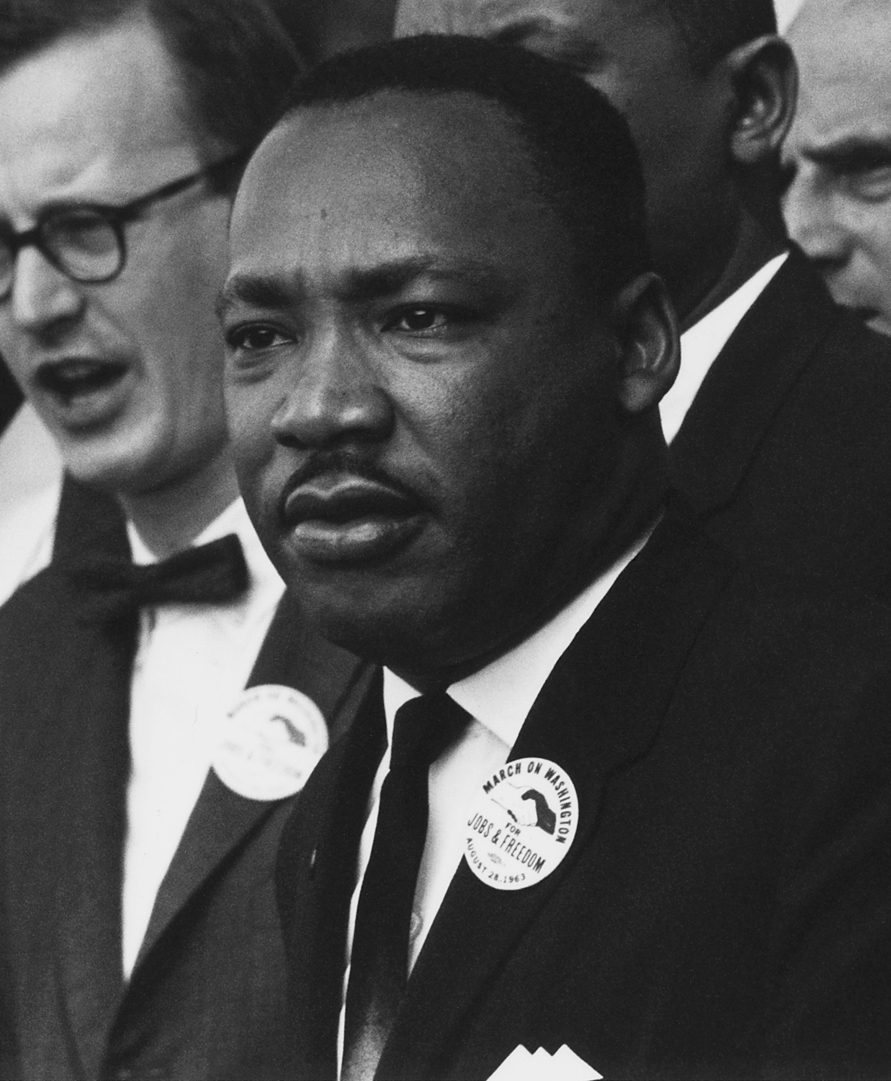
Martin Luther King Jr. (1929-1968) was the Baptist minister who became the defining leader of the American civil rights movement: he led the Montgomery bus boycott in 1955-56, co-founded the Southern Christian Leadership Conference, wrote the Letter from Birmingham Jail, delivered the I Have a Dream address in 1963, and at thirty-five became the youngest Nobel Peace Prize laureate of his time.
At a Glance
- Born
- 15 January 1929, Atlanta, Georgia - born Michael Luther King Jr., later renamed Martin
- Montgomery
- Led the Montgomery bus boycott of 1955-56, which ended after the Supreme Court declared bus segregation unconstitutional
- Organisation
- First president of the Southern Christian Leadership Conference (SCLC), founded 1957
- The Dream
- Delivered the I Have a Dream address at the March on Washington, 28 August 1963, before some 250,000 people
- Nobel Peace Prize
- 1964 - at 35, the youngest recipient at that time; he gave the 54,123-dollar prize money to the civil rights movement
- Died
- Assassinated on 4 April 1968 in Memphis, Tennessee, aged 39
- The holiday
- Federal holiday signed into law on 2 November 1983 and first observed on 20 January 1986, on the third Monday of January
Introduction
King led the movement for thirteen years, from a Montgomery church basement to the steps of the Lincoln Memorial, without holding political office or abandoning nonviolence even when his own home was bombed. His method - disciplined, televised, morally framed protest that forced segregation to show its violence to the world - produced the two great statutes of the era, the Civil Rights Act of 1964 and the Voting Rights Act of 1965. He was shot dead at thirty-nine in Memphis, standing with striking sanitation workers.
Origins: Atlanta, Morehouse and a Doctorate
Martin Luther King Jr. was born on 15 January 1929 at 501 Auburn Avenue in Atlanta, Georgia, the second child of the Reverend Michael King and Alberta Williams King. He was born Michael Luther King Jr.; his name was later changed to Martin. His grandfather and father both pastored Atlanta's Ebenezer Baptist Church, and King grew up in the Black middle-class world of Auburn Avenue, entering Morehouse College at fifteen and graduating in 1948. He took a divinity degree at Crozer Theological Seminary in 1951, where he was elected president of a predominantly white senior class, and completed his doctorate at Boston University in 1955. In Boston he met Coretta Scott, whom he married; they had four children.
In 1954 King became pastor of Dexter Avenue Baptist Church in Montgomery. He was twenty-five, newly arrived and, by the Nobel Foundation's account, already on the executive committee of the local NAACP. Montgomery was about to make him famous - and to test whether nonviolent mass protest could beat segregation in court and in the streets at the same time.
Montgomery and the SCLC, 1955-1962
On 1 December 1955 Rosa Parks was arrested for refusing to give up her bus seat to a white passenger. Montgomery's Black community boycotted the buses, and the young pastor was chosen to lead the Montgomery Improvement Association that ran the protest. The boycott lasted 382 days, by the Nobel Foundation's count. King's home was bombed and he was arrested, but the boycotters carpooled, walked and held. On 21 December 1956, after the Supreme Court declared the laws requiring segregation on buses unconstitutional, Black and white passengers rode Montgomery's buses as equals.
In 1957 King was elected president of the new Southern Christian Leadership Conference, formed to give the burgeoning movement coordinated leadership. The Nobel biography describes its sources plainly: its ideals King took from Christianity, its operational techniques from Gandhi. Over the following eleven years he travelled more than six million miles, spoke more than 2,500 times, wrote five books, and was arrested upwards of twenty times - a workload that made him, well before 1963, the movement's national voice.
Birmingham, the Dream and the Nobel Prize, 1963-1964
In spring 1963 King led the Birmingham campaign against segregation in one of America's most violently defended Jim Crow cities. Arrested there, he wrote his Letter from Birmingham Jail, answering white clergymen who had called the protests unwise and untimely; the National Park Service notes that the brutality shown to the campaign's demonstrators, together with the Letter, brought international attention to the movement. Its most quoted line, preserved on the King Memorial in Washington, holds that injustice anywhere is a threat to justice everywhere.
On 28 August 1963 King directed the March on Washington of some 250,000 people and delivered his I Have a Dream address from the Lincoln Memorial. Time named him its Man of the Year for 1963. The Civil Rights Act followed in July 1964, and that December, in Oslo, King received the Nobel Peace Prize. At thirty-five he was the youngest man to have received it at that time, and he announced that he would turn over the prize money of 54,123 dollars to the furtherance of the civil rights movement.
Selma, the Wider Agenda and Memphis, 1965-1968
In 1965 King helped organise the Selma voting-rights campaign in Alabama. The marches from Selma to Montgomery - the first met with state violence on the Edmund Pettus Bridge on 7 March, in what became known as Bloody Sunday - ended with a protected march to the state capitol and, that August, the Voting Rights Act of 1965. King then widened his agenda beyond southern segregation: to housing and poverty in Chicago, to the Poor People's Campaign, and, in 1967, to public opposition to the Vietnam War - positions that cost him allies in Washington and in parts of the press.
In the spring of 1968 he went to Memphis to support striking Black sanitation workers. On the evening of 4 April 1968, standing on the balcony of his motel room, he was assassinated. He was thirty-nine. James Earl Ray pleaded guilty to the killing the following year and was sentenced to 99 years in prison, though he later recanted his plea and the case has been argued over ever since.
Timeline
- 15 January 1929
Born Michael Luther King Jr. in Atlanta, Georgia; his name is later changed to Martin.
- 1948-1955
Graduates from Morehouse College, studies at Crozer Theological Seminary, and completes his doctorate at Boston University.
- 1954
Becomes pastor of Dexter Avenue Baptist Church in Montgomery, Alabama.
- December 1955 - December 1956
Leads the 382-day Montgomery bus boycott; the Supreme Court declares bus segregation unconstitutional and the boycott ends in victory.
- 1957
Elected first president of the Southern Christian Leadership Conference (SCLC).
- Spring 1963
Leads the Birmingham campaign and writes the Letter from Birmingham Jail.
- 28 August 1963
Delivers the I Have a Dream address to some 250,000 people at the March on Washington.
- 2 July 1964
The Civil Rights Act is signed into law, outlawing segregation in public accommodations.
- 10 December 1964
Receives the Nobel Peace Prize in Oslo - at 35, the youngest recipient at that time - and gives the prize money to the movement.
- March 1965
The Selma to Montgomery marches press for voting rights after Bloody Sunday on the Edmund Pettus Bridge.
- 6 August 1965
The Voting Rights Act is signed into law.
- 4 April 1968
Assassinated on a motel balcony in Memphis, Tennessee, where he was supporting striking sanitation workers.
- 2 November 1983
President Ronald Reagan signs the bill creating a federal holiday in King's honour.
- 20 January 1986
Martin Luther King Jr. Day is observed as a federal holiday for the first time.
Significance
King's significance is that he made nonviolence work as American politics. Birmingham and Selma were chosen battlegrounds where segregation's enforcement would be seen, and the seeing changed the law: the National Park Service draws the line directly, from Montgomery to the civil rights acts of 1957 and 1960, from Birmingham to the Civil Rights Act of 1964, and from Selma to the Voting Rights Act of 1965. His writings, above all the Letter from Birmingham Jail, gave the movement a permanent moral text, and his oratory gave the country a shared vocabulary for its own founding promises.
Myths and disputes
The federal holiday was not a swift national thank-you. A campaign for it began within days of King's death in 1968, but the bill took fifteen years: Britannica records that it overcame forceful opposition, with critics citing FBI surveillance files to argue that King was a radical influenced by communists. The surveillance itself is documented history, not allegation: under director J. Edgar Hoover the FBI monitored King for years as part of its COINTELPRO programme, a record later investigated by Congress. The House and Senate nonetheless passed the holiday bill by overwhelming, veto-proof margins, and President Reagan, setting aside his initial doubts, signed it on 2 November 1983; it was first observed on 20 January 1986, and some states resisted adopting it for years afterwards.
Two smaller corrections belong here. King was not born with the name Martin: he was born Michael Luther King Jr., and the change came later, as the Nobel Foundation's biography states. And the Montgomery boycott's length is given as 382 days by the Nobel Foundation and 381 days by some other accounts, depending on whether the final day is counted - a one-day counting difference, not a disagreement about the event.
Legacy
Coretta Scott King founded the King Center in Atlanta in the year of his death, and the campaign she led gave the United States its January holiday, observed on the third Monday near his birthday and, since 1994, marked as a national day of service. Atlanta preserves his birth home and Ebenezer Baptist Church as a national historical park; Washington has his memorial on the National Mall. But the durable legacy is the template itself: disciplined nonviolent protest, aimed at a law's conscience and a camera's eye, could move a reluctant nation - a method movements worldwide have studied ever since.
Sources
- Nobel Prize - Martin Luther King Jr., Biographical
- National Park Service - Martin Luther King, Jr., Civil Rights
- National Park Service - Quotations, Martin Luther King, Jr. Memorial
- National Archives - Celebrating Rev. Dr. Martin Luther King Jr.'s Birthday and Legacy
- Stanford University, King Institute - Letter from Birmingham Jail
- Stanford University, King Institute - Montgomery Bus Boycott
- Encyclopaedia Britannica - Martin Luther King, Jr.: Historical significance and legacy
The facts on this page were checked against these sources on 19 November 2026. The History Trail's permanent pages are researched and written for this site; the live profiles elsewhere on The History Trail are assembled automatically from Wikipedia and Wikidata.
About the Author
Researched and written by the The History Trail Editorial Team — the accountable editorial function behind this site's permanent story pages. The team works from the published sources cited on each page; it does not invent historians, reviewers or credentials, and it corrects errors openly.
Fact Check
Every load-bearing fact on this page traces to one of the sources listed above, and significant claims link to their source in the text. Our checking method is described on the methodology page; errors can be reported via the corrections page.
Sources & Citations
Cite this page as: The History Trail Editorial Team, The History Trail — this article's title, publication and update dates are shown beneath its headline. The full source list appears under Sources above; the site's source standards are on the sources page.