
Events
First Movie Theater
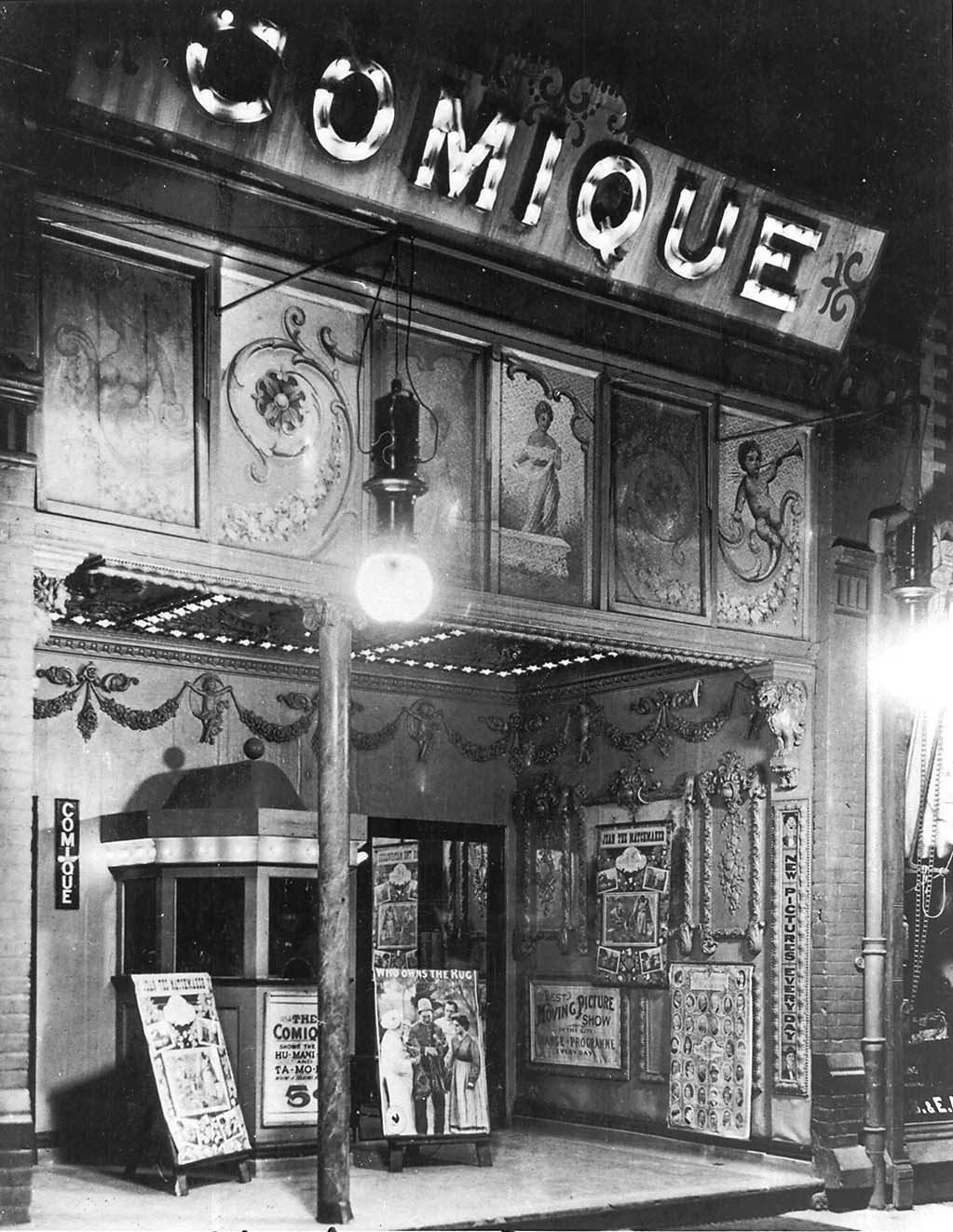
On 19 June 1905 a converted storefront in Pittsburgh began showing motion pictures all day for five cents, and cinema found its home. Harry Davis and John P. Harris's Nickelodeon - 96 seats, a piano, continuous shows - is widely credited as the first permanent theater in the United States devoted to motion pictures, and the model it proved spread to thousands of towns within three years.
At a Glance
- Event
- Opening of the Nickelodeon, widely credited as the first permanent theater in the United States devoted to motion pictures
- Date
- 19 June 1905
- Place
- 433-435 Smithfield Street, Pittsburgh, Pennsylvania
- Founders
- Harry Davis and his brother-in-law John P. Harris, both established Pittsburgh showmen
- The offer
- 96 seats plus standing room, continuous shows from 8 a.m. to midnight, films of 15-20 minutes with piano accompaniment, admission five cents
- Opening day
- About 450 people attended; weekly profit was soon estimated at close to 1,000 dollars
- The boom
- An estimated 8,000-10,000 nickelodeons in the United States by 1908; an estimated 26 million Americans attending weekly by 1910
- The dispute
- Tally's Electric Theatre, Los Angeles (1902), is often called the first purpose-built cinema; the Nickelodeon's claim rests on permanence, success and the model it spread
Introduction
On 19 June 1905, in a converted storefront at 433-435 Smithfield Street in Pittsburgh, two showmen named Harry Davis and John P. Harris opened a small hall with 96 seats, a piano and a projector, charged a nickel, and ran films all day. About 450 people came on the first day. They called it the Nickelodeon - nickel for the price, odeon from the Greek word for a theatre - and the model they perfected, a permanent room built for nothing but showing motion pictures, spread across America within two years. The Nickelodeon is widely credited as the first permanent movie theater in the United States devoted to motion pictures - a title that is contested, as this page sets out honestly.
Film Before Theatres
Motion pictures had existed for a decade before anyone built them a home. Thomas Edison's first machines were peephole viewers: one person at a time watched a film loop through a Kinetoscope, and the first Kinetoscope parlor opened in a converted New York storefront in April 1894. Projection came in 1896. Edison marketed the Vitascope, a projector invented by Thomas Armat, and on 23 April 1896 it was demonstrated publicly at Koster and Bial's Music Hall in New York - the Library of Congress's history of Edison's motion pictures traces how the company moved from peephole viewing to projection in exactly this period.
For its first decade, projected film had no place of its own. Films were acts inside vaudeville programmes - novelties slotted between singers and jugglers, sometimes used as 'chasers', short pictures shown to signal that the show was over and clear the house. A vaudeville ticket cost far more than a nickel, and the audience was not film's to command. The question of 1905 was whether pictures alone could fill a room, all day, every day.
Pittsburgh, 19 June 1905
Harry Davis was already Pittsburgh's leading showman: he had presented the city's first projected movies at his Avenue Theatre in 1896, and his brother-in-law John P. Harris had shown motion pictures there in 1897 through his Harris Comedy and Specialty Company. When fire burned Davis's Avenue Theatre in June 1905, he moved the picture show into a Smithfield Street storefront - and instead of folding films back into variety, he and Harris devoted the room to films alone.
The formula, as the Heinz History Center tells it, was precise: continuous shows from 8 in the morning until midnight, programmes of short films lasting about 15 to 20 minutes - titles such as The Baffled Burglar, Poor But Honest and The Great Train Robbery - a pianist, and one price, five cents. Standing room took perhaps a hundred more. The historian Charles Musser, quoted in the standard accounts, judged the result plainly: 'It is not too much to say that modern cinema began with the nickelodeons.' Davis himself moved fast - by late 1907 he had 15 nickelodeons in Pittsburgh alone.
The Nickelodeon Boom
The nickelodeon was cheap to copy: a storefront, chairs, a projector, a pianist. Within a few years there were thousands. Britannica puts the American total at an estimated 8,000 to 10,000 by 1908, and one widely cited estimate holds that by 1910 some 26 million Americans were attending nickelodeons every week. The future founders of Hollywood learned the trade in these rooms - William Fox opened his first nickelodeon in Brooklyn in 1905, and Carl Laemmle opened the White Front Theatre in Chicago in 1906.
The audience was the revolution. Nickelodeons drew working-class and immigrant crowds precisely because a five-cent ticket and a story told in pictures needed no English and no evening dress. Reformers and civic groups complained the dark, cheap rooms were disreputable and dangerous - hard wooden seats, few exits, crowds packed in - but the complaint itself proved the point: a new mass public had appeared, and it belonged to the movies.
Timeline
- 14 April 1894
The first Kinetoscope parlor opens in New York: customers watch Edison's films one at a time through peephole viewers.
- 23 April 1896
Edison's Vitascope projector is publicly demonstrated at Koster and Bial's Music Hall, New York; films become vaudeville acts.
- April 1902
Thomas L. Tally opens the Electric Theatre in Los Angeles, a leading rival claimant to the title of first purpose-built cinema.
- 19 June 1905
Harry Davis and John P. Harris open the Nickelodeon at 433-435 Smithfield Street, Pittsburgh; about 450 attend on the first day.
- 1905
William Fox opens his first nickelodeon, in Brooklyn; within three years Davis alone runs 15 in Pittsburgh.
- 1906
Carl Laemmle opens the White Front Theatre in Chicago, an early step toward the studio system he would build.
- 1908
An estimated 8,000 to 10,000 nickelodeons operate in the United States; the storefront model saturates the country.
- 1910
An estimated 26 million Americans attend nickelodeons weekly.
- 11 April 1914
The Mark Strand Theatre opens in New York - a million-dollar hall built only for motion pictures, managed by Samuel 'Roxy' Rothafel.
- 1927
New York's Roxy Theatre opens with some 5,900 seats, billed as 'the cathedral of the motion picture'.
- 1929
A bronze tablet marking the Nickelodeon's Pittsburgh site is unveiled - the claim to be first is cast in metal.
Significance
The Nickelodeon's invention was not a machine but a business model: one art form, one low price, continuous entry, a room of its own. It turned film from an act inside someone else's show into an industry with its own buildings, its own audience and its own economics - the demand that within a decade produced feature films, stars and studios. Almost everything in cinema since, from the picture palace to the multiplex to the streaming premiere, descends from the decision that pictures deserved a room.
Myths and disputes
The title 'first movie theater' is genuinely disputed, and the honest account has three claimants. Tally's Electric Theatre in Los Angeles, opened in April 1902, is often called the first purpose-built cinema - a theatre constructed for movies rather than converted - though it switched to vaudeville within about a year. Earlier still, the Mark brothers' Vitascope Theatre in Buffalo, opened in October 1896, has been promoted as the first permanent, purpose-designed movie theatre. Pittsburgh's claim rests on different ground: not on being purpose-built or earliest, but on permanence, profitability and the model - the Nickelodeon ran for years, made money, and was imitated everywhere. Even the word was not new: an Austin's Nickelodeon dime museum had operated in Boston in 1888. The Pittsburgh claim was argued into print by E. W. Lightner's 1919 article 'Pittsburg Gave Birth to the Movie Theater Idea' and fixed with a bronze tablet in 1929.
The other legend is older and shakier: that audiences at the Lumière brothers' Arrival of a Train at La Ciotat fled in panic as the locomotive bore down on them. The film historian Martin Loiperdinger, examining the story in 2004, found no contemporary newspaper or police record of any such panic; the train film was not even in the famous Paris programme of 28 December 1895, and was first shown in January 1896. The fleeing audience is cinema's founding myth - a wonderful story about the new medium's power, repeated for a century, for which the documentary evidence is essentially absent.
Legacy
The Smithfield Street storefront is long gone, but Pittsburgh kept the name alive: the city's Harris Theater honours John P. Harris, the Nickelodeon's co-founder. The nickelodeon itself lasted barely a decade as the dominant form - rising expectations, regulation and feature-length films pushed audiences toward the picture palaces of the 1910s and 1920s. But the transaction it invented never ended: a small price, a dark room, a story in light, shown continuously to anyone who walks in. Every cinema since has been a Nickelodeon with better seats.
Sources
- Senator John Heinz History Center - Five Surprising Pittsburgh Innovations (Western Pennsylvania History)
- Library of Congress - History of Edison Motion Pictures
- Encyclopaedia Britannica - History of film: Technical breakthroughs
- Encyclopaedia Britannica - Nickelodeon (Britannica Kids/Students)
- HISTORY - Pioneering Nickelodeon theater opens (This Day in History, 19 June)
- Encyclopedia.com (Gale) - Nickels Count: Storefront Theaters, 1905-1907
The facts on this page were checked against these sources on 19 November 2026. The History Trail's permanent pages are researched and written for this site; the live profiles elsewhere on The History Trail are assembled automatically from Wikipedia and Wikidata.
About the Author
Researched and written by the The History Trail Editorial Team — the accountable editorial function behind this site's permanent story pages. The team works from the published sources cited on each page; it does not invent historians, reviewers or credentials, and it corrects errors openly.
Fact Check
Every load-bearing fact on this page traces to one of the sources listed above, and significant claims link to their source in the text. Our checking method is described on the methodology page; errors can be reported via the corrections page.
Sources & Citations
Cite this page as: The History Trail Editorial Team, The History Trail — this article's title, publication and update dates are shown beneath its headline. The full source list appears under Sources above; the site's source standards are on the sources page.