
Things
History of photography
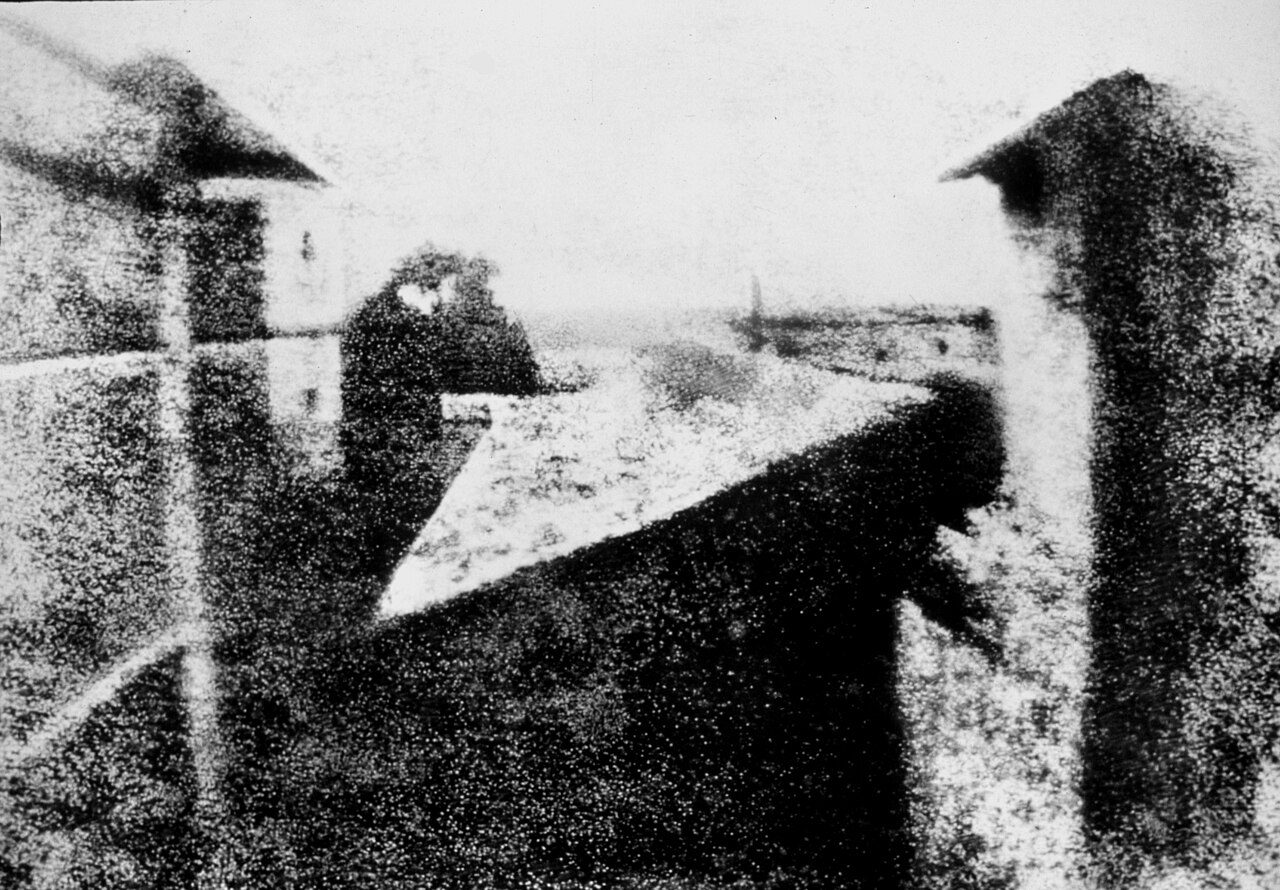
Photography began with a picture almost nobody could see: in 1826 or 1827 - the date is still debated - Joseph Nicéphore Niépce exposed a bitumen-coated pewter plate in a camera obscura at Le Gras in France and produced the earliest surviving photograph made with a camera. Within two centuries the process ran through silver plates, paper negatives, roll film, colour and instant prints, until chemistry gave way to sensors and the camera merged into the telephone.
At a Glance
- First surviving camera photograph
- View from the Window at Le Gras, by Joseph Nicéphore Niépce, 1826 or 1827 (the date is debated); heliography on a pewter plate, now held by the Harry Ransom Center, Austin, Texas
- Photography's public birthday
- 1839: Daguerre's daguerreotype is announced in Paris, and its working details are published on 19 August 1839 after the French government buys the rights
- The reproducible image
- Talbot's calotype, patented 1841: a paper negative from which many positive prints could be made, demonstrated in The Pencil of Nature (1844-1846)
- Speed
- Frederick Scott Archer's wet collodion process (1851) cuts exposures to seconds; Richard Maddox's gelatin dry plate (1871) frees photographers from the portable darkroom
- Photography for everyone
- Eastman's Kodak camera of 1888, sold loaded with a 100-exposure roll and returned to Rochester for processing - 'You press the button, we do the rest'
- Colour
- Autochrome, the first commercially successful colour process (Lumière brothers, 1907); Kodachrome film follows in 1935
- Digital
- Steven Sasson's Kodak prototype of 1975 records a 0.01-megapixel image on a cassette tape; by the 2000s the camera phone outsells every earlier kind of camera
Introduction
Photography is a chain of processes, not a single invention. Each link - a new light-sensitive surface, a faster emulsion, a cheaper way to print - changed who could make a picture and how many people could see it. The chain runs from a pewter plate that needed hours of sunlight to a telephone that makes and sends a picture in a second, and at almost every step the credit is contested.
It starts with the oldest surviving camera photograph. Niépce had been copying engravings by sunlight since 1822 with a process he called heliography. In 1826 or 1827 he pointed a camera obscura from an upstairs window and exposed a bitumen-coated plate to the view outside. The result, View from the Window at Le Gras, shows rooftops, a barn and a tree, faintly: the first camera photograph that still exists.
A Partnership, a Death, and a Lost Plate
Niépce knew heliography was too slow to be practical. In 1829 he formed a partnership with Louis-Jacques-Mandé Daguerre, a Parisian showman hunting for the same secret. Niépce died in 1833, still short of a reliable process, and Daguerre worked on alone. The Le Gras plate was carried to England and lost to view for decades, then rediscovered in 1952 by the photographic historian Helmut Gernsheim. It is now held by the Harry Ransom Center at the University of Texas at Austin.
1839: Two Processes, One Public Birthday
On 7 January 1839 Daguerre's pictures were shown to the French Académie des Sciences: one-of-a-kind images on silver-plated copper, sensitised with iodine vapour, exposed in a camera, developed in mercury fumes and fixed. François Arago championed the invention, and the French government bought the rights in exchange for pensions, giving the process to the world. On 19 August 1839 the working details were published, and the daguerreotype became the first widely used photographic method.
In England, William Henry Fox Talbot had been beaten to the announcement. After struggling to draw on a Lake Como honeymoon in 1833, he had devised 'photogenic drawing' - paper sensitised with salt and silver nitrate - and presented it in January 1839. His breakthrough came on 23 September 1840, when he found that a few seconds' exposure left an invisible latent image that chemistry could develop out. Patented in February 1841 as the calotype, it was softer than Daguerre's plate but revolutionary in one respect: the paper negative could print many positives. His Pencil of Nature (1844-1846), illustrated with 24 photographic prints, was the first book of its kind.
Faster Plates and the Printed Photograph
In March 1851 Frederick Scott Archer published the wet collodion process: a glass plate coated with collodion, sensitised, exposed and developed while still wet. It married the daguerreotype's sharpness to the calotype's reproducibility and cut exposures to a few seconds, but the whole performance - coating, exposing, developing within about fifteen minutes - had to happen on the spot, so photographers travelled with portable darkrooms. By the end of the 1860s wet collodion was the world's standard process.
Richard Maddox's gelatin dry plate, published in 1871, displaced the wet plate: emulsion could be factory-coated, stored and developed later, and George Eastman built his business on manufacturing dry plates from 1880. On 4 March 1880 the New York Daily Graphic published 'A Scene in Shantytown' by Stephen Horgan's halftone screen - the first reproduction of a photograph with a full tonal range in a newspaper. Halftone broke the image into dots a press could print alongside type, and within two decades photographs were routine in newspapers and magazines.
The Snapshot Century: Roll Film, 35mm and Colour
In 1888 Eastman's company launched the Kodak: a simple box camera sold for 25 dollars, pre-loaded with a roll of paper negatives for 100 exposures. When the roll was finished, the whole camera went back to Rochester to be developed, printed and reloaded. The slogan the George Eastman Museum records - 'You press the button, we do the rest', which the museum says Eastman penned himself - described the bargain exactly. Transparent roll film replaced the paper roll in 1889, and the one-dollar Brownie of 1900 put a camera within reach of children.
Professionals went the other way: smaller and faster. The Leica I of 1925 built a still camera around 35mm cine film, and the discreet, quick 35mm camera became the tool of the new photojournalism. Colour arrived commercially with the Lumière brothers' Autochrome of 1907 - dyed potato-starch grains on glass - and matured in 1935, when Leopold Godowsky Jr. and Leopold Mannes produced Kodachrome in Kodak's laboratories, the first modern colour film.
Instant, Then Digital
Edwin Land demonstrated his instant process in February 1947, and in the autumn of 1948 Polaroid's Land Camera Model 95 went on sale: the first production unit was inscribed with Land's initials and is now in the Smithsonian. The camera developed its own picture, delivering a finished print in about sixty seconds - photography with the waiting removed.
In 1969 Willard Boyle and George E. Smith at Bell Laboratories invented the charge-coupled device, the CCD, a semiconductor that turns light into electrical signals. In December 1975 Steven Sasson, a Kodak engineer, built it into a camera: eight pounds of borrowed parts recording a 100-by-100-pixel image onto a cassette tape in about 23 seconds. Digital cameras began as expensive professional tools, were ordinary consumer goods by the end of the 1990s, and in 1999 Kyocera's Visual Phone VP-210 put a camera into a telephone.
Timeline
- 1826 or 1827
Niépce makes View from the Window at Le Gras by heliography, the earliest surviving camera photograph.
- 7 January 1839
The daguerreotype is shown to the Académie des Sciences; working details are published on 19 August 1839.
- February 1841
Talbot patents the calotype, the first practical negative-positive photographic process.
- 1851
Archer publishes the wet collodion process; exposures fall to a few seconds.
- 1871
Maddox describes the gelatin dry plate, freeing photographers from coating plates on the spot.
- 4 March 1880
The New York Daily Graphic prints 'A Scene in Shantytown', the first full-tone halftone photograph in a newspaper.
- 1888
Eastman launches the Kodak, pre-loaded for 100 exposures: 'You press the button, we do the rest'.
- 1935
Kodachrome brings modern colour film, developed by Godowsky and Mannes for Kodak.
- 1948
Polaroid's Land Camera Model 95 goes on sale, delivering a finished print in about a minute.
- 1975
Steven Sasson builds the first digital camera prototype at Kodak, recording images on cassette tape.
- 1999
Kyocera's Visual Phone VP-210 becomes the first commercially available camera phone.
Significance
Photography changed what counted as evidence. A drawing could be doubted as one person's interpretation; a photograph carried the force of a trace of the thing itself, and once the negative and the halftone press existed it could be multiplied without limit. Portraits left the studio class behind, war and poverty acquired faces, and ordinary families began, for the first time, to keep visual records of their own lives.
Myths and disputes
Who invented photography? The honest answer is a list, not a name. Niépce made the first surviving camera photograph. Daguerre made the first practical, widely used process, building on his partnership with Niépce. Talbot independently invented the negative-positive system on which all later film photography rests. Hippolyte Bayard, who had a working direct-positive paper process of his own, demonstrated it in 1839 and is routinely left out of the story. 'Inventor of photography' is a title the evidence refuses to give to any one person.
Even the first photograph's date is unsettled. Gernsheim, who rediscovered the plate, first dated it to 1826; later research argued for 1827, Gernsheim accepted the revision, and the Harry Ransom Center dates the plate to 1827. The famous exposure time is shakier still: 'eight hours' is the traditional figure, repeated everywhere, but the holding institution describes an exposure of several days, and Britannica gives 'several hours or possibly days'.
Legacy
Photography's processes are mostly gone - few now coat a plate or load a film - but its grammar is universal: the framed rectangle, the assumption that moments should be recorded and shared. The medium that began with one man exposing a plate for days at a window now produces more images in a day than the whole nineteenth century made.
Sources
- The Metropolitan Museum of Art, Heilbrunn Timeline of Art History - Daguerre (1787-1851) and the Invention of Photography
- The Metropolitan Museum of Art, Heilbrunn Timeline of Art History - William Henry Fox Talbot (1800-1877) and the Invention of Photography
- National Science and Media Museum, Science Museum Group - What do you need to make a photo?
- George Eastman Museum - From the Camera Obscura to the Revolutionary Kodak
- Smithsonian National Museum of American History - Polaroid Land Camera Model 95
- Encyclopaedia Britannica - 12 Key Dates in the History of Photography
The facts on this page were checked against these sources on 19 November 2026. The History Trail's permanent pages are researched and written for this site; the live profiles elsewhere on The History Trail are assembled automatically from Wikipedia and Wikidata.
About the Author
Researched and written by the The History Trail Editorial Team — the accountable editorial function behind this site's permanent story pages. The team works from the published sources cited on each page; it does not invent historians, reviewers or credentials, and it corrects errors openly.
Fact Check
Every load-bearing fact on this page traces to one of the sources listed above, and significant claims link to their source in the text. Our checking method is described on the methodology page; errors can be reported via the corrections page.
Sources & Citations
Cite this page as: The History Trail Editorial Team, The History Trail — this article's title, publication and update dates are shown beneath its headline. The full source list appears under Sources above; the site's source standards are on the sources page.