
Things
Camera
The camera is older than photography by centuries: it began as the camera obscura, a darkened room or box that projected an inverted image - described in antiquity, analysed by Ibn al-Haytham a thousand years ago, and used by artists before anyone could fix the image. When chemistry caught up in 1839, the box acquired a plate, then film, then a sensor, shrinking from a room to a pocket telephone.
At a Glance
- Ancestor
- The camera obscura: a dark chamber projecting an inverted image through a pinhole or lens, described by Mozi in China about 400 BCE and analysed by Ibn al-Haytham in the 11th century
- First commercial cameras
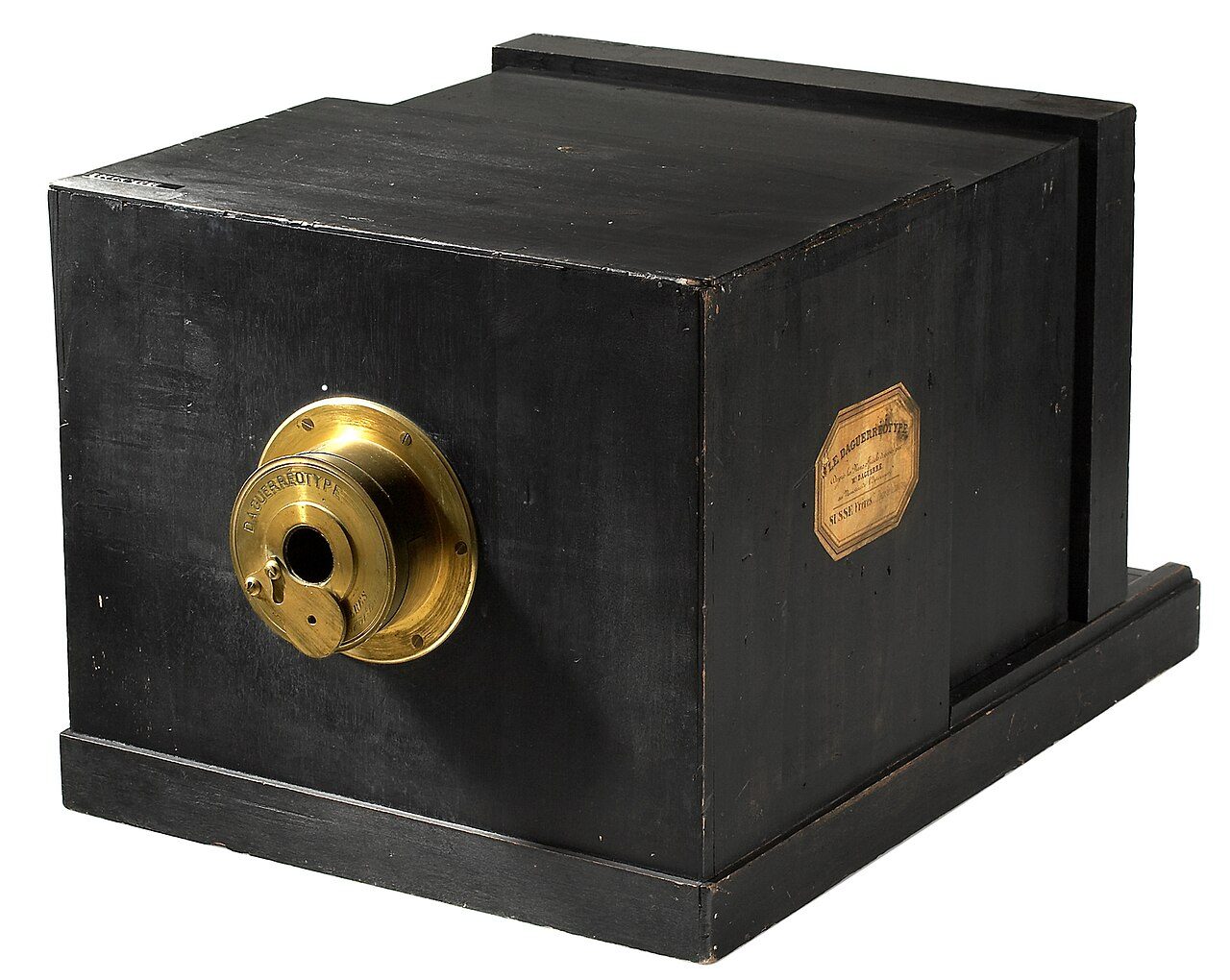
- The sliding-box daguerreotype cameras manufactured in Paris from 1839 by Alphonse Giroux et Cie and Maison Susse Frères under Daguerre's licence; the Giroux is generally described as the first commercially manufactured camera
- The amateur era
- Eastman's Kodak of 1888, a simple box pre-loaded for 100 exposures, and the one-dollar Brownie of 1900
- The 35mm era
- The Leica I of 1925, built by Leitz to Oskar Barnack's design, makes the small camera a professional instrument
- Instant
- Polaroid's Land Camera Model 95 (1948) develops the picture inside the camera
- The sensor
- The charge-coupled device (CCD), invented by Willard Boyle and George E. Smith at Bell Laboratories in 1969; Nobel Prize in Physics, 2009
- Absorption
- The first commercial camera phone, Kyocera's Visual Phone VP-210, appears in 1999; within a generation the phone becomes the world's default camera
Introduction
A camera is a light-tight box with a hole at one end and a surface at the other that can catch the image the hole projects. Everything in its history is a variation on that box: better lenses, faster shutters, smaller bodies, new surfaces. The box itself is ancient - centuries older than the chemistry that made its images permanent. This page follows the instrument; the processes that fixed its images are told on the History of Photography page.
The Camera Obscura: A Room That Draws
The principle was described in China by the philosopher Mozi about 400 BCE: light passing through a pinhole into a dark room projects an inverted image on the opposite wall. The Greeks probably knew it too - Aristotle among them. The Arab scholar Ibn al-Haytham, in the 10th or 11th century, is thought to have been the first to build a camera obscura and analyse how it worked; for centuries the device served to watch solar eclipses safely.
By the 16th century the camera obscura had become an aid to drawing: Giambattista della Porta described a version fitted with a lens, and portable box forms let an artist set the projected scene and trace it. The image was vivid, accurate - and gone the moment the light changed. For three hundred years the camera was a machine for looking. What it lacked was a memory.
1839: The First Commercial Cameras
When the memory arrived, the box was ready. Daguerre's camera, as the Metropolitan Museum describes it, was a wooden box: a lens at one end threw an image onto a frosted glass screen at the other, where the photographer composed and focused before swapping the screen for a sensitised plate. On 22 June 1839 Daguerre signed contracts with two Paris manufacturers, Alphonse Giroux et Cie and Maison Susse Frères, to produce cameras to his design - before the process itself had even been publicly explained.
The Giroux camera, a sliding-box design in which the inner box moved to focus, is generally described as the first commercially manufactured camera; the National Science and Media Museum calls its Giroux model the first commercially available camera, while the Susse Frères version, at 350 francs against the Giroux's 400, may have reached buyers first. Both took whole plates of about 21.6 by 16.7 centimetres, and both were slow - up to 20 minutes for an image, the Science Museum Group notes. Speed came in 1840, when Joseph Petzval designed a portrait lens the Smithsonian describes as twenty times faster than those fitted to the first daguerreotype cameras. Through the plate era the standard instrument became the bellows camera on a tripod, focusing by extension, one plate at a time.
The Box Camera: Photography Without Skill
George Eastman's genius was to design the skill out of the instrument. The Kodak of 1888 was a box with a fixed-focus lens, a simple shutter and no adjustments: as the George Eastman Museum puts it, the user armed the shutter by pulling a string, pointed the camera, and pressed the release. It came loaded for 100 exposures and went back to the factory for everything else. In 1900 the Brownie reduced the same idea to a cardboard box costing one dollar. Between them they changed the camera from a professional's instrument into a household object.
Small Cameras, Reflexes and Automation
Professionals, meanwhile, shrank the box. Oskar Barnack of Leitz built a prototype still camera around 1913 that used 35mm motion-picture film; development was delayed by the First World War, and the design reached the market in 1925 as the Leica I - the camera that made candid photography a profession. Reflex viewing matured alongside: Franke & Heidecke's Rolleiflex of 1928 made the twin-lens reflex practical, and single-lens reflex designs spread through the following decades.
After the Second World War the camera learned to do its own work. Polaroid's Land Camera Model 95 of 1948 folded the darkroom into the camera. In November 1977 Konica's C35 AF became the first mass-produced autofocus camera, focusing itself by an electronic system licensed from Honeywell; through the 1980s autofocus, auto-exposure and motor drives spread everywhere, and the fully automatic point-and-shoot became the standard family camera.
The Sensor Replaces the Film
The deepest change was to the surface at the back of the box. In 1969, at Bell Laboratories, Willard Boyle and George E. Smith invented the charge-coupled device, the CCD - an imaging semiconductor circuit for which they received the Nobel Prize in Physics in 2009. In 1975 Kodak's Steven Sasson built the first digital camera around one: the film plane had become a sensor, and the photograph a file. Eric Fossum's CMOS sensor, developed at NASA in the 1990s, made chips small and cheap enough for telephones.
In 1999 Kyocera released the Visual Phone VP-210, the first commercially available camera phone. Within a generation the telephone had become the camera most people owned, and the standalone camera settled back into professional and enthusiast hands.
Timeline
- c. 400 BCE
The Chinese philosopher Mozi describes pinhole projection - the principle of the camera obscura.
- 11th century
Ibn al-Haytham analyses the camera obscura; the device is used to observe eclipses.
- 1839
Giroux and Susse Frères manufacture Daguerre's sliding-box camera in Paris - the first cameras made for commercial sale.
- 1840
Petzval designs a portrait lens about twenty times faster than earlier camera lenses.
- 1888
Eastman's Kodak goes on sale, pre-loaded for 100 exposures, needing no adjustments.
- 1925
Leitz launches the Leica I, Barnack's 35mm camera, delayed from its pre-war prototype by the war.
- 1948
Polaroid's Land Camera Model 95 goes on sale, developing its picture inside the camera.
- 1969
Willard Boyle and George E. Smith invent the CCD sensor at Bell Laboratories.
- 1975
Sasson's Kodak prototype records a digital image on cassette tape - the first digital camera.
- 1999
Kyocera's Visual Phone VP-210 becomes the first commercially available camera phone.
Significance
The camera's history is a history of removal: of the darkroom from the field, of skill from the taking, of delay from the seeing, and finally of the camera itself into another device. Each removal multiplied the number of photographs and the range of things photographed - from the formal portrait sittings of the daguerreotype era, when a sitter held still for minutes, to billions of unposed images a day. The camera's two-century shrink from a room to a chip decided what the modern world would look like to itself.
Myths and disputes
Two tidy claims outrun the evidence. The first is that 'the first photograph needed an eight-hour exposure'. The figure belongs to tradition, not measurement: it is attached to Niépce's Le Gras plate of 1826 or 1827, but the Harry Ransom Center describes an exposure of several days, and Britannica gives 'several hours or possibly days'. Early daguerreotype exposures vary the same way - the Science Museum Group says the first cameras could take up to 20 minutes, while the Smithsonian gives two to ten minutes or more for the lenses of 1839. The honest summary: early exposures ran to minutes or far longer, and the famous single numbers are later simplifications.
The second is the claim that the Old Masters painted with optical help. That some artists used the camera obscura is documented history - it was a standard drawing aid for centuries. The disputed step is the Hockney-Falco thesis, proposed by David Hockney in 1999 and developed with Charles Falco in the 2001 book Secret Knowledge: that the naturalism of Western painting from about 1430 was driven by widespread use of lenses and mirrors, by artists from Van Eyck to Caravaggio. Many art historians contest it - pointing to the thin documentary evidence, to the optics of the period, and to realists who needed no such aids - and it remains a thesis, not a settled finding.
Legacy
The camera obscura's dark room survives in the word itself - camera is Latin for a chamber - and in every device that still works the same way: a lens, a dark interior, a sensitive surface. The box that once filled a room, and that an 1839 buyer carried home from Giroux's for 400 francs, is now a component millimetres thick inside a telephone - and it takes more photographs before breakfast than its inventors saw in their lives.
Sources
- National Science and Media Museum, Science Museum Group - What do you need to make a photo?
- The Metropolitan Museum of Art, Heilbrunn Timeline of Art History - Daguerre (1787-1851) and the Invention of Photography
- George Eastman Museum - From the Camera Obscura to the Revolutionary Kodak
- Smithsonian National Museum of American History - Polaroid Land Camera Model 95
- Nobel Prize - The Nobel Prize in Physics 2009, press release
- Encyclopaedia Britannica - 12 Key Dates in the History of Photography
The facts on this page were checked against these sources on 19 November 2026. The History Trail's permanent pages are researched and written for this site; the live profiles elsewhere on The History Trail are assembled automatically from Wikipedia and Wikidata.
About the Author
Researched and written by the The History Trail Editorial Team — the accountable editorial function behind this site's permanent story pages. The team works from the published sources cited on each page; it does not invent historians, reviewers or credentials, and it corrects errors openly.
Fact Check
Every load-bearing fact on this page traces to one of the sources listed above, and significant claims link to their source in the text. Our checking method is described on the methodology page; errors can be reported via the corrections page.
Sources & Citations
Cite this page as: The History Trail Editorial Team, The History Trail — this article's title, publication and update dates are shown beneath its headline. The full source list appears under Sources above; the site's source standards are on the sources page.