
Years
1901 in History
1901 opened with the end of an era — Queen Victoria died on 22 January after a reign of 63 years — and turned in September, when President William McKinley was shot at Buffalo and Theodore Roosevelt succeeded him. It closed with two beginnings: the first Nobel Prizes, awarded on 10 December, and, two days later, Marconi receiving the first transatlantic radio signal in Newfoundland.
At a Glance
- Defining event
- President William McKinley is shot at Buffalo on 6 September and dies on 14 September; Theodore Roosevelt succeeds him
- Era ends
- Queen Victoria dies at Osborne House on 22 January, after a reign of 63 years
- Honours begin
- The first Nobel Prizes are awarded on 10 December, five years after Nobel's death — Röntgen takes Physics
- Signal of the year
- Marconi receives the first transatlantic radio signal, the letter 'S', at St. John's, Newfoundland, on 12 December
- Oil begins
- The Spindletop gusher blows in near Beaumont, Texas, on 10 January, beginning the Texas oil boom
- Born this year
- Louis Armstrong (4 August), Walt Disney and Werner Heisenberg (both 5 December)
The defining story: the old order passes
The year began with a death that closed the nineteenth century more decisively than any calendar. On 22 January Queen Victoria died at Osborne House after a reign of 63 years — Britain's longest to that date — and with her went the name an age had borrowed. Five days later Giuseppe Verdi, the composer of Aida, Rigoletto and La traviata, died in Milan at 87. Between those two funerals, on 10 January, the future announced itself noisily in Texas: the Spindletop gusher blew in near Beaumont, beginning the Texas oil boom and the age of cheap petroleum on which the new century would run.
The year's violent centre came in September. On 6 September, at the Pan-American Exposition in Buffalo, the anarchist Leon Czolgosz shot President William McKinley twice. McKinley died of gangrene eight days later, on 14 September, and Theodore Roosevelt — the vice president elected as McKinley's running mate the year before — became president. In October Roosevelt officially renamed the Executive Mansion in Washington the White House, a small act of branding by a president who intended the office to be seen. The day before the shooting's month was out, the old world's account with China was also settled on paper: the Boxer Protocol, signed in Peking on 7 September, formally ended the Boxer Rebellion and imposed a huge indemnity on Qing China.
December supplied the counterweight: institutions designed to outlast assassinations. On 10 December, exactly five years after Alfred Nobel's death, the first Nobel Prizes were awarded in Stockholm and Christiania — Röntgen in Physics, van 't Hoff in Chemistry, von Behring in Medicine, Sully Prudhomme in Literature, and Dunant and Passy sharing Peace. Two days later, at St. John's, Newfoundland, Guglielmo Marconi received the first transatlantic radio signal — the letter 'S' in Morse code — sent from Poldhu in Cornwall. A prize for benefiting humankind and a signal that crossed an ocean without wires: the new century's twin ambitions, announced within forty-eight hours.
The year also quietly founded a federation: on 9 May Australia opened its first federal parliament in Melbourne, months after the colonies had federated. And in Frankfurt, a 51-year-old woman named Auguste Deter was admitted to an asylum with profound memory loss — the patient whose case, followed by Dr Alois Alzheimer, would give a disease its name, though for most of a century almost nobody would know hers.
Timeline of 1901
- 10 January
The Spindletop gusher blows in near Beaumont, Texas, beginning the Texas oil boom.
- 22 January
Queen Victoria dies at Osborne House after a reign of 63 years.
- 27 January
Giuseppe Verdi, composer of Aida, Rigoletto and La traviata, dies in Milan at 87.
- 1 February
Clark Gable and Langston Hughes are born on the same day — Hollywood's future king and the Harlem Renaissance's defining voice.
- 9 May
Australia opens its first federal parliament in Melbourne, months after federation.
- 4 August
Louis Armstrong, who will make jazz a soloist's art, is born.
- 6 September
President William McKinley is shot twice by the anarchist Leon Czolgosz at Buffalo; he dies eight days later.
- 7 September
The Boxer Protocol is signed in Peking, formally ending the Boxer Rebellion and imposing a huge indemnity on China.
- 14 September
William McKinley dies of gangrene; Theodore Roosevelt becomes president.
- 24 October
Annie Edson Taylor, a 63-year-old schoolteacher, becomes the first person to survive going over Niagara Falls in a barrel.
- 10 December
The first Nobel Prizes are awarded in Stockholm and Christiania, exactly five years after Nobel's death.
- 12 December
Marconi receives the first transatlantic radio signal — the letter 'S' — at St. John's, Newfoundland.
Why 1901 still matters
McKinley's assassination changed the American presidency's direction as surely as any election. Roosevelt brought to the office an energy the institution had not contained before, and the century of American power that followed began, in personnel terms, with a gunshot in Buffalo. The anarchist's bullet also completed a grim pattern — the third American presidential assassination in thirty-six years — and security around presidents was never innocent again.
The December pair proved more durable than the September shot. The Nobel Prizes became the world's standing measure of achievement, awarded on the same December date ever since; Marconi's three faint dots in a Newfoundland receiver began the wireless century, in which distance stopped being an argument. Spindletop, in January, had already announced the fuel that century would burn.
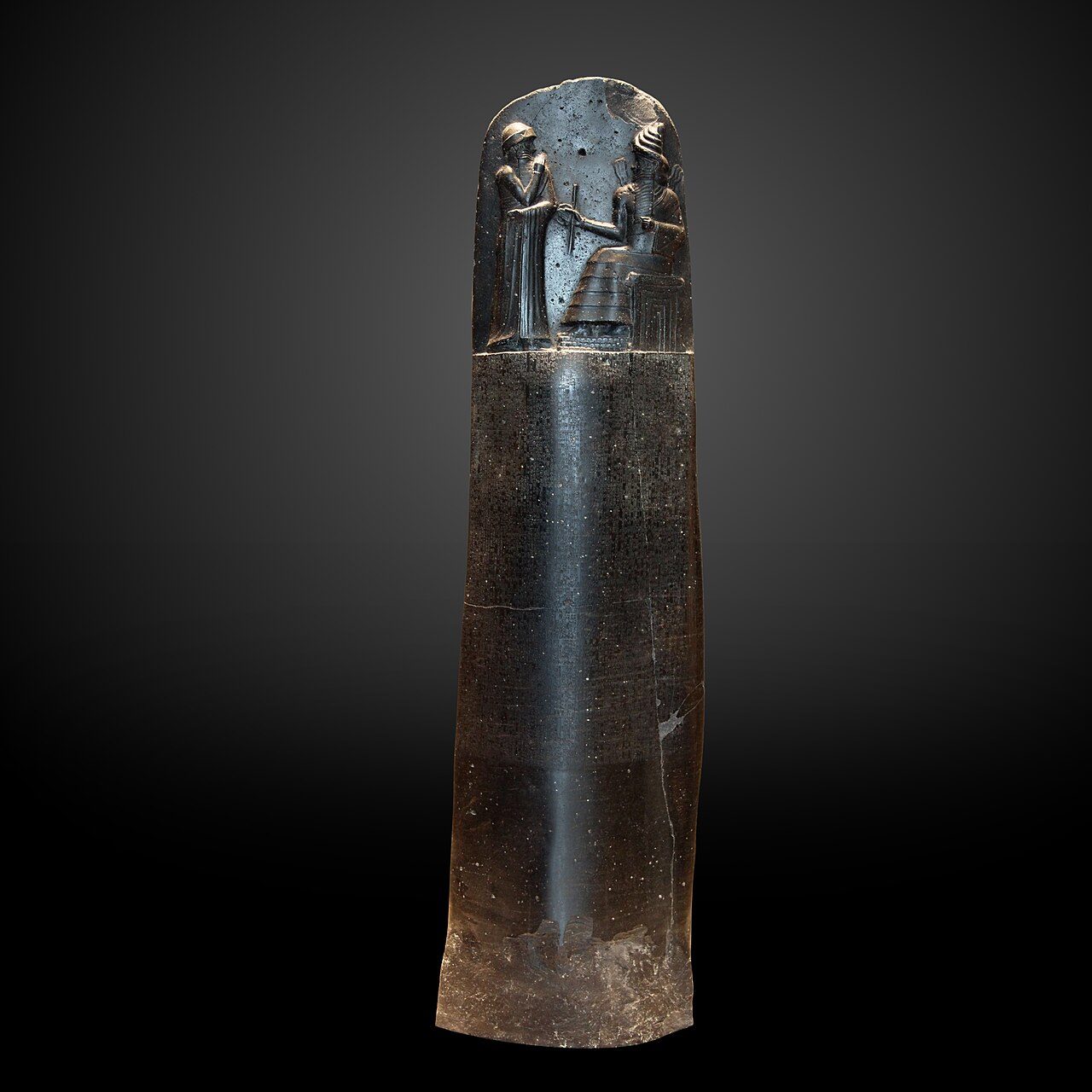
And the year's recoveries ran deep in time. In the winter of 1901–02 a French expedition under Jacques de Morgan found, at Susa in modern Iran, a black basalt stele in three fragments: the Code of Hammurabi, some 4,130 lines of cuneiform law from Babylon, carried off as war booty in the 12th century BCE and buried for three thousand years. Its publication created a whole branch of comparative jurisprudence. The newest year of the modern age began, fittingly, by digging up the oldest complete law code on Earth.
1901 on The History Trail
Victoria's death and McKinley's assassination frame this year on The History Trail, with the first Nobel Prizes and an ancient law code recovered from the earth.
- January 22 in History — Queen Victoria dies after a reign of 63 years.
- September 6 in History — President McKinley is shot at the Pan-American Exposition in Buffalo.
- September 14 in History — McKinley dies, and Theodore Roosevelt becomes president.
- December 10 in History — The first Nobel Prizes are awarded, five years after Nobel's death.
- December 12 in History — Marconi receives the first transatlantic radio signal.
- January 10 in History — The Spindletop gusher begins the Texas oil boom.
- Code of Hammurabi — Babylon's laws carved in black stone, found in three pieces at Susa in the winter of 1901–02.
- Alzheimer's disease — The peculiar case of Auguste Deter, admitted in Frankfurt in 1901, that named a disease.
Sources
- Encyclopaedia Britannica — On This Day: January 22
- Encyclopaedia Britannica — On This Day: September 6
- Encyclopaedia Britannica — On This Day: September 14
- Encyclopaedia Britannica — On This Day: December 10
- Encyclopaedia Britannica — On This Day: December 12
- Encyclopaedia Britannica — On This Day: January 10
- Encyclopaedia Britannica — On This Day: May 9
- Encyclopaedia Britannica — On This Day: September 7
The facts on this page were checked against these sources on 19 November 2026. The History Trail's permanent pages are researched and written for this site; the live profiles elsewhere on The History Trail are assembled automatically from Wikipedia and Wikidata.
About the Author
Researched and written by the The History Trail Editorial Team — the accountable editorial function behind this site's permanent story pages. The team works from the published sources cited on each page; it does not invent historians, reviewers or credentials, and it corrects errors openly.
Fact Check
Every load-bearing fact on this page traces to one of the sources listed above, and significant claims link to their source in the text. Our checking method is described on the methodology page; errors can be reported via the corrections page.
Sources & Citations
Cite this page as: The History Trail Editorial Team, The History Trail — this article's title, publication and update dates are shown beneath its headline. The full source list appears under Sources above; the site's source standards are on the sources page.