
On This Day
September 6 in History
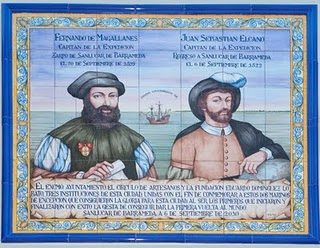
On 6 September 1522 the battered carrack Victoria dropped anchor at Sanlucar de Barrameda in Spain, completing the first circumnavigation of the Earth. She was the only survivor of the five ships that had sailed with Ferdinand Magellan three years earlier, and just 18 of the roughly 240 men who set out came home on her. September 6 is also the day President McKinley was shot in 1901 and the First Battle of the Marne began in 1914.
Choose another date: open the On This Day calendar to browse events, births and deaths for any day of the year.
At a Glance
- The ship
- The Victoria, a carrack of about 85 tons, the smallest-but-one of the expedition's five ships
- The captain
- Juan Sebastian Elcano, the Basque master who took command after Magellan was killed in the Philippines in April 1521
- The departure
- Five ships and roughly 240 men left Sanlucar de Barrameda on 20 September 1519
- The return
- One ship and 18 men reached Sanlucar on 6 September 1522, then sailed upriver to Seville
- The cargo
- The Victoria carried a valuable cargo of cloves and other spices from the Moluccas, which by itself repaid much of the expedition's cost
- The proof
- The voyage demonstrated in practice that the Earth is a single globe-girdling ocean system — and that the Americas were far wider, and Asia farther off, than Europe had believed
Events on this day
- 1522The Victoria, under Juan Sebastian Elcano, arrives at Sanlucar de Barrameda, completing the first circumnavigation of the Earth — the featured story above.
- 1620The Mayflower departs Plymouth, England, carrying the Pilgrims toward America; she reaches Cape Cod in November.
- 1781British forces under the turncoat Benedict Arnold burn New London, Connecticut, and storm Fort Griswold across the Thames River.
- 1847Henry David Thoreau leaves the cabin at Walden Pond where he has lived for two years, two months and two days.
- 1901President William McKinley is shot twice by the anarchist Leon Czolgosz at the Pan-American Exposition in Buffalo; he dies eight days later.
- 1914The First Battle of the Marne begins as the French Sixth Army attacks the German First Army's flank north-east of Paris.
- 1966South African prime minister Hendrik Verwoerd, the architect of apartheid, is stabbed to death in parliament in Cape Town.
- 1968Swaziland — now Eswatini — becomes independent of Britain under King Sobhuza II.
- 1991The Soviet city of Leningrad votes to restore its original name, Saint Petersburg.
- 1997The funeral of Diana, Princess of Wales is held at Westminster Abbey, watched by an estimated 2.5 billion people worldwide.
- 2022Liz Truss becomes prime minister of the United Kingdom, succeeding Boris Johnson.
Born on this day
- 1757Marquis de Lafayette — French aristocrat who became a hero of the American Revolution while still a teenager.
- 1766John Dalton — English chemist and physicist who developed the modern atomic theory and studied colour blindness.
- 1860Jane Addams — American social reformer, founder of Hull House and the first American woman to win the Nobel Peace Prize.
- 1943Roger Waters — English musician, co-founder and principal songwriter of Pink Floyd.
- 1972Idris Elba — British actor of The Wire and Luther.
Died on this day
- 1998Akira Kurosawa — Japanese director of Rashomon and Seven Samurai, dead at 88.
- 2007Luciano Pavarotti — Italian operatic tenor, dead of pancreatic cancer at 71.
- 2018Burt Reynolds — American actor of Deliverance and Smokey and the Bandit, dead at 82.
- 2021Jean-Paul Belmondo — French New Wave star of Breathless, dead at 88.
The featured story: the Victoria completes the first circumnavigation, 6 September 1522
When the Victoria came into Sanlucar de Barrameda on 6 September 1522, the people who saw her could hardly credit what she was: a rotting, leaking carrack, her sails in rags, crewed by eighteen gaunt men — and she had been around the world. Three years earlier, on 20 September 1519, she had sailed from the same town as one of five ships of Ferdinand Magellan's Armada de Molucca, some 240 men seeking a western passage through or around the Americas to the Spice Islands. Magellan himself did not live to see Spain again; nor did four of his five ships.
The voyage had found the strait at South America's tip that still bears Magellan's name, then crossed a Pacific so vast and calm that the crews ate rats, ox hides and sawdust and died of scurvy in an ocean whose size nobody in Europe had imagined. Magellan was killed on 27 April 1521 in a skirmish on Mactan in the Philippines, intervening in a local dispute. Command passed through several hands; ships were lost, burned and abandoned; and by the time the expedition loaded cloves in the Moluccas, only the Victoria and the Trinidad remained. The Trinidad, leaking, stayed behind for repairs and was captured by the Portuguese. The Victoria sailed alone, under Juan Sebastian Elcano, a Basque master who had joined as a ship's officer and risen through catastrophe to command.
Elcano's homeward run was a masterpiece of survival navigation. To avoid Portuguese patrols he kept the Victoria far out in the Indian Ocean, then rounded the Cape of Good Hope against contrary winds, and crawled up the African coast. Off Cape Verde, desperate for food, he risked stopping at a Portuguese port claiming to come from America; the Portuguese discovered the cargo of cloves, seized a boat's crew of thirteen men, and the Victoria fled with barely enough hands to work her. Eighteen men reached Sanlucar on 6 September 1522, and sailed on to Seville two days later, where the survivors walked barefoot, candles in hand, to give thanks — and where the ship's log revealed a puzzle: by their careful reckoning it was Wednesday 5 September, but in Spain it was Thursday the 6th. Sailing westward around the world, they had lost a day.
Charles I of Spain received Elcano, granted him a pension and a coat of arms bearing a globe with the motto Primus circumdedisti me — 'You first went around me'. The cargo of spices the Victoria carried repaid much of the expedition's cost, and her voyage settled the shape of the world more decisively than any theory: the Earth was one, its oceans connected, its circumference measurable, and the New World a continent in its own right, far wider than Columbus had promised. It also fixed the human price of proving it — of the roughly 240 who sailed, only 35 men in all ever completed the circle, eighteen on the Victoria and a handful of the Trinidad's survivors years later.
Why this date matters
September 6 is a day of voyages ending and eras closing. The first ship to circle the Earth limps home in 1522 and the Mayflower sets out on the same date in 1620; the Marne stops the German advance in 1914 and apartheid's architect is killed in a parliament in 1966; a president is shot in Buffalo in 1901 and a princess is buried in London in 1997 before one of the largest audiences in history. Again and again the date marks the moment a long journey — around a planet, through a war, across a life — reaches its reckoning.
Sources
- Encyclopaedia Britannica — On This Day: September 6
- HISTORY — This Day in History: September 6
- Google Arts & Culture / Museo Naval, Madrid — Elcano's Return
- Wikipedia — September 6
The facts on this page were checked against these sources on 19 November 2026. The History Trail's permanent pages are researched and written for this site; the live profiles elsewhere on The History Trail are assembled automatically from Wikipedia and Wikidata.
About the Author
Researched and written by the The History Trail Editorial Team — the accountable editorial function behind this site's permanent story pages. The team works from the published sources cited on each page; it does not invent historians, reviewers or credentials, and it corrects errors openly.
Fact Check
Every load-bearing fact on this page traces to one of the sources listed above, and significant claims link to their source in the text. Our checking method is described on the methodology page; errors can be reported via the corrections page.
Sources & Citations
Cite this page as: The History Trail Editorial Team, The History Trail — this article's title, publication and update dates are shown beneath its headline. The full source list appears under Sources above; the site's source standards are on the sources page.