
On This Day
September 7 in History
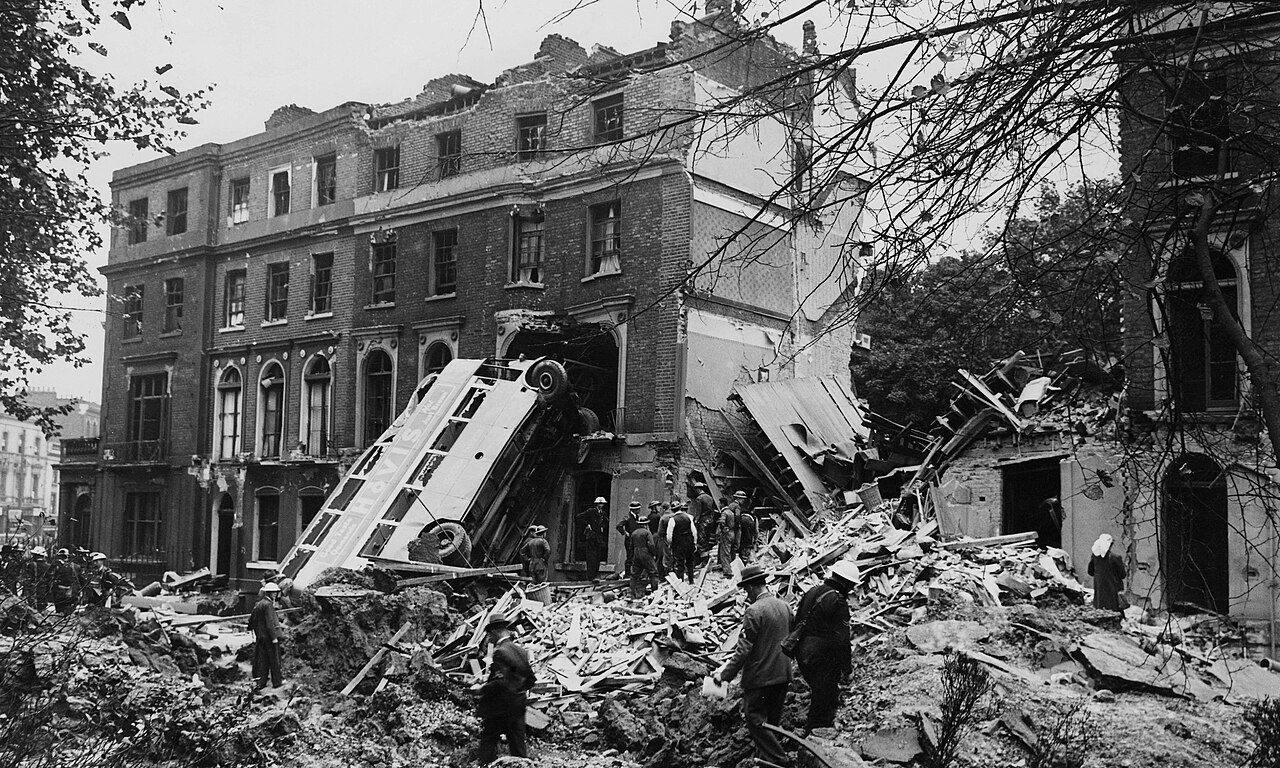
In the late afternoon of 7 September 1940 — 'Black Saturday' — 348 German bombers escorted by more than 600 fighters struck London's docks, beginning the Blitz: eight months of bombing that would kill an estimated 43,000 British civilians. London would be bombed for 56 of the next 57 nights. September 7 is also the day the American Turtle made the first submarine attack in 1776 and the Panama Canal treaties were signed in 1977.
Choose another date: open the On This Day calendar to browse events, births and deaths for any day of the year.
At a Glance
- The first raid
- 348 bombers and 617 fighters attacked London's docks on the afternoon of 7 September 1940, with a second wave that night
- The target
- The Port of London — the Surrey Commercial Docks, the West India Docks and the Isle of Dogs — and the working-class East End around them
- The pattern set
- London was bombed for 56 of the following 57 nights; the Blitz continued across Britain until May 1941
- The toll
- An estimated 43,000 civilians were killed in the Blitz across the United Kingdom, almost half of them in London
- The context
- The raid marked the Luftwaffe's switch from attacking RAF airfields in the Battle of Britain to bombing cities
- The name
- 'Blitz' is short for Blitzkrieg, 'lightning war' — the British press's name for the campaign
Events on this day
- 1776The American submersible Turtle attempts the first submarine attack in warfare, trying to fix a time bomb to HMS Eagle in New York Harbor; it fails.
- 1813The nickname 'Uncle Sam' for the United States is traced to this day, from meat packer Samuel Wilson's barrels stamped 'U.S.' for the army.
- 1822Dom Pedro proclaims Brazil's independence from Portugal on the banks of the Ipiranga brook in Sao Paulo.
- 1864General William T. Sherman orders the civilian population to evacuate Atlanta, ahead of his army's occupation and march to the sea.
- 1876The James-Younger gang's daylight raid on the bank at Northfield, Minnesota, collapses under townspeople's gunfire; the gang is shattered.
- 1901The Boxer Protocol is signed in Peking, formally ending the Boxer Rebellion and imposing a huge indemnity on Qing China.
- 1911The poet Guillaume Apollinaire is arrested in Paris on suspicion of stealing the Mona Lisa; he is released within days.
- 1940The Blitz begins as Germany bombs London — the featured story above.
- 1968Feminist protesters picket the Miss America pageant in Atlantic City, in one of the women's liberation movement's founding spectacles.
- 1977President Jimmy Carter and Panama's Omar Torrijos sign the treaties that transfer the Panama Canal to Panama at the end of 1999.
- 1996Rapper Tupac Shakur is shot in Las Vegas after a boxing match; he dies of his wounds six days later.
Born on this day
- 1533Elizabeth I — queen of England and Ireland, last of the Tudor monarchs.
- 1936Buddy Holly — American rock and roll pioneer of 'That'll Be the Day' and 'Peggy Sue'.
- 1943Gloria Gaynor — American singer of 'I Will Survive'.
- 1951Chrissie Hynde — American singer and guitarist, founder of the Pretenders.
Died on this day
- 1978Keith Moon — English drummer of the Who, dead at 32.
- 1994James Clavell — Australian novelist of Shogun and King Rat.
- 1997Mobutu Sese Seko — longtime ruler of Zaire, dead in exile in Morocco months after his overthrow.
- 2018Mac Miller — American rapper, dead at 26.
The featured story: the Blitz begins, 7 September 1940
For two months in the summer of 1940 the Battle of Britain had been fought over airfields and radar stations, a military contest in the sky. On 7 September it became a war on a city. Late that afternoon — a fine, warm Saturday — the largest formation yet seen, 348 German bombers escorted by 617 fighters, crossed the Thames estuary and made for the Port of London: the great timber yards of the Surrey Commercial Docks, the warehouses of the West India Docks, the Isle of Dogs. The bombers came in waves, almost unopposed at first, because Fighter Command had expected the armada to split toward separate targets. By evening the docks were a wall of fire — timber, paint, sugar, rum and grain burning together — and a second wave returned after dark to bomb by the light of the flames, raiding until dawn.
The choice of target was a strategic turn. Hitler, enraged by RAF raids on Berlin and persuaded that Britain could be terrorised into terms, authorised the switch from airfields to London at the very moment the airfield attacks were biting hardest; historians have argued ever since over whether the change saved Fighter Command. What is certain is what it meant for Londoners, above all in the East End, the poor dockland districts that wrapped around the target. That first night an estimated 430 people were killed and some 1,600 seriously injured — figures vary between sources — and thousands were bombed out of their homes, many to spend the rest of the war in shelters, Tube stations and rest centres that the authorities had barely prepared.
London was bombed that autumn for 56 of the next 57 nights. The pattern of the Blitz set in within days: sirens at dusk, the drone of bombers, fires fought by auxiliary firemen and wardens, the all-clear at dawn, and a city that cleaned its streets, opened its shops and went to work among the ruins. Other cities would take their turns — Coventry in November, Liverpool, Glasgow, Belfast, Hull — and by the time the Luftwaffe turned east against the Soviet Union in May 1941, an estimated 43,000 British civilians had been killed, almost half of them Londoners, and more than a million London homes damaged or destroyed.
Yet the campaign failed in its purpose. British morale, far from collapsing into pressure for surrender, hardened into the defiance the government had hoped for and the myth of the 'Blitz spirit' was born — a myth with a real core, since the city demonstrably did keep functioning. The first night's fires were the largest London had seen since 1666, and the comparison was made at once: the city that had rebuilt itself after the Great Fire would do so again. St Paul's Cathedral, ringed by flame that first weekend, survived the whole Blitz to become its emblem.
Why this date matters
September 7 is a day of first blows and long consequences. A one-man submarine makes war's first underwater attack in 1776 and fails; a slaveholding empire's heir declares Brazil independent in 1822; a bank robbery in Minnesota in 1876 destroys America's most famous outlaw gang; and in 1940 the first great blow of the Blitz falls on London, opening a campaign of eight months. Its gentler entries point the other way — a canal handed back by treaty in 1977, a protest in 1968 that helped found a movement — but the date's gravity is the gravity of beginnings that cannot be taken back.
Sources
- Encyclopaedia Britannica — On This Day: September 7
- HISTORY — This Day in History: September 7
- Wikipedia — The Blitz
- Wikipedia — September 7
The facts on this page were checked against these sources on 19 November 2026. The History Trail's permanent pages are researched and written for this site; the live profiles elsewhere on The History Trail are assembled automatically from Wikipedia and Wikidata.
About the Author
Researched and written by the The History Trail Editorial Team — the accountable editorial function behind this site's permanent story pages. The team works from the published sources cited on each page; it does not invent historians, reviewers or credentials, and it corrects errors openly.
Fact Check
Every load-bearing fact on this page traces to one of the sources listed above, and significant claims link to their source in the text. Our checking method is described on the methodology page; errors can be reported via the corrections page.
Sources & Citations
Cite this page as: The History Trail Editorial Team, The History Trail — this article's title, publication and update dates are shown beneath its headline. The full source list appears under Sources above; the site's source standards are on the sources page.