
Years
1830 in History
1830 joined dispossession to acceleration. On 28 May President Andrew Jackson signed the Indian Removal Act, the law that set in motion the forced removal of the southeastern Native nations, including the Cherokee Trail of Tears. In September the Liverpool and Manchester Railway opened as the world's first fully timetabled inter-city railway. Paris rose in the July Revolution, Poland rose in November, and Simón Bolívar — who resigned his presidency in April — died in December.
At a Glance
- Defining event
- Indian Removal Act signed by President Andrew Jackson, 28 May 1830
- Nations affected
- Cherokee, Choctaw, Chickasaw, Muscogee (Creek) and Seminole — an estimated 60,000 people removed between 1829 and 1837
- The railway age
- Liverpool and Manchester Railway opens, 15 September — the world's first fully timetabled inter-city railway
- Revolution in Paris
- The July Revolution begins 27 July; Charles X flees and Louis-Philippe takes the throne
- A church founded
- Joseph Smith organises the Church of Christ in New York state, 6 April
- The Liberator dies
- Simón Bolívar dies in Colombia on 17 December, aged 47
The defining story: the Indian Removal Act
Andrew Jackson built his presidency on expansion, and the land he wanted most lay in the American Southeast, where the Cherokee, Choctaw, Chickasaw, Muscogee (Creek) and Seminole nations held millions of acres guaranteed to them by treaty. Settlers coveted the land for cotton, the state of Georgia extended its laws over Cherokee territory, and gold had been found on Cherokee land. Jackson pressed Congress for a general removal law that would move the eastern nations across the Mississippi River, framing expulsion as benevolence toward peoples he claimed could not survive beside white settlement.
On 28 May 1830 Jackson signed the Indian Removal Act. The law authorised the president to grant Native nations land in the west in exchange for their homelands within the existing states, and provided money to negotiate removal treaties and to pay for the journeys. It did not, in its own words, order anyone to march. In practice the treaties that followed were extracted under pressure, fraud and the threat of force, and the removals of the 1830s became one of the great forced migrations of the nineteenth century — an estimated 60,000 people removed between 1829 and 1837, with the Cherokee march of 1838–39 remembered as the Trail of Tears.
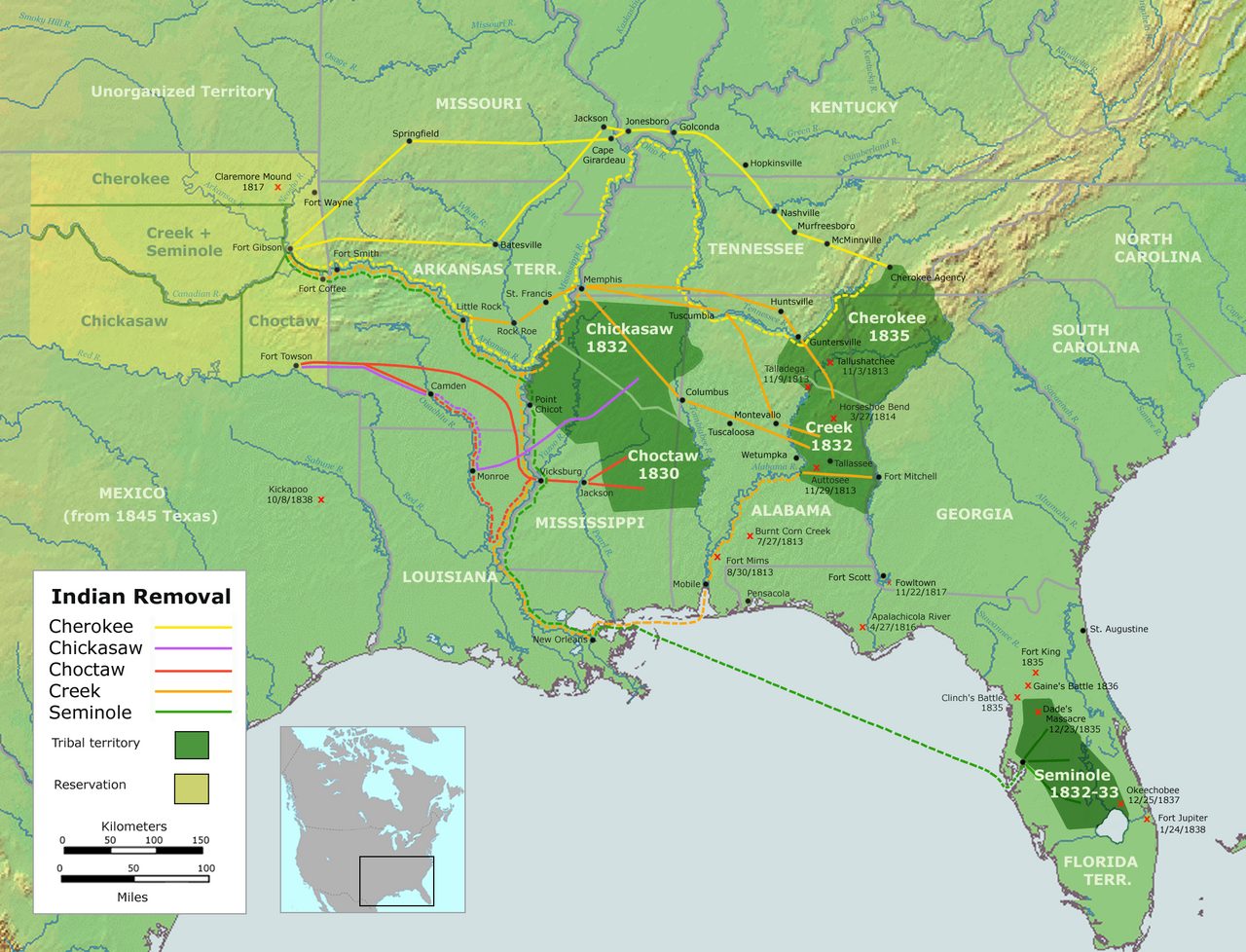
The map above shows why the singular name misleads: the removals followed many routes at once, overland and by river, between 1836 and 1839 in the map's span, as nation after nation was driven west to the same exile. The Act of 1830 was the legal engine of the whole system — a statute written in the language of exchange that operated as expulsion.
The rest of 1830 moved at the new century's speed. On 6 April Joseph Smith organised the Church of Christ in New York state, the beginning of the Latter Day Saint movement. On 24 May the Baltimore and Ohio Railroad opened the first regular railroad passenger service in the United States. In Paris the July Revolution began on 27 July against King Charles X's ordinances; within three days he had fled and the 'Citizen King' Louis-Philippe took the throne. On 15 September the Liverpool and Manchester Railway opened — and a cabinet minister was killed at the ceremony, the railway age's first famous casualty. In South America Simón Bolívar, who had resigned the presidency of Gran Colombia on 27 April as his dream of unity dissolved, died on 17 December at 47; in Warsaw, on 29 November, Polish cadets had opened the November Uprising against Russian rule.
Timeline of 1830
- 6 April
Joseph Smith organises the Church of Christ in New York state, the beginning of the Latter Day Saint movement.
- 27 April
Simón Bolívar resigns the presidency of Gran Colombia, his dream of a united Spanish America dissolving.
- 24 May
The Baltimore and Ohio Railroad opens the first regular railroad passenger service in the United States.
- 28 May
President Andrew Jackson signs the Indian Removal Act, authorising the forced removal of Native nations westward.
- 26 June
George IV, formerly the Prince Regent, dies at Windsor at 67.
- 27 July
The July Revolution begins in Paris; within three days Charles X has fled and Louis-Philippe takes the throne.
- 18 August
Franz Joseph I, who will reign as emperor of Austria for 68 years, is born.
- 15 September
The Liverpool and Manchester Railway opens, the world's first fully timetabled inter-city railway.
- 29 November
The November Uprising begins in Warsaw, opening Poland's revolt against Russian rule.
- 10 December
Emily Dickinson, who will publish barely a dozen poems in her lifetime, is born in Amherst.
- 17 December
Simón Bolívar, the Liberator of much of South America, dies in Colombia at 47.
Why 1830 still matters
1830 still matters most for the Removal Act's long shadow. The forced migrations it authorised emptied the Southeast for cotton, killed thousands on the journeys west, and fixed the geography of Native America — the nations removed in the 1830s remain centred in Oklahoma to this day. The Act also stands as a permanent case study in how dispossession is legislated: a law that spoke of exchange and consent, applied through pressure and fraud, remembered by the Cherokee name for the road of suffering.
The railways of 1830 remade distance in the opposite spirit. The Baltimore and Ohio's first regular passenger service and the Liverpool and Manchester's timetabled inter-city line turned travel from an expedition into a schedule — the precondition for industrial cities, standard time and mass movement of people and goods. That a cabinet minister died at the opening ceremony underlined that the new machine age would have its own casualties, accepted as the price of speed.
Politically, the July Revolution showed that 1789's arguments were not finished: a king who ruled by ordinance could still be unmade in three days of Paris street fighting, and the November Uprising carried the same refusal to Warsaw. Bolívar's death closed Spanish America's heroic age in the year his continental project collapsed, while Emily Dickinson's birth on 10 December and Franz Joseph's on 18 August quietly supplied the coming century with its most private poet and its longest-reigning emperor.
1830 on The History Trail
Removal, railways and revolution — 1830 day by day.
- May 28 in History — The Indian Removal Act is signed — the featured story of the removal law.
- September 15 in History — The Liverpool and Manchester Railway opens.
- July 27 in History — The July Revolution begins in Paris.
- April 6 in History — Joseph Smith organises the Church of Christ.
- November 29 in History — The November Uprising begins in Warsaw.
- December 10 in History — Emily Dickinson is born in Amherst.
Sources
- Encyclopaedia Britannica — On This Day: May 28
- HISTORY — This Day in History: May 28
- Encyclopaedia Britannica — On This Day: September 15
- Encyclopaedia Britannica — On This Day: July 27
- Encyclopaedia Britannica — On This Day: April 27
- Encyclopaedia Britannica — On This Day: December 17
The facts on this page were checked against these sources on 19 November 2026. The History Trail's permanent pages are researched and written for this site; the live profiles elsewhere on The History Trail are assembled automatically from Wikipedia and Wikidata.
About the Author
Researched and written by the The History Trail Editorial Team — the accountable editorial function behind this site's permanent story pages. The team works from the published sources cited on each page; it does not invent historians, reviewers or credentials, and it corrects errors openly.
Fact Check
Every load-bearing fact on this page traces to one of the sources listed above, and significant claims link to their source in the text. Our checking method is described on the methodology page; errors can be reported via the corrections page.
Sources & Citations
Cite this page as: The History Trail Editorial Team, The History Trail — this article's title, publication and update dates are shown beneath its headline. The full source list appears under Sources above; the site's source standards are on the sources page.