
Questions
Why did Elizabeth II have two birthdays?
Elizabeth II had two birthdays because she was born on 21 April 1926, but as sovereign she also had an official birthday, celebrated on a Saturday in June with the Trooping the Colour parade. The real date was marked privately and with gun salutes; the June date was the public one - an arrangement invented for monarchs whose actual birthdays fell in Britain's cold, wet months, and kept for her, and now for Charles III, whatever the weather on the real day.
At a Glance
- Her real birthday
- 21 April 1926, in Mayfair, London - marked privately, and publicly with royal gun salutes
- Her official birthday
- A Saturday in June - on the second Thursday of June until 1959, then the second Saturday - marked by Trooping the Colour
- Why
- Public birthday ceremonies need summer weather: the official birthday was standardised by Edward VII, born 9 November, who moved his celebration to May or June
- The ceremony
- Trooping the Colour: over 1,400 soldiers, 200 horses and 400 musicians on Horse Guards Parade, closing with an RAF fly-past
- The older root
- The sovereign's official birthday has been marked since 1748, in the reign of George II - another November-born king
- Elsewhere
- Other Commonwealth realms choose their own dates: Canada marks the sovereign's birthday on Victoria Day in May, most Australian states on a Monday in June, Western Australia and Queensland in September or October
- Now
- Charles III, born 14 November 1948, keeps the same arrangement: his official birthday is the June Trooping the Colour date
- Anniversary
- 21 April 2027 is the 101st anniversary of Elizabeth II's birth; she died on 8 September 2022, aged 96
Introduction
No law of nature gave the Queen two birthdays; the British weather did. A sovereign's birthday is a state occasion - a parade, crowds, soldiers standing in the open for hours - and state occasions in Britain are hostage to the season. The solution was to split the event in two: the anniversary of the birth, kept on the day itself, and the official birthday, kept when the weather could be trusted. Elizabeth II, born in April, hardly had the worst birthday on the calendar, but the institution she inherited no longer varied the arrangement monarch by monarch. She kept both dates for seventy years, and the present king keeps them still.
The Origin: A November Problem
The official birthday's roots lie with November-born kings. The Royal Family records that Trooping the Colour has marked the sovereign's official birthday for over 260 years, a connection usually dated to 1748, in the reign of George II, who was born in November. Historic Royal Palaces' research adds an honest caution: the evidence for a birthday parade in 1748 itself is sparse - the surviving order-book reference is to extra guards for the king's birthday, probably for the ball, not a parade - and a recognisable birthday parade is documented from the early nineteenth century, fixed as an annual tradition by George III's reign.
What is firmly documented is the standardisation, and it belongs to Edward VII. He was born on 9 November 1841, and a November parade in London invited cold and rain. As king from 1901, Edward held his official celebration in May or June instead - Historic Royal Palaces puts it directly: Edward VII standardised the summer official birthday, so that it always took place in June. The actual birthday remained 9 November; the public one migrated to summer, attached to the military ceremony of Trooping the Colour, whose own origins are practical - a regiment's colour, its flag, was marched slowly through the ranks so every soldier would know his rallying point in battle.
Fixing June: George V, George VI and a Thursday That Became a Saturday
Edward's arrangement lapsed when it was not needed and returned when it was. George V was born on 3 June, a summer birthday that needed no substitute. George VI, born in December, did need one: he revived the official birthday and kept it on the second Thursday of June. His daughter inherited both the problem's machinery and its date. For the first years of her reign Elizabeth II's official birthday fell on the second Thursday of June, her father's day; in 1959 she moved it to the second Saturday, where it stayed - a weekend parade for a country that mostly worked on Thursdays. The date was never fixed to a single day of the month: it is the chosen Saturday in June, announced each year, not a second date of birth.
Two Birthdays in Practice
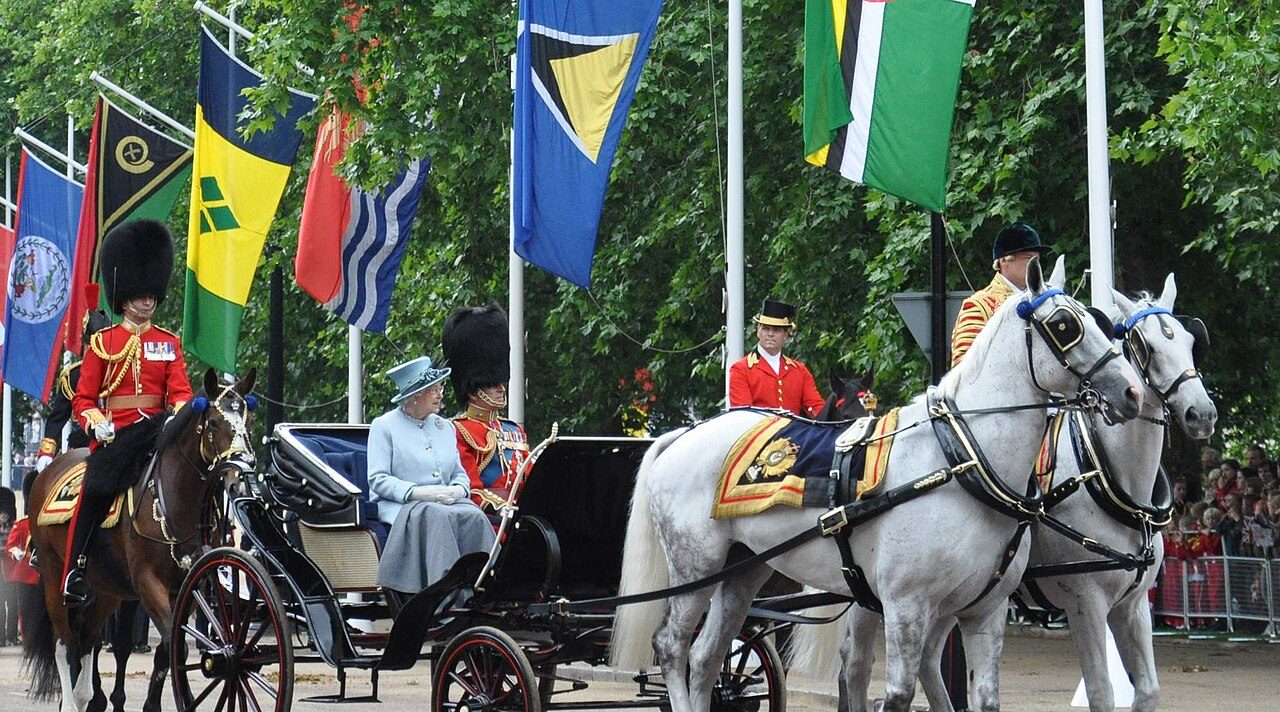
The two days looked entirely different. The real birthday, 21 April, was largely private - spent with family - but not unmarked: royal gun salutes were fired in London on the day, at Hyde Park and the Tower of London. The official birthday in June was the public festival. At Trooping the Colour, over 1,400 parading soldiers, 200 horses and 400 musicians assembled on Horse Guards Parade; the sovereign inspected the troops, the chosen regiment's colour was trooped through the ranks, and the parade closed with an RAF fly-past watched from the Buckingham Palace balcony. Elizabeth attended in every year of her reign except 1955, when a rail strike cancelled the parade, and her last Trooping, in the Platinum Jubilee year of 2022, was held on Thursday 2 June to open the jubilee weekend. The Birthday Honours list belongs to the official birthday, not the real one.
One Sovereign, Many Birthdays: The Commonwealth Realms
Britain's June Saturday was never the whole story, because the sovereign was head of state of other realms too, and each realm picks its own official date. Canada marks the monarch's official birthday on Victoria Day, the Monday before 25 May - a date that began as Queen Victoria's actual birthday, 24 May, and stayed when monarchs changed. Most Australian states keep the King's Birthday on the second Monday in June, but Western Australia proclaims its own date, usually in late September or early October, and Queensland has marked it on the first Monday of October since 2016. New Zealand keeps a June Monday. The 'official birthday' is thus not one day but a family of days - each realm bending the same institution to its own calendar and climate.
Timeline
- 1748
The sovereign's official birthday is first officially marked, under George II - though the evidence for a parade that year is sparse.
- 9 November 1841
Edward, later Edward VII, is born - the November birthday that will drive the summer standardisation.
- 1901-1910
Edward VII holds his official birthday celebration in May or June, standardising the summer official birthday.
- December 1895
George VI is born; as king he revives the official birthday, keeping it on the second Thursday of June.
- 21 April 1926
Princess Elizabeth Alexandra Mary is born in Mayfair, London - the real birthday behind this page's question.
- 1952
Elizabeth II succeeds her father and inherits the two-birthday arrangement, official birthday on the second Thursday of June.
- 1959
The Queen moves her official birthday from the second Thursday of June to the second Saturday.
- 2 June 2022
Her last Trooping the Colour opens the Platinum Jubilee weekend - her 70th year of official birthdays.
- 8 September 2022
Elizabeth II dies at Balmoral, aged 96, after a reign of 70 years.
- 17 June 2023
Charles III's first Trooping the Colour as king: born 14 November, he keeps the June official birthday.
- 21 April 2027
The 101st anniversary of Elizabeth II's birth.
Significance
The two birthdays are a small, durable example of how the monarchy separates the person from the office. The birth on 21 April 1926 happened to one woman; the official birthday happens to the sovereign, whoever that is, on a date chosen for the convenience of the state and its crowds. That is why the arrangement survived a change of reign without a pause, and why it never depended on the actual birthday being inconvenient - by Elizabeth's reign it was simply how the office worked. It also explains the institution's spread: a date that belongs to the office can be re-chosen by every realm that shares the sovereign, which is what the Commonwealth realms did.
Questions readers ask
Was she really born in June? No. Elizabeth II was born on 21 April 1926; June was never a claim about her birth, only the date of the public celebration. Nothing was concealed - the real date was saluted with guns every year of her reign, and the official date was openly described as official.
Did she get two parties? In effect, one private and one public. The April day was kept quietly, usually at Windsor with family; the June day was the state's, with the parade, the fly-past and the Honours list. The two-birthday phrase is a shorthand for that split, not for two rounds of cake.
Does Charles III have two birthdays too? Yes, and his case is the classic one: he was born on 14 November 1948, deep in the parade-hostile season, and his official birthday remains a Saturday in June, marked by the same Trooping the Colour - his first as king was held on 17 June 2023. The institution passed to him as it passed to his mother, because it was never hers personally. It is the sovereign's.
Legacy
Elizabeth II died on 8 September 2022, and with her the April date changed its meaning: 21 April is no longer a living queen's private birthday but an anniversary - on 21 April 2027, the 101st anniversary of her birth. The June date did not miss a beat: the parade that marked her official birthday for seventy years now marks her son's. That contrast is the answer in its final form. She had two birthdays because one belonged to her and one belonged to the Crown - and the Crown's birthday, unlike hers, is still being celebrated.
Sources
- The Royal Family - What is Trooping the Colour?
- The Royal Family - The Queen and Members of The Royal Family attend Trooping the Colour 2019
- Historic Royal Palaces - 'Trooping the Colour': The history of the King's birthday parade
- Encyclopaedia Britannica - Trooping the Colour
- Household Division - Trooping the Colour: Origins
The facts on this page were checked against these sources on 19 November 2026. The History Trail's permanent pages are researched and written for this site; the live profiles elsewhere on The History Trail are assembled automatically from Wikipedia and Wikidata.
About the Author
Researched and written by the The History Trail Editorial Team — the accountable editorial function behind this site's permanent story pages. The team works from the published sources cited on each page; it does not invent historians, reviewers or credentials, and it corrects errors openly.
Fact Check
Every load-bearing fact on this page traces to one of the sources listed above, and significant claims link to their source in the text. Our checking method is described on the methodology page; errors can be reported via the corrections page.
Sources & Citations
Cite this page as: The History Trail Editorial Team, The History Trail — this article's title, publication and update dates are shown beneath its headline. The full source list appears under Sources above; the site's source standards are on the sources page.