
Questions
How Elizabeth II Became Queen in 1952
Elizabeth II became queen on 6 February 1952, at the exact moment her father, George VI, died in his sleep at Sandringham. She was 25, on tour in Kenya, and she did not need to be chosen, elected or crowned: under British law the succession is instant, and the Crown never dies.
At a Glance
- The moment
- The instant George VI died on 6 February 1952 - succession in British law is automatic, with no gap between reigns
- Where she was
- Kenya, on a Commonwealth tour; she had spent the previous night at Treetops and learned the news at Sagana Lodge
- Her age
- 25
- Why she was in line
- The abdication of Edward VIII on 11 December 1936 made her father George VI king and Elizabeth his heir presumptive
- Proclaimed
- By the Accession Council at St James's Palace; the public proclamation was read on 8 February 1952
- Crowned
- 2 June 1953 at Westminster Abbey, sixteen months later - mourning and preparation took that long
- Anniversary
- 75 years since the accession falls on 6 February 2027
Introduction
That single fact explains the strange shape of 1952. Elizabeth flew home from Kenya already a queen, was proclaimed at St James's Palace within two days, and yet was not crowned until 2 June 1953, sixteen months later. This page explains how she came to be in line at all, what happened in Kenya and London in February 1952, and why the coronation - the ceremony most people picture - came so long after the reign itself began. On 6 February 2027, the accession reaches its 75th anniversary.
The Abdication That Put Her in Line
Elizabeth was born third in line, behind her uncle Edward, Prince of Wales, and her father. When George V died in January 1936, Edward became Edward VIII - and within the year he proposed to marry Wallis Simpson, an American who had been divorced once and was divorcing again. The government and the Church of England, of which the king is head, would not accept the marriage, and on 11 December 1936 Edward signed the Instrument of Abdication, the only British monarch ever to give up the throne voluntarily.
The crown passed at once to his younger brother, who became George VI, and the ten-year-old Elizabeth moved into first place in the succession. She was heir presumptive rather than heir apparent: a presumptive heir can still be overtaken - in her case, by any son born later to George VI and Queen Elizabeth - whereas an apparent heir, such as a monarch's eldest son, cannot be displaced by any later birth. No son was born, so the distinction never took effect, but it was the correct legal description of her position from 1936 to 1952.
The Night in Kenya
By 1951 George VI was seriously ill, and Elizabeth and her husband Philip, Duke of Edinburgh, took his place on a long Commonwealth tour. They left London on 31 January 1952 and stopped first in Kenya, staying at Sagana Lodge, a wedding present, and spending the night of 5 February at Treetops, a game lodge built in a great tree above a watering hole. In the small hours of 6 February, at Sandringham House in Norfolk, George VI died in his sleep of a coronary thrombosis; he was found dead that morning, aged 56.
News travelled slowly to Kenya. Word reached Nairobi by coded message, and at Sagana Lodge that afternoon Philip's equerry passed the news to Philip, who told his wife as they walked in the garden. She had been queen since the moment of her father's death, hours earlier - the first sovereign in over 200 years to accede while abroad, as the Royal Family records. The hunter Jim Corbett, who had stayed at Treetops, wrote in its visitors' book that a young girl had climbed into a tree a princess and climbed down a queen. It is a famous line, though in strict fact Elizabeth learned the news after she had come down, back at Sagana Lodge.
Proclamation: The Accession Council
In London the machinery moved the same day. The Accession Council - privy counsellors and other dignitaries - met at St James's Palace on the evening of 6 February, as Parliament's record for that day shows, and settled the proclamation declaring that the crown had solely and rightfully come to Princess Elizabeth Alexandra Mary. Elizabeth herself reached London on 7 February, dressed in mourning black, and on the morning of 8 February she met the Council and read her declaration; the proclamation was then read publicly from the balcony at Friary Court by the Garter King of Arms.
None of this made her queen; it announced that she already was. British succession allows no gap between reigns: the new sovereign succeeds at the instant of the old sovereign's death, a principle summed up in the old formula, the king is dead, long live the king. Elizabeth also settled her regnal name at this point. Asked what name she would reign under, she kept her own - Elizabeth, of course - and so became Elizabeth II, the second distinguishing her from Elizabeth I of Tudor England.
Why the Coronation Waited Sixteen Months
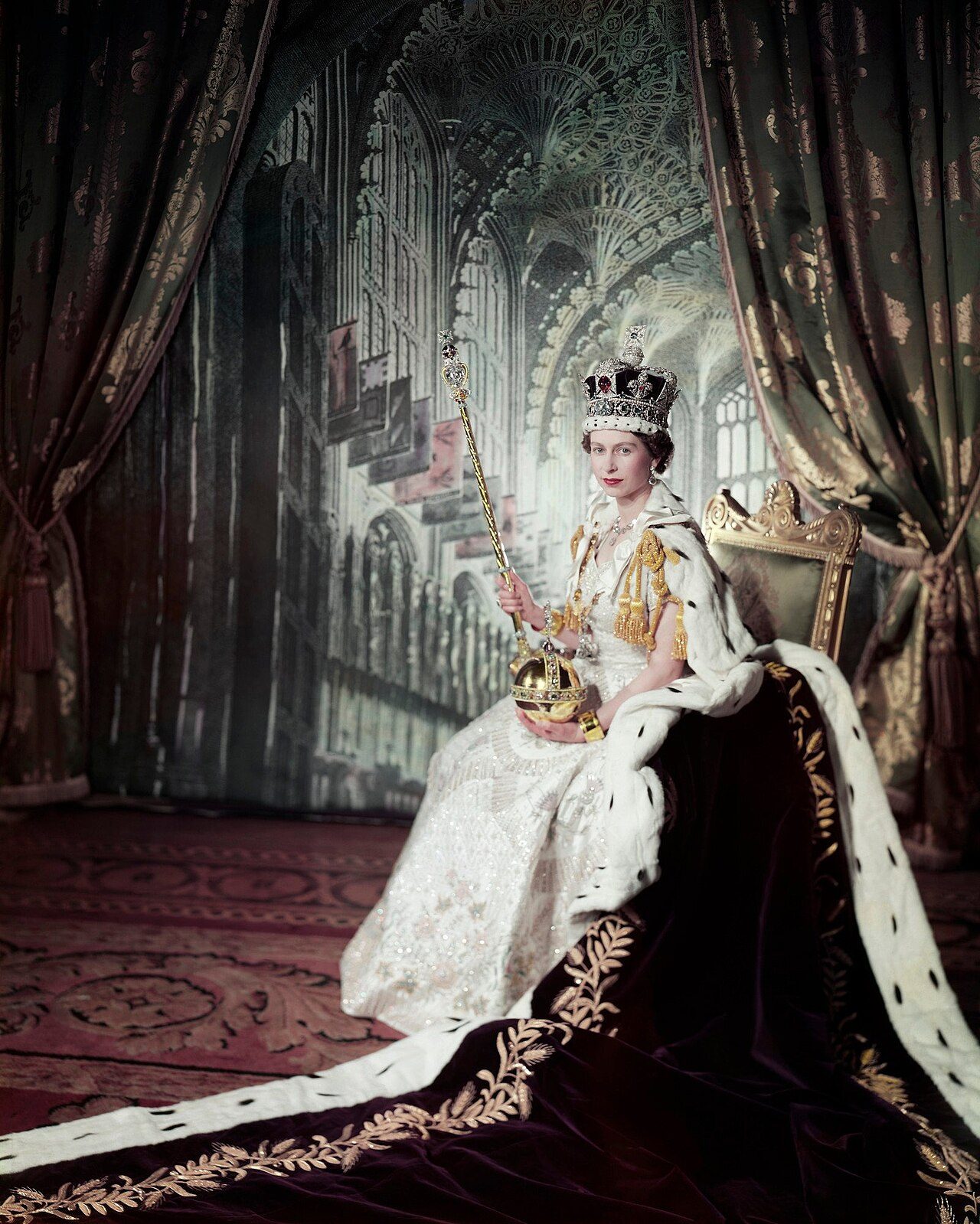
If she was already queen, why wait until 2 June 1953 to crown her? Two reasons: mourning and scale. A coronation is a festival, and tradition required a proper interval of mourning after a sovereign's death. The ceremony itself also took more than a year to prepare: the Coronation Commission first met in April 1952, Westminster Abbey was closed for five months to build seating for 8,251 guests, and delegations had to travel to London from across the Commonwealth.
The wait also produced a landmark. Elizabeth insisted, against Prime Minister Winston Churchill's doubts, that cameras be allowed inside the Abbey, and her coronation became the first to be televised in full; 27 million people watched in Britain alone. Legally it changed nothing. She had already reigned for sixteen months, opened Parliament for the first time on 4 November 1952, and needed no ceremony to be sovereign - but the broadcast fixed the public image of the new reign.
Timeline
- 20 January 1936
George V dies; Elizabeth's uncle becomes Edward VIII, and she stands second in line.
- 11 December 1936
Edward VIII abdicates; George VI becomes king and Elizabeth becomes heir presumptive.
- 20 November 1947
Elizabeth marries Philip Mountbatten, Duke of Edinburgh, at Westminster Abbey.
- 1951
George VI's health declines; Elizabeth represents him at public events and tours Canada.
- 31 January 1952
Elizabeth and Philip leave London on a Commonwealth tour, standing in for the King.
- Night of 5-6 February 1952
The couple spend the night at Treetops in Kenya; George VI dies in his sleep at Sandringham.
- 6 February 1952
Elizabeth, told the news at Sagana Lodge, flies home to London as queen.
- 8 February 1952
The Accession Council meets with the Queen at St James's Palace and her accession is proclaimed publicly.
- 2 June 1953
Elizabeth is crowned at Westminster Abbey in the first coronation televised in full.
Significance
The accession of 1952 remains the clearest working example of how the British succession functions: no vote, no vacancy and no ceremony required. The crown passes in an instant, and everything else - the proclamation, the oaths, the coronation sixteen months later - is announcement and celebration. Elizabeth went on to reign for 70 years and 214 days, longer than any other British monarch, which is why the quiet February day in Kenya, rather than the televised spectacle of 1953, marks the true beginning of her reign. On 6 February 2027 it will be 75 years since a 25-year-old princess in Kenya became queen before she even knew it.
Sources
- The Royal Family - 50 facts about Queen Elizabeth II's Coronation
- Historic Hansard - Death of King George VI, House of Commons, 6 February 1952
- Encyclopaedia Britannica - Elizabeth II
- The National Archives - Coronation of Her Majesty Queen Elizabeth II 1953: Press, BBC and TV facilities
- The History Press - The moment Princess Elizabeth became queen
The facts on this page were checked against these sources on 19 November 2026. The History Trail's permanent pages are researched and written for this site; the live profiles elsewhere on The History Trail are assembled automatically from Wikipedia and Wikidata.
About the Author
Researched and written by the The History Trail Editorial Team — the accountable editorial function behind this site's permanent story pages. The team works from the published sources cited on each page; it does not invent historians, reviewers or credentials, and it corrects errors openly.
Fact Check
Every load-bearing fact on this page traces to one of the sources listed above, and significant claims link to their source in the text. Our checking method is described on the methodology page; errors can be reported via the corrections page.
Sources & Citations
Cite this page as: The History Trail Editorial Team, The History Trail — this article's title, publication and update dates are shown beneath its headline. The full source list appears under Sources above; the site's source standards are on the sources page.