
On This Day
April 21 in History
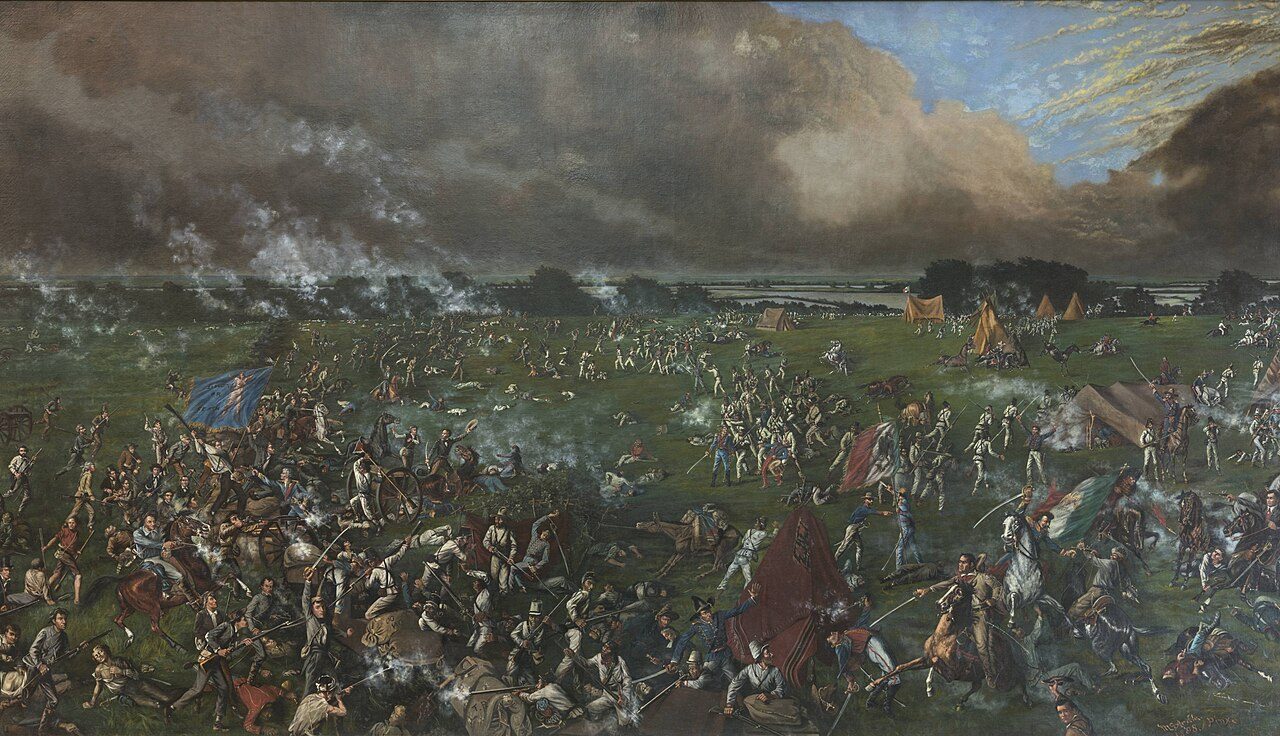
On 21 April 1836, on a marshy plain where Buffalo Bayou meets the San Jacinto River, Sam Houston's small Texas army attacked the camp of Mexican president-general Antonio López de Santa Anna during the afternoon siesta and won, in about eighteen minutes, the battle that decided the Texas Revolution. April 21 is also the traditional founding date of Rome, the day Abraham Lincoln's funeral train left Washington, and the day the Red Baron was killed over the Somme.
Choose another date: open the On This Day calendar to browse events, births and deaths for any day of the year.
At a Glance
- The armies
- About 910 Texans under Sam Houston against some 1,200 Mexican troops under Santa Anna
- The moment
- About 3:30 p.m., 21 April 1836, while the Mexican camp rested during the afternoon siesta
- The battle
- Eighteen minutes, by Houston's official report; the killing and capture continued longer
- The cost
- Houston's report counted 630 Mexicans killed and 730 taken prisoner; nine Texans were killed or mortally wounded
- The prize
- Santa Anna was captured the next day, and Texas independence followed; the United States annexed Texas in 1845
- The cry
- The Texans charged shouting 'Remember the Alamo! Remember Goliad!' for the garrisons lost in March
Events on this day
- 753 BCAccording to Roman tradition, Romulus founds Rome on the Palatine Hill — the date from which Roman years were later counted.
- 1836Sam Houston's Texans rout Santa Anna's Mexican army at the Battle of San Jacinto, winning the Texas Revolution — the featured story above.
- 1865The funeral train carrying Abraham Lincoln's body leaves Washington, D.C., beginning its slow journey to burial in Springfield, Illinois.
- 1895Woodville Latham and his sons demonstrate the Panopticon in New York, the first movie projector developed in the United States.
- 1930Fire sweeps the Ohio State Penitentiary in Columbus, killing 320 inmates, many locked in their cells — among the worst prison disasters in American history.
- 1934The 'surgeon's photograph' of the Loch Ness monster is published in the Daily Mail; six decades later it is admitted to have been a hoax.
- 1966Ethiopian emperor Haile Selassie arrives in Jamaica, a visit celebrated ever since by Rastafari as Grounation Day.
- 1966At Julius' Bar in New York, gay activists stage a 'Sip-In', publicly demanding to be served and challenging the rules used to close gay bars.
- 1967General Motors celebrates its 100 millionth American-made car, at the height of its reign as the world's largest automaker.
- 1980Rosie Ruiz crosses the Boston Marathon finish line first in the women's race; eight days later she is stripped of the title for having joined the race near its end.
- 1986Geraldo Rivera opens Al Capone's vault beneath Chicago's Lexington Hotel on live television before some 30 million viewers — and finds only dirt and empty bottles.
Born on this day
- 1782Friedrich Fröbel — German educator who founded the kindergarten and gave early-years education its name and philosophy.
- 1816Charlotte Brontë — English novelist of Jane Eyre, the only one of the three Brontë sisters to live past 31.
- 1830James Starley — English inventor whose 'penny-farthing' and later designs made him the father of the bicycle industry.
- 1926Elizabeth II — queen of the United Kingdom from 1952 to 2022, the longest-reigning monarch in British history.
Died on this day
- 1918Manfred von Richthofen — the 'Red Baron', Germany's leading First World War flying ace with 80 victories, shot down over the Somme at 25.
- 1990Erté — Russian-born artist and designer, a defining figure of Art Deco fashion and theatre design, dead at 97.
- 2016Prince — American singer, songwriter and virtuoso musician, creator of Purple Rain, found dead at Paisley Park at 57.
- 2025Francis — pope from 2013, the first from the Americas and the first Jesuit pope, dead at 88 a day after appearing at Easter services.
The featured story: the Battle of San Jacinto, 21 April 1836
The Texas Revolution had gone badly that spring. In March 1836 Santa Anna's army stormed the Alamo and, weeks later, executed the Texan garrison captured at Goliad. Sam Houston's volunteer army retreated eastward across Texas, pursued and derided, while terrified settlers fled in the scramble remembered as the Runaway Scrape. On 2 March Texas had declared independence from Mexico, but by mid-April the declaration looked like paper. Everything depended on whether Houston's roughly nine hundred men could beat the Mexican army that was hunting them — and on 20 April the two forces camped within sight of each other near the San Jacinto River.
Santa Anna, confident and careless, had divided his army and now had about 1,200 men in a camp backed by marsh and water, with no strong line of retreat. On the morning of 21 April, reinforcements under General Cos swelled his force, and Houston answered by ordering Deaf Smith to destroy Vince's Bridge, the crossing behind both armies. The move cut off Mexican reinforcements — and escape. Houston held a council of war, then waited for the hottest, quietest part of the afternoon, when the Mexican camp, by every account, settled into its siesta and posted inadequate sentries.
At about half past three the Texan line advanced across the open prairie, hidden for much of the way by a rise in the ground, its two small cannon — the 'Twin Sisters' — in the centre and its cavalry under Mirabeau Lamar swinging wide to cut off flight. The attackers were within a few hundred yards before the camp woke. Then came the volley, the charge and the cries of 'Remember the Alamo! Remember Goliad!' Houston's official report timed the battle itself at eighteen minutes. The rout that followed lasted longer: 630 Mexican soldiers were killed and 730 captured, against nine Texans killed or mortally wounded. Houston himself took a bullet through the ankle.
Santa Anna slipped away in the confusion and was captured the next day, disguised, tradition says, in a private soldier's uniform; brought before the wounded Houston, he agreed to order his remaining forces out of Texas. The Treaties of Velasco followed in May, and though Mexico never formally recognised Texan independence, the Republic of Texas was a fact. Nine years later the United States annexed Texas — a path that led to the Mexican-American War and the modern map of the American Southwest. Few battles so short have redrawn so much: eighteen minutes on a bayou prairie fixed the fate of a territory larger than most European kingdoms.
Why this date matters
April 21 is a day of foundings and final accounts. Rome's traditional birthday falls here; so does the afternoon on which Texas was, in effect, founded in eighteen minutes of gunfire. The date also closes stories: Lincoln's body begins its last journey home in 1865, the Red Baron's run of eighty victories ends in 1918, and in 1986 America's most hyped opening of a strongbox finds nothing at all. Beginnings dressed as endings, and endings dressed as beginnings — April 21 keeps dealing both from the same hand.
Sources
- Encyclopaedia Britannica — On This Day: April 21
- HISTORY — What Happened on April 21
- Texas State Historical Association — Texas forces win at San Jacinto
- Wikipedia — April 21
The facts on this page were checked against these sources on 19 November 2026. The History Trail's permanent pages are researched and written for this site; the live profiles elsewhere on The History Trail are assembled automatically from Wikipedia and Wikidata.
About the Author
Researched and written by the The History Trail Editorial Team — the accountable editorial function behind this site's permanent story pages. The team works from the published sources cited on each page; it does not invent historians, reviewers or credentials, and it corrects errors openly.
Fact Check
Every load-bearing fact on this page traces to one of the sources listed above, and significant claims link to their source in the text. Our checking method is described on the methodology page; errors can be reported via the corrections page.
Sources & Citations
Cite this page as: The History Trail Editorial Team, The History Trail — this article's title, publication and update dates are shown beneath its headline. The full source list appears under Sources above; the site's source standards are on the sources page.